Disclosure: Kalend is ours.
Short answer
Our pick is Kalend — tasks, calendar, habits and a journal in one free app. Free, no subscription. The closest alternatives are Things 3, Todoist and Apple Reminders. All 10 are compared below, each with a stated drawback.
Most "best to-do app" lists are a ranking of which company runs the biggest affiliate programme. This one is a comparison of what these apps actually are, because the honest answer is that the right to-do app depends almost entirely on one question: do you want your tasks on somebody else's server?
That single decision splits the category in half. Apps that sync through a company account can offer shared lists, web access and collaboration. Apps that sync through your own iCloud cannot do those things easily — but they also cannot lose your data in a shutdown, cannot start charging you for what used to be free, and keep working when the company stops existing.
Both are legitimate. What follows is which app is best at which, what each one costs, and the drawback each has that its own marketing page will not tell you.
At a glance
| App | Best for | Pricing |
|---|---|---|
| Kalend (ours) | Tasks, calendar, habits and a journal in one free app | Free, no subscription |
| Things 3 | People who want the most refined single-user task app | Paid once, per platform |
| Todoist | Shared lists and working across every platform | Free tier plus subscription |
| Apple Reminders | People who want zero setup and zero cost | Free, included with iOS |
| TickTick | A to-do list with a calendar and a timer attached | Free tier plus subscription |
| OmniFocus | Serious GTD practitioners with complex projects | Subscription or one-time purchase |
| Microsoft To Do | Anyone already inside a Microsoft 365 workplace | Free |
| Structured | Seeing the day as a timeline rather than a list | Free tier plus subscription |
| Notion | People who want to design their own system | Free tier plus subscription |
| Google Tasks | People who live in Gmail and Google Calendar | Free |
The apps in detail
Kalend
Ours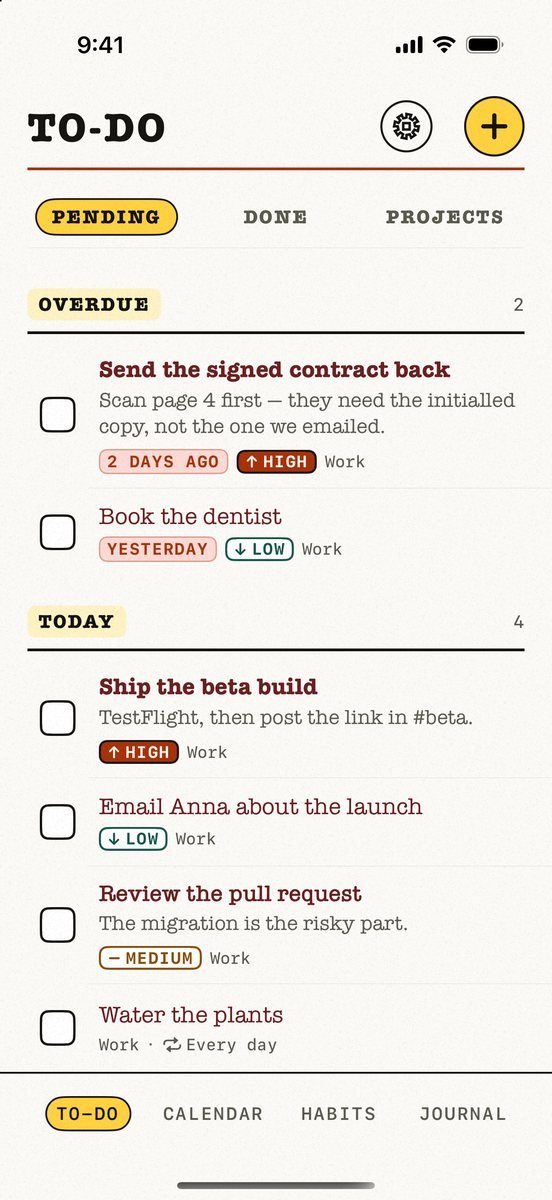
- Best for
- Tasks, calendar, habits and a journal in one free app
- Highlights
- Four tools in one app — tasks, calendar, habits, journal
- Syncs through your own iCloud, so there is no account to make
- Works fully offline; nothing is uploaded to us
- No paid tier, so nothing is held back
- Pricing
- Free, no subscription
- Watch out
- Apple platforms only — no Android and no web version, and it needs iOS 18 or later — and because it syncs through your personal iCloud there are no shared or collaborative lists. If you need to assign a task to somebody else, this is the wrong app.
Things 3
- Best for
- People who want the most refined single-user task app
- Highlights
- A genuinely considered interface that has aged well
- Projects, areas and headings without feeling heavy
- Fast keyboard and Quick Entry support
- One-time purchase, no subscription
- Pricing
- Paid once, per platform
- Watch out
- You pay separately for iPhone, iPad and Mac, and there is no web version or Android app at all.
Todoist
- Best for
- Shared lists and working across every platform
- Highlights
- Runs everywhere including the browser
- Natural-language input that genuinely works
- Shared projects and assignment built in
- Long track record and a stable company
- Pricing
- Free tier plus subscription
- Watch out
- Reminders, calendar view and useful filters all sit behind the paid tier, and your tasks live on their servers.
Apple Reminders
- Best for
- People who want zero setup and zero cost
- Highlights
- Already on the phone, syncs through iCloud
- Excellent Siri and location-based reminders
- Shared lists with anyone who has an Apple account
- Smart lists cover most filtering needs
- Pricing
- Free, included with iOS
- Watch out
- Project structure is shallow — there are lists and sub-tasks and not much else, so it strains once you are managing genuine projects.
TickTick
- Best for
- A to-do list with a calendar and a timer attached
- Highlights
- Built-in calendar view and Pomodoro timer
- Habit tracking alongside tasks
- Available on effectively every platform
- Generous free tier by category standards
- Pricing
- Free tier plus subscription
- Watch out
- The interface carries a lot at once, and the calendar view — the main reason many people choose it — is a paid feature.
OmniFocus
- Best for
- Serious GTD practitioners with complex projects
- Highlights
- The deepest project and perspective system available
- Custom perspectives that genuinely change how you work
- Long, stable history from an established developer
- Choice of subscription or one-time licence
- Pricing
- Subscription or one-time purchase
- Watch out
- Expensive and genuinely difficult. If you are not already committed to a formal system, it will feel like being handed a cockpit to cross the road.
Microsoft To Do
- Best for
- Anyone already inside a Microsoft 365 workplace
- Highlights
- Free with no paid tier at all
- Syncs with Outlook tasks and flagged email
- Shared lists across an organisation
- My Day gives a clean daily focus view
- Pricing
- Free
- Watch out
- It really wants a Microsoft account, and it is noticeably less capable if you are not otherwise in that ecosystem.
Structured
- Best for
- Seeing the day as a timeline rather than a list
- Highlights
- Timeline layout that makes over-committing obvious
- Pulls in calendar events alongside tasks
- Very quick to add and drag things around
- Pleasant, focused interface
- Pricing
- Free tier plus subscription
- Watch out
- It is a day planner more than a task manager — there is little support for projects that span weeks.
Notion
- Best for
- People who want to design their own system
- Highlights
- Build exactly the structure you want
- Tasks, notes and databases in one place
- Strong collaboration and sharing
- Free tier is usable for one person
- Pricing
- Free tier plus subscription
- Watch out
- Slow to open compared to a native task app, and the setup itself becomes a project. Poor offline behaviour on a phone.
Google Tasks
- Best for
- People who live in Gmail and Google Calendar
- Highlights
- Free with no upsell
- Appears directly inside Gmail and Calendar
- Tasks with dates land on your calendar
- Trivial to learn
- Pricing
- Free
- Watch out
- Deliberately minimal — no priorities, no tags, no attachments. It is a list, not a system.
What is still missing
The gap in this category is not features. It is that almost every capable app now assumes a company account, and almost every app without one is deliberately limited so you will upgrade to the version that has it.
That is the space Kalend was built for, and it is worth being plain about the trade: syncing through your own iCloud means no shared lists, no web version and no Android — genuinely no collaboration at all. In exchange your tasks are not on anybody's server, there is no account to create, and there is no paid tier because there is nothing withheld.
If you need to assign work to other people, pick Todoist or Microsoft To Do and do not look back. If you have been burned by a productivity app shutting down or moving behind a subscription, the iCloud-only approach is worth the things it costs you.
Common questions
What is the best free to-do app for iPhone?
Apple Reminders, if you want something already installed that handles lists and reminders well. Kalend if you want tasks, calendar, habits and a journal together with no account and no paid tier. Microsoft To Do and Google Tasks are also genuinely free but assume you are in their ecosystem.
Which to-do apps work without an account?
Apple Reminders and Kalend both sync through your own iCloud, so there is no separate sign-up. Things 3 works offline with its own sync service. Everything else here expects you to create an account with the company.
Is a one-time purchase better than a subscription?
For a single-user task app that does not depend on a server, usually yes — Things 3 and OmniFocus both offer one. Where an app provides genuine ongoing service, like shared projects or web access, a subscription is at least honest about the cost of running it.
Do any of these work offline?
Apple Reminders, Kalend, Things 3 and OmniFocus all work fully offline and sync when a connection returns. Notion is the weakest here — it is close to unusable on a phone with no signal.
Can I move my tasks between these apps?
Partially. Most export to CSV or plain text and most import the same, but project structure, repeat rules and attachments rarely survive the trip. Export a copy before you commit to switching.
Published · Updated · No affiliate links





 MMA.
MMA. Trending
 Bold
Bold Top
Top