Disclosure: Kalend is ours.
Short answer
Our pick is Kalend — the literal answer to the query: a planner whose appointments live in the app, with Apple and Google as an opt-in read-only overlay. Free — no subscription, no ads, no paid tier; the only purchase is an optional tip. The closest alternatives are TimeTree, Cozi Family Organizer and Proton Calendar. All 8 are compared below, each with a stated drawback.
There is a question people keep typing into search engines in slightly different words, and nobody answers it plainly: is this planner storing my appointments, or is it only drawing my Google calendar in a nicer font?
It matters more than it sounds. Many of the best-looking planners on the App Store hold no data of their own: you type "dentist, Thursday, 2pm" and the app writes it straight into your Apple or Google account through the operating system. Take the account away — you leave the job that owned the Workspace login, a school revokes an account, a family login goes read-only — and the planner opens to an empty grid.
An overlay app has no store: every event you create is immediately somebody else's record, held in an account you manage elsewhere, and the app's only job is rendering. An own-store app has its own database — the appointment lives in the app, or in that app's account, and any Apple or Google calendar you connect is a second layer drawn alongside it.
The test takes two minutes: create an event, then disconnect the external calendar in Settings. If your event goes with it, you were using an overlay. Run that before you spend a year typing into something.
One caveat: own-store is a trade, not an upgrade. Once your events leave Google and Apple, they stop being visible to everything else that reads those calendars — a colleague's free/busy lookup, your car, a work invitation. Several apps below cannot send an invitation at all.
At a glance
| App | Best for | Where the event lives | Pricing |
|---|---|---|---|
| Kalend (ours) | A personal planner with no account at all | In the app, synced via your own iCloud | Free, no subscription |
| TimeTree | Households and couples | Your TimeTree account | Free with ads, optional subscription |
| Cozi Family Organizer | Family calendar plus lists and meals | Your Cozi family account | Free with ads, annual Gold tier |
| Proton Calendar | Getting off Google on principle | Proton's servers, end-to-end encrypted | Free tier plus paid Proton plans |
| Tuta Calendar | Privacy maximalists | Tuta's servers in Germany, encrypted | Free tier plus paid Tuta plans |
| Structured | Timeboxing a single day | The app, via iCloud or Structured Cloud | Free tier, Pro subscription or lifetime |
| Howbout | Making plans with friends | Your Howbout account | Free, optional paid extras |
| Tiimo | Visual, ADHD-friendly day planning | Your Tiimo account | Limited free, Pro subscription |
The apps in detail
Kalend
Ours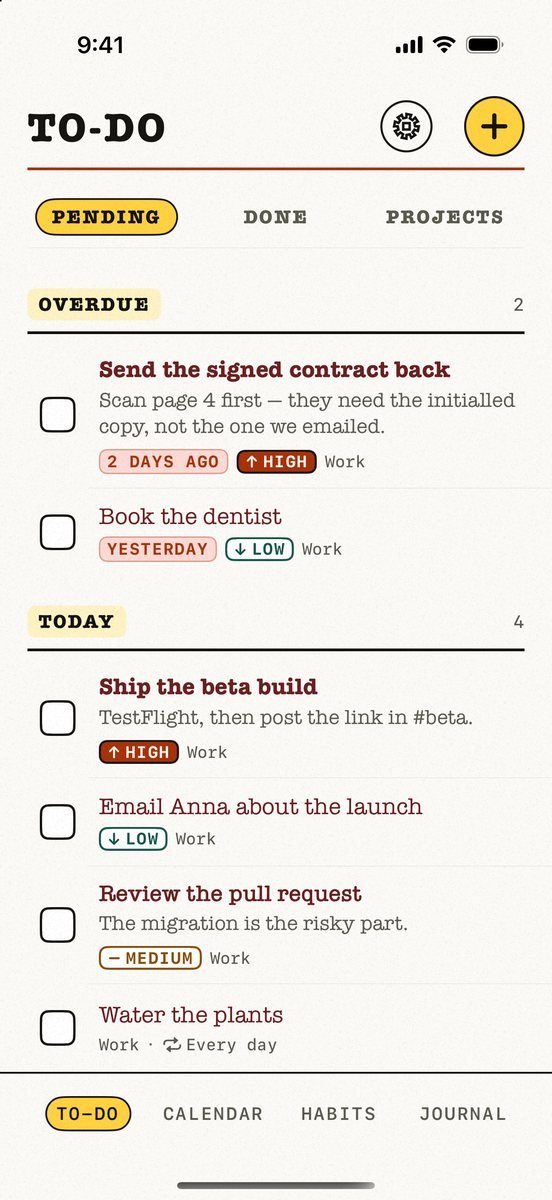
- Best for
- The literal answer to the query: a planner whose appointments live in the app, with Apple and Google as an opt-in read-only overlay.
- Highlights
- Four tabs in one app — To-Do, Calendar, Habits, Journal
- The Calendar tab stores your own appointments; Apple and Google events are an overlay you can switch off in Settings, leaving a calendar that is still full
- Habits with weekday, N-per-week and every-N-days schedules, streaks that forgive an unscheduled day, a month grid and a 365-day strip
- A private journal with live bold and italic while typing, month browsing and search
- Syncs through your own iCloud — no account, no server of ours, no analytics — plus a Watch app, widgets and Siri Shortcuts
- Pricing
- Free — no subscription, no ads, no paid tier; the only purchase is an optional tip
- Watch out
- It only reads external calendars: it can never write back to Google or Apple, and it cannot invite anyone, so it is no use for scheduling with other people. It is Apple-only, with no Android and no web version, has no sharing, keeps habit statistics deliberately simple and has no natural-language or email capture. It went on the App Store on 17 August 2026 and needs iOS 18 or later, so it is brand new — no ratings, no reviews, and nobody has lived with it yet.
TimeTree
- Best for
- Households who want the shared calendar itself to be the record, with Google merely visible beside it.
- Highlights
- Events live in your TimeTree account — the shared calendar is the original, not a mirror
- Google, Apple and Outlook calendars appear inside it as a read-only layer
- Each event has its own comment thread, so the discussion sits on the plan
- Long-running and widely used on iPhone, Android and the web, so a family is not betting on one release
- Pricing
- Free with ads, plus an optional subscription that removes them
- Watch out
- The data only flows in. TimeTree's own help centre says you cannot export entries and events to another calendar, and no tier adds two-way Google sync, so leaving is a genuine problem.
Cozi Family Organizer
- Best for
- Families who want one colour-coded household calendar plus lists and meals, held in a family account rather than a parent's Google login.
- Highlights
- The calendar lives in a Cozi account, a colour per person, independent of anyone's Google login
- Shared to-do and shopping lists, a recipe box and meal planning sit beside it
- The Google, Outlook and Apple link is read-only, so no outside calendar becomes the master copy
- Everyone sees the same thing on iPhone, Android or web, with no per-seat charge
- Pricing
- Free with ads, plus an annual Cozi Gold tier that removes them
- Watch out
- The free tier is genuinely ad-supported, and month view, search and birthday tracking sit behind Gold. The interface has aged, and the read-only link means you cannot edit a Cozi event from Google Calendar.
Proton Calendar
- Best for
- Anyone who wants their events stored somewhere emphatically not Google, and will accept a walled garden for it.
- Highlights
- End-to-end encrypted on Proton's own servers in Switzerland, so title, location and notes stay unreadable by the provider
- Real iPhone and Android apps rather than web wrappers, syncing through your Proton account
- Easy Switch bulk-imports an existing Google Calendar, so the migration is a real one
- Part of a maintained suite — Mail, Drive, VPN — which matters for longevity
- Pricing
- Free tier with limits, plus paid Proton plans
- Watch out
- You have to live inside Proton. Encrypted sharing works properly only with other Proton users, and sharing outward weakens the encryption that was the point. It is more locked-down than Google on integrations, the iOS import path is thinner than on web, and CalDAV access from Apple Calendar undoes the encryption in practice.
Tuta Calendar
- Best for
- The privacy maximalist who wants event data — and even the reminder text — kept away from the phone's operating system.
- Highlights
- Events, reminders and contacts encrypted by default on Tuta's own servers in Germany, under GDPR
- Reminders arrive without exposing the event details to the OS layer, a stronger claim than most
- Calendars can be subscribed to and .ics files imported, so outside events never become the record
- No ads, no tracking, no profiling, as a design position rather than a slogan — on phone, web and desktop
- Pricing
- Free tier with limits, plus paid Tuta plans
- Watch out
- It is not usable alone — the calendar requires a Tuta account, so adopting it means adopting Tuta. The free tier limits colour-coded and family calendars, and the feature set is spare: no natural-language entry, no rich integrations, and the outside world mostly reaches it through subscribed feeds.
Structured
- Best for
- People who want a timeline of the day where their own blocks come first and calendar events are pulled in as guests.
- Highlights
- Your tasks and time blocks are Structured's own records, synced via iCloud or Structured Cloud
- Imported Apple, Google and Outlook events land in the timeline as tasks you can tick off
- The import is one-way by design: nothing you change here goes back to the source
- Broad coverage for a small app — iPhone, iPad, Mac, Watch, Android and web
- Pricing
- Free tier with limits; Pro as a subscription or a one-off lifetime purchase
- Watch out
- Calendar import is a Pro feature and the free tier is too thin to evaluate the app without paying. The one-way import cuts both ways: reschedule something here and the original calendar never hears about it.
Howbout
- Best for
- Social plans among friends, where the event is created in the app and other calendars are consulted only for clashes.
- Highlights
- Plans are stored in Howbout itself, with a chat attached to each plan and group
- Google, Outlook and iCloud connect only so the app knows when you are busy — availability in, not events out
- Howbout events reach Apple or Google through an outbound feed, making the direction of truth explicit
- A large user base on iPhone and Android, which matters for an app that depends on your friends joining
- Pricing
- Free to use, with optional paid extras
- Watch out
- Only useful if the people you plan with install it too — as a solo calendar it is close to pointless, and it is not a work calendar. The exit is a one-way feed rather than a proper export, and your availability becomes visible to a friends feed.
Tiimo
- Best for
- Visual, low-friction day planning — particularly for ADHD and autistic users — where the plan you build is what gets stored.
- Highlights
- Activities and routines are Tiimo's own records in your account, so the same plan appears on iPhone, Android, Apple Watch and the web
- Google, iCloud and Outlook calendars are imported so outside commitments sit inside the visual plan
- Built around visual timelines, icons and checklists instead of a grid
- Actively developed, with a recent ground-up Android rebuild
- Pricing
- Limited free version on mobile, with a monthly or yearly Pro subscription
- Watch out
- Most of it sits behind Pro, and the free version functions as a trial. It is a day planner, not a calendar — no strong month or agenda view to replace Apple or Google — and the imported-calendar behaviour is not clearly documented, so treat outside events as read-only until you test it.
What is still missing
Read those eight watch-outs together and a pattern appears: once an app owns your events, the way out is the weak point. TimeTree says outright that you cannot export to another calendar. Howbout's exit is a one-way feed. Cozi and Structured only ever read the outside world, so nothing you do inside them reaches the calendar your colleagues see. Independence from Google is paid for in isolation.
Proton and Tuta handle it best, simply because they speak .ics, a format nobody owns. If long-term custody of your own history is why you started searching, weigh that above the interface.
The other unsolved half is the round trip: nobody here makes your events the master copy with Google kept in step as the mirror. It is technically possible; it is just nobody's business model.
Kalend sits at the strict end. The appointments are yours, in the app, synced through your own iCloud with no account to create, and the external overlay is a switch you can leave off forever. The trade, which you should know now rather than in a month: it only reads. No writing back to Google or Apple, no invitations — and it is brand new, having gone on the App Store on 17 August 2026, so there are no ratings and no reviews to weigh it by. If you need invitations or a shared household calendar, take TimeTree or Cozi instead.
Common questions
What is the difference between an overlay calendar and an app that stores its own events?
An overlay holds nothing: what you type goes straight into your Apple or Google account and the app only renders it back. An own-store app has its own database, and any outside calendar is a separate layer. Disconnect the account — if the calendar is still full, the app stores its own events.
Is there a calendar app that works without a Google account?
All eight here do. Kalend needs no account at all, syncing through your own iCloud or not at all. TimeTree, Cozi, Proton, Tuta, Howbout and Tiimo each need their own account — not Google, but still an account. Structured runs on iCloud or its own cloud.
What happens to my events if I delete the app?
With an overlay, nothing is lost — the events were always in your Apple or Google account. With an own-store app it depends where the store sits. Kalend's events live in your own iCloud and return on reinstall. The rest sit on company servers, so they come back when you sign in, and leave with the company if it goes.
Can I use a planner offline on iPhone with no sync at all?
Kalend is the closest fit: turn iCloud sync off and appointments simply stay on the phone, with no account to create. The account-based apps all cache offline, but they are built around syncing to their own servers, so offline-only is not the intended mode.
Which of these can invite other people to an event?
TimeTree, Cozi and Howbout are built around shared plans, and Proton and Tuta share calendars within their own ecosystems. Kalend cannot invite anyone at all, which rules it out for scheduling with colleagues. Structured and Tiimo are personal planners, not invitation tools.
Can I get my events back out again if I change my mind?
This is the real cost of an own store. TimeTree's help centre states you cannot export entries and events to another calendar. Howbout's exit is a one-way feed. Proton and Tuta speak standard .ics files, the safest position in this group. Ask about export on day one.
Is Apple Calendar itself an overlay or an own store?
It is an own store, in that iCloud holds the events — but it is the account most people are trying to escape when they search for this. If you want a calendar not linked to iCloud or Google, the Apple app is what you are replacing, not the answer.
Which one should I pick if I just want my calendar to survive losing a work Google account?
Pick by who else needs to see it. On your own, Kalend or Structured. For a household, TimeTree or Cozi. If you are leaving Google for privacy rather than access, Proton or Tuta. Move your events across deliberately — do not assume a sync will carry them.
Published · Updated · No affiliate links







 MMA.
MMA. Trending
 Bold
Bold Top
Top