Disclosure: Kalend is ours.
Short answer
Our pick is Kalend — keeping the tick and the written line in one free app that also holds tasks and a calendar. Completely free — no subscription, no ads; the only purchase is an optional tip. The closest alternatives are Habitify, Productive and Stoic. All 6 are compared below, each with a stated drawback.
Kalend is our own app, and we have put it first in this list. We would rather say that in the opening line than bury it in a footer. Everything below it is judged on the same four fields, Kalend included, and its entry carries three real limitations that will rule it out for a lot of people. If that disclosure changes how you read the rest, skip straight to the second entry — the research behind the other five comes from their own App Store listings and websites, not from us.
The test here is narrow. An app qualifies if a habit can be marked done and a line can be written about how it went, and if those two things end up in the same record rather than in two features that happen to share an icon. Three questions decide the order: is the note attached to the habit itself or merely stored in the same app; can you find an old entry again months later; and is the writing side more than tapping a mood face. A grid of squares with nothing written on it tells you that you ran on Tuesday. It does not tell you that Tuesday's run hurt your knee, which is the thing you will want in March.
That test cuts both ways. Two apps that get filed as ordinary streak trackers turned out to describe a note on the habit itself, which moves them up. One reflection app keeps its writing on the day's entry rather than on a particular goal, which moves it down a place even though its writing tools extend to templates, photos and voice memos. This is a short list on purpose: several well-known trackers describe no writing on a completion at all, and rather than pad the count with apps that fail the test, they are left out. Prices are given as models rather than figures because they change; check the listing before you buy. Every claim about a competitor is drawn from the sources listed against its entry.
At a glance
| App | Best for | Pricing |
|---|---|---|
| Kalend (ours) | Keeping the tick and the written line in one free app that also holds tasks and a calendar | Completely free — no subscription, no ads; the only purchase is an optional tip |
| Habitify | A note and a mood on a habit that follows you across phone, desktop and browser | Free plan plus a subscription or a one-off lifetime purchase |
| Productive | Notes pinned to habits inside a structured programme | Free to download with a paid upgrade |
| Stoic | Prompted writing with routines and streaks built around it | Free journalling, with a Premium subscription, a separate AI subscription and a one-off lifetime option |
| Daylio | Writing that carries the day, with goals tracked alongside it | Free to download with a Daylio Premium in-app purchase |
| Finch | Guided bullet journalling next to a gentle goal tracker | Free with a Finch Plus subscription |
The apps in detail
Kalend
Ours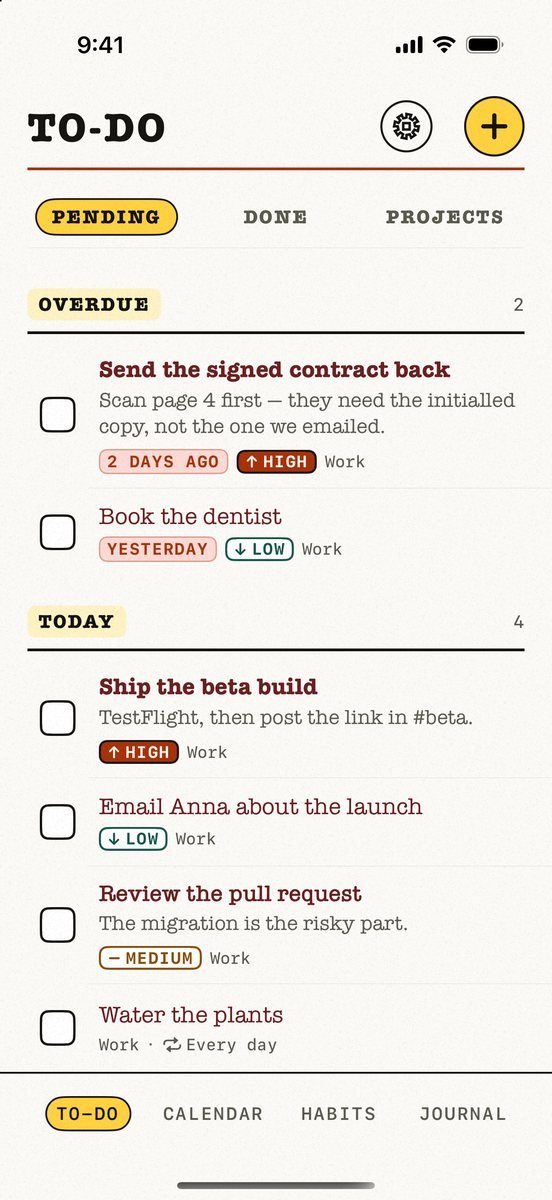
- Best for
- Keeping the tick and the written line in one free app that also holds tasks and a calendar
- Highlights
- Habits and a journal live in the same app as tasks and a calendar, so a day's completions and a day's writing are read as one record rather than two exports.
- The journal takes formatted text — headings, lists and checkboxes — with newest entries first, so an entry can be a paragraph rather than a single icon.
- Habit schedules cover daily, chosen weekdays, a number of times per week or every N days, with one grace day before a streak breaks.
- Data syncs through your own iCloud. There is no Kalend account, no sign-up and no server of ours holding anything, and the app works fully offline.
- Pricing
- Completely free — no subscription, no ads; the only purchase is an optional tip
- Watch out
- Apple only: there is no Android version and no web version, so a household or a coach on another platform is out. Because it syncs through your personal iCloud there is no sharing and no collaboration of any kind — you cannot assign a task or share a list with anyone. And it is brand new: version 1.0 reached the App Store on 17 August 2026, so there are no ratings, no reviews and no track record to judge it on yet, and it needs iOS 18 or later.
Habitify
- Best for
- A note and a mood on a habit that follows you across phone, desktop and browser
- Highlights
- The App Store description lists "Notes, mood tracking, and a built-in timer" as part of habit tracking, so the note and the tick belong to the same habit.
- Habitify's own site describes Built-in Notes as capturing and reflecting on your thoughts, and mood tracking as a way to see emotional health against your habits.
- Habitify's site describes it as a multiplatform habit tracker covering watchOS, iOS, Android, macOS and a web app, so the same note is reachable from a phone, a desktop and a browser.
- Syncs with Apple Health and Google Fit, syncs to Apple Calendar, and offers API access with Zapier and IFTTT.
- Pricing
- Free plan plus a subscription or a one-off lifetime purchase
- Watch out
- The pricing page lists a free plan capped at three habits, so a real routine means paying, and the App Store listing carries monthly purchases alongside the annual and lifetime options. The writing is a note field on a habit rather than a journal — there are no prompts, no formatting and no separate entry you would sit down to write.
Productive
- Best for
- Notes pinned to habits inside a structured programme
- Highlights
- The listing states plainly: "Add notes to your habits to highlight the main points during the day."
- Programmes run daily habit tips, reflection check-ins and motivation prompts, so some of the writing is prompted rather than left to a blank field.
- Habit templates, goals and detailed statistics with milestones cover the tracking side.
- Reminders can fire by time or by location, and challenges let you track a habit alongside other people.
- Pricing
- Free to download with a paid upgrade
- Watch out
- There is no journal as such — the writing is a note on a habit plus whatever a programme's reflection check-in asks, so there is nowhere to write about a day that had nothing to do with a habit. Premium is a paid upgrade, sold on the App Store as a subscription with a separate one-off upgrade purchase also listed; the website publishes a free trial rather than prices, so check the store page before buying. The listing covers iPhone, iPad, Apple Watch and Vision Pro with no Mac app.
Stoic
- Best for
- Prompted writing with routines and streaks built around it
- Highlights
- Guided prompts written with therapists and experts, plus morning and evening check-ins, make up the daily entry.
- Entries take written text, voice notes, photos and video, and the listing includes search and trends for going back through them.
- Routines with streak tracking, reminders and milestone badges sit around the writing, along with meditation and breathing exercises.
- getstoic.com's download row lists the App Store, the Mac App Store, Google Play and a web app, so the writing is reachable from an iPhone, an Android phone, a Mac or a browser.
- Pricing
- Free journalling, with a Premium subscription, a separate AI subscription and a one-off lifetime option
- Watch out
- The habit side is streaks on routines rather than a tracker with flexible schedules, so anything more structured than "did it today" is a poor fit. Journalling is free, but a Premium subscription, a separate AI subscription and a one-off lifetime option gate parts of the app.
Daylio
- Best for
- Writing that carries the day, with goals tracked alongside it
- Highlights
- An entry is a mood plus activity tags made in two taps, and the listing describes adding notes to keep "an old school diary".
- Notes extend into writing templates, photos and voice memos, so the writing side goes well past a single face.
- Daily, weekly and monthly goals sit alongside entries for building habits and collecting achievements.
- Weekly, monthly and yearly charts, advanced correlations and a Year in Pixels view; exports to PDF or CSV; PIN, fingerprint and Face ID lock.
- Pricing
- Free to download with a Daylio Premium in-app purchase
- Watch out
- The note attaches to the day's entry with its activity tags, while goals are a separate feature — so a particular habit's history and the writing about it are read in two places rather than one row. Premium is an in-app purchase, and the listing covers iPhone, iPad and Vision Pro with no Mac app.
Finch
- Best for
- Guided bullet journalling next to a gentle goal tracker
- Highlights
- A goal tracker records healthy habits and celebrates the wins they add up to, with a virtual pet growing as you complete them.
- Guided bullet journalling prompts are offered to clear the mind, track important moments and practise gratitude.
- A mood tracker with trends sits alongside quizzes covering anxiety, depression and body image appreciation.
- Insights combine the mood tracker, bullet journal tags, goal tracker and quizzes into one read on how things are going.
- Pricing
- Free with a Finch Plus subscription
- Watch out
- Journalling is prompt-led and tagged rather than written against a specific goal, so the habit record and the writing meet in the Insights analysis rather than on the same row. Finch Plus is a subscription with a further Guardian tier, and the App Store listing covers iPhone, iPad and Vision Pro, with a separate Android release and no desktop version.
What is still missing
The category has settled into two shapes that both miss. Trackers treat the note as metadata — a text field hanging off a completion, unformatted, unsearchable in any real sense, and usually invisible unless you tap into a specific day. Reflection apps treat the habit as decoration — a streak counter or a tag on an entry that was really about your mood. Very few apps in either camp have decided that a habit and the sentence explaining it are one object. Plenty do not attempt it at all: HabitKit, for instance, describes no note on a completion anywhere on habitkit.app or its App Store listing, which is a coherent position for a grid tracker but leaves the tick and the sentence in separate apps.
The second gap is retrieval, and it is the one that decides whether any of this was worth doing. A record only pays off when you can answer a question with it months later: which weeks did the running stop, and what did I write when it did. That needs the note indexed and reachable from the habit, not from the calendar. Most apps here will show you a chart of the tick and hide the writing one tap deeper, on a screen you would only find if you already knew the date — which is precisely the thing you are trying to look up. Export to CSV is offered as the answer and is not one; nobody opens a spreadsheet to remember why February went wrong.
The third gap is the one we have not closed either. Kalend puts habits and a journal in the same free app with tasks and a calendar, which is the joining this post is asking for, but it is Apple-only, it has no sharing or collaboration at all because it syncs through your personal iCloud, and it is brand new, so there are no ratings, no reviews and no track record to go on yet. If you need Android, a browser, or a record you can hand to a coach or a therapist, nothing on this list is a clean answer — the ones with the widest platform reach have the thinnest writing, and the ones with real writing tend to keep it locked to one ecosystem or behind a subscription.
Common questions
What is the difference between a habit tracker with a journal and a normal habit tracker?
A normal tracker records whether you did the thing. A tracker with a journal records what happened when you did it. The distinction that matters is where the writing is stored: an app where the note attaches to the habit's own day gives you a history that explains itself, while an app where the note lives on a separate diary entry gives you two records you have to line up by date yourself. Habitify and Productive both describe a note on the habit. Daylio, Finch and Stoic attach the writing to the day or to a prompt instead, and Kalend keeps a formatted journal in the same app as the habits rather than a field on one.
Can I get a habit tracker with a journal for free?
Yes, with limits worth knowing. Kalend is completely free with no paid tier at all, but it is Apple-only, has no sharing of any kind, and is brand new — it reached the App Store on 17 August 2026, so it has no ratings yet. Stoic's App Store listing states you can still journal for free without buying Premium. Habitify's pricing page lists a free plan capped at three habits. Daylio, Finch and Productive are all free to download with a paid tier that unlocks the parts most people end up wanting.
Which habit tracker lets you write notes on each habit?
Habitify's App Store description lists notes and mood tracking as part of habit tracking, so the note belongs to the habit. Productive states it directly: add notes to your habits to highlight the main points during the day. Kalend takes a different route — the journal is its own formatted section sitting in the same app as the habits, rather than a field on one of them. Stoic, Daylio and Finch put the writing on the day or on a prompt, so there the habit and the note are joined by date rather than by row.
Is a mood emoji enough, or do I need somewhere to actually write?
It depends on what you want back from the record. A mood scale is fast enough to survive a bad week, and Daylio's whole design rests on that — two taps, every day, for years. But a face cannot tell you the run hurt your knee or that the early start is why the reading stopped. If you expect to read the record back and act on it, look for an app that takes a paragraph: Kalend takes formatted text with headings and lists, Stoic takes text, voice notes, photos and video, and Daylio extends notes with templates, photos and voice memos.
Should I use one app for habits and journalling, or two separate apps?
Two apps is a reasonable choice if you already like a tracker you would not give up — a grid-style streak tracker, for instance, paired with any journal you enjoy writing in. The cost is that the tick and the sentence never meet, so answering "what was I writing during the month I stopped" means opening two apps and matching dates. One app is worth it when you expect to look backwards. If you go that way, check first whether the app you pick keeps the note on the habit or merely in the same place, because that single detail is what makes the record readable a year later.
Published · Updated · No affiliate links










 MMA.
MMA. Trending
 Bold
Bold Top
Top