Disclosure: Kalend is ours.
Short answer
Our pick is Kalend — a tasks, calendar, habits and journal app with no model, no account and no server of ours. Free, with no paid tier, no subscription and no ads; the only purchase is an optional tip. The closest alternatives are Things 3, OmniFocus and GoodTask. All 9 are compared below, each with a stated drawback.
Kalend is listed first on this page and Kalend is ours — we make it, so read its position as our placement rather than as a verdict. It is judged on exactly the same fields as everything below it and carries the same kind of drawback list, including the ones that will rule it out for a lot of people. Every other app here was checked against its own App Store listing or the developer's own website, and anything a developer does not state is left out rather than guessed at.
The reason to check rather than remember is that this category moves in release notes. An app that was a plain list two years ago can ship an assistant in a point update, and the listing is usually the only place that says so before you notice it in the interface. Three apps on this page have something model-shaped on their own official pages right now — Apple's Reminders listing describes Apple Intelligence suggesting tasks from shared content, Things' App Store release notes describe groundwork for a future Apple Intelligence integration, and 2Do's Mac page describes an MCP server that lets Claude or another agent act on your live tasks. None of that is hidden. It is just not the thing anyone reads.
That also sets the shape of this list. Because the filter is what a planner does with your text rather than what it costs, several free apps come out badly and several paid one-off apps come out well. Where a developer publishes a price it is given; where the model matters more than the number, the model is described. Where a claim could not be found on an official page, it is not made.
At a glance
| App | Best for | Pricing |
|---|---|---|
| Kalend (ours) | A tasks, calendar, habits and journal app with no model, no account and no server of ours | Free, with no paid tier, no subscription and no ads; the only purchase is an optional tip |
| Things 3 | A task and project manager with no AI feature in the current shipping list | One-off purchase, sold as separate App Store apps for Mac, iPhone & Watch, iPad and Vision Pro (US$9.99 on iPhone at the time of writing); no subscription and no in-app purchases listed |
| OmniFocus | Structured project work with end-to-end encrypted sync you can host yourself | One-off v4 Standard or v4 Pro licence (US$74.99 and US$149.99), or an optional subscription at US$99.99 a year that adds web access |
| GoodTask | Adding views and filters on top of the Reminders database you already have | Free with a one-off Unlock Everything purchase (US$19.99) and an optional yearly supporter subscription |
| Streaks | Daily habits, with a privacy card that lists almost nothing | One-off purchase (US$5.99); no subscription listed |
| Obsidian | Planning in plain files you own, on Windows, macOS, Linux, iOS and Android | Free without limits, with optional paid Sync and Publish services and optional Catalyst or Commercial licences |
| Apple Reminders | Free, already on the device, with shared lists and assignment built in through iCloud | Free, included with the operating system |
| Sorted³ | Laying tasks, events and notes on one timeline and moving them by hand | Free with a one-off PRO in-app purchase, bought separately for iOS (US$14.99) and macOS (US$24.99), or as a bundle |
| 2Do | Choosing your own sync backend, including a CalDAV server you run | Priced per platform: a one-off US$49.99 purchase on Mac with a 14-day free trial, also available through Setapp; free on Android with optional in-app purchases unlocking Pro features; the iPhone app is not currently on sale. |
The apps in detail
Kalend
Ours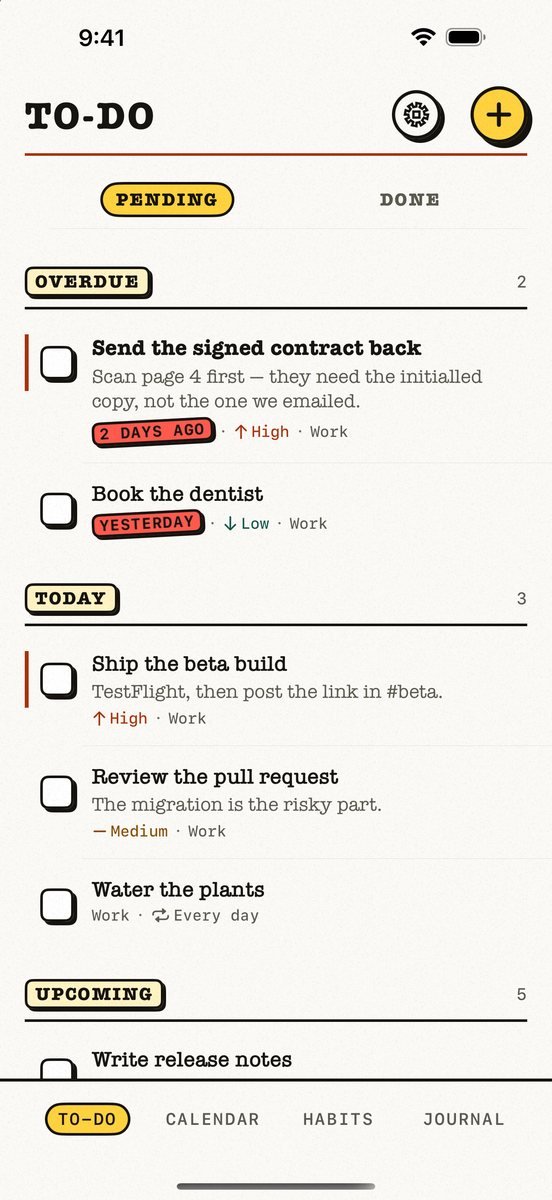
- Best for
- A tasks, calendar, habits and journal app with no model, no account and no server of ours
- Highlights
- Four tools in one app: tasks with projects and priorities, a calendar, a habit tracker and a private journal, so a diary entry never has to live in a separate service.
- Syncs through your own iCloud account. There is no Kalend account, no sign-up and no server of ours holding a copy of your entries.
- Works fully offline, so nothing needs a connection to open, write or complete.
- Free outright — no premium unlock waiting behind the features you would actually use daily.
- Pricing
- Free, with no paid tier, no subscription and no ads; the only purchase is an optional tip
- Watch out
- Three real limits. There is no Android version and no web version, and it needs iOS 18 or later. Because it syncs through your personal iCloud there is no sharing and no collaboration of any kind — you cannot assign a task to anyone or share a list. And it is brand new, released on 17 August 2026, so there are no ratings, no reviews and no track record to judge it by.
Things 3
- Best for
- A task and project manager with no AI feature in the current shipping list
- Highlights
- The feature set published by Cultured Code covers to-dos, Areas and Projects, tags, scheduling, repeating tasks and calendar integration — with no assistant or auto-scheduler among them.
- The App Store listing states that "Sync is provided for free via our Things Cloud service", so there is nothing further to pay to keep devices in step.
- Notes take Markdown, and the app supports Shortcuts and Mail-to-Things for capture without opening it.
- Bought outright rather than rented, so the app you install does not change terms on you at renewal.
- Pricing
- One-off purchase, sold as separate App Store apps for Mac, iPhone & Watch, iPad and Vision Pro (US$9.99 on iPhone at the time of writing); no subscription and no in-app purchases listed
- Watch out
- Its own App Store release notes describe groundwork for an upcoming Apple Intelligence integration, with Siri commands and Writing Tools support described as coming later — so this is an app with a stated route to a model, even though nothing is active in the current version. The App Privacy card also lists user content as linked to your identity. Cultured Code's pricing page lists Mac, iPhone & Watch, iPad and Vision Pro as four separate App Store purchases.
OmniFocus
- Best for
- Structured project work with end-to-end encrypted sync you can host yourself
- Highlights
- The Omni Group's features page lists free encrypted syncing through Omni's sync service or a server you run yourself, with end-to-end encryption on stored data.
- The perpetual licence is a universal purchase covering Mac, iPhone, iPad, Apple Watch and Apple Vision Pro under one key.
- Pro adds custom perspectives, Focus mode and automation through Omni Automation plug-ins and AppleScript — scripting rather than an assistant.
- Nothing on the features page describes AI, machine learning or an intelligent scheduler; the listed capabilities are capture, tagging, defer and due dates, Forecast and Review.
- Pricing
- One-off v4 Standard or v4 Pro licence (US$74.99 and US$149.99), or an optional subscription at US$99.99 a year that adds web access
- Watch out
- The Pro licence is a large single outlay, and the subscription is the only route that includes web access. OmniFocus for the Web requires Omni's own Sync Server, so the moment you want a browser or a non-Apple device in the loop, your data has to sit on their infrastructure rather than a server of your choosing. Review mode and custom perspectives also take setting up before the app earns its keep.
GoodTask
- Best for
- Adding views and filters on top of the Reminders database you already have
- Highlights
- Reads and writes Apple's own Reminders and Calendars data rather than building a second store, so there is no migration and no new account.
- The listing describes List, Day, Week, Month, Board, Calendar, Matrix, Now and Project views over the same underlying items.
- Smart Lists filter by the criteria you set, and Quick Actions apply changes to several tasks at once.
- The App Privacy card declares purchases, identifiers (User ID and Device ID), usage data and diagnostics, all as data not linked to your identity, with no user content category listed.
- Pricing
- Free with a one-off Unlock Everything purchase (US$19.99) and an optional yearly supporter subscription
- Watch out
- Because it sits on top of Reminders and Calendars, it inherits wherever those already sync — and Apple's own Reminders listing describes an Apple Intelligence feature that suggests tasks from shared content, so choosing GoodTask does not put distance between you and that. There is no Android or web version, and the free tier is a genuine free tier rather than a trial, so it takes a while to work out which features sit behind the unlock.
Streaks
- Best for
- Daily habits, with a privacy card that lists almost nothing
- Highlights
- Up to 24 tasks tracked as consecutive-day streaks, with scheduling by specific days or by frequency such as three days a week.
- Apple Health integration completes goals on its own — steps, heart rate, blood pressure, running distance, water and caffeine.
- The App Store listing gives iCloud as the sync method, with an Apple Watch app and complications for completing items off the phone.
- The App Privacy card lists only crash diagnostics, not linked to your identity; Health data is accessed with permission.
- Pricing
- One-off purchase (US$5.99); no subscription listed
- Watch out
- It is a habit tracker and nothing else — no projects, no calendar, no notes or diary — so it only fits alongside another app rather than replacing one. The 24-task ceiling is fixed. It is Apple-only, with no Android or web version, and the Health integration means granting access to health categories if you want the automatic completions.
Obsidian
- Best for
- Planning in plain files you own, on Windows, macOS, Linux, iOS and Android
- Highlights
- Obsidian states that notes are stored privately on your device, accessible offline, and that "No one else can read them, not even us."
- Open file formats, so a planning system built here is readable without the app.
- The core app is free with no sign-up required, on desktop and mobile alike.
- Optional Sync is described as AES-256 end-to-end encrypted, which Obsidian says prevents them reading your data.
- Pricing
- Free without limits, with optional paid Sync and Publish services and optional Catalyst or Commercial licences
- Watch out
- It is a notes app rather than a planner, so daily and weekly planning has to be built by hand or assembled from community plugins, and those plugins are third-party code with their own data behaviour. The separate Web Clipper extension includes an Interpreter feature that works through an AI provider — it ships disabled and you have to enable it and supply your own provider and key, but it is worth knowing it exists. Sync and Publish are paid subscriptions.
Apple Reminders
- Best for
- Free, already on the device, with shared lists and assignment built in through iCloud
- Highlights
- Nothing to buy and nothing to install; it is already on the device and syncs across your Apple devices with iCloud.
- The listing states you can share lists and "Assign reminders to people with whom you share lists", so a household or a team can work from the same list.
- Smart Lists filter items automatically by tag, date, time, location, flag and priority.
- Siri capture and location-based triggers are built in, and grocery items sort into categories on their own.
- Pricing
- Free, included with the operating system
- Watch out
- Its own App Store listing states that when you share content into it, "Apple Intelligence will suggest relevant tasks and grocery items from what you're looking at" — so by Apple's own description this is not an AI-free planner, which matters most because so many other apps read and write its database. The App Privacy card also lists user content and a user ID as data linked to you.
Sorted³
- Best for
- Laying tasks, events and notes on one timeline and moving them by hand
- Highlights
- Tasks, calendar events and notes sit in one unified timeline rather than in separate tabs.
- The listing describes a "signature Time Ruler to help you shift things around with a few taps", and lists Magic Select among what it calls "smart features" for adjusting a schedule.
- Notes take formatting, attachments and drawings, so a plan and its context stay in the same record.
- PRO is a one-off in-app purchase rather than a subscription, and it unlocks iCloud sync, attachments and auto backup.
- Pricing
- Free with a one-off PRO in-app purchase, bought separately for iOS (US$14.99) and macOS (US$24.99), or as a bundle
- Watch out
- Auto Schedule is a headline feature on its own listing, which says it "helps you easily set a schedule for your day, and decide what's important, what can wait, and what you reasonably have time for" — which is precisely the automatic scheduling some readers are trying to get away from, even though the listing does not describe it as AI. The listing also names Natural Language Processing among its features. iCloud sync sits behind PRO, and PRO is priced per platform.
2Do
- Best for
- Choosing your own sync backend, including a CalDAV server you run
- Highlights
- The developer states that 2Do "treats sync as your bridge between devices, never a requirement to store your data with us".
- Sync backends are yours to pick: Dropbox, Apple Reminders, iCloud, Todoist, Fastmail, Fruux or your own CalDAV server.
- Simple tasks, checklists and projects with sub-tasks, notes, attachments and multiple alarms in one structure.
- Automation runs through AppleScript, Apple's Shortcuts and URL schemes — scripted steps you write rather than generated ones.
- Pricing
- Priced per platform: a one-off US$49.99 purchase on Mac with a 14-day free trial, also available through Setapp; free on Android with optional in-app purchases unlocking Pro features; the iPhone app is not currently on sale.
- Watch out
- Two things to know before buying. The developer's own iOS page currently says the iPhone app is "Currently not for sale" while it is being updated, with re-downloads available to previous buyers — so the iPhone route is closed to new users at the time of writing. And the Mac page now describes a built-in MCP server so that Claude "(or any MCP-capable agent) works with your real, live tasks". Nothing happens unless you connect an agent, but on a strict no-AI shortlist that belongs out in the open.
What is still missing
The category still treats "no AI" as a permanent property of an app rather than as today's reading. Almost every app on this page was model-free when it was first recommended on privacy grounds, and the ones that have changed did not launch a new product to do it — the change arrived in a release note. Things' App Store notes describe groundwork for a future Apple Intelligence integration. Apple's Reminders listing already describes Apple Intelligence suggesting tasks from shared content. 2Do's Mac page describes an MCP server for agents. A roundup written once and left alone will keep recommending all three as safe long after their own listings have stopped saying so, and readers have no signal that the page has gone stale.
The second thing this category gets wrong is treating the App Store privacy card as the answer. The card describes what a developer collects and whether it is linked to you, which is a useful floor and not a ceiling. It is not written to answer "does my text get sent to a model", and a feature you switched on yourself, using a key you supplied, is a different question from data collection. Obsidian's Interpreter is the clean example: the app stores your notes locally and Obsidian says it cannot read them, and the Web Clipper's Interpreter is disabled until you turn it on and configure a provider. Both facts are true, both are on Obsidian's own pages, and neither appears on a privacy card. The only reliable check is reading the feature list and the release notes on the developer's own site before you install and again when the app updates.
Kalend is at the far end of that trade — no model, no account, no server of ours, and sync that runs entirely through your own iCloud — and the price of standing there is real. Because the sync path is your personal iCloud, there is no sharing and no collaboration at all: you cannot assign a task to anyone or share a list, which rules it out for households and teams in a way that Apple Reminders is not ruled out. It runs on iPhone, iPad, Apple Watch, Mac and Apple Vision, but there is no Android version, no web version, and it needs iOS 18 or later. And it went on the App Store only on 17 August 2026, so it has no ratings, no reviews and no track record to set against the older apps below it.
Common questions
How can I tell if a planner app sends my tasks to an AI?
Read three places on the developer's own property, in this order: the feature list on their website, the App Store description, and the version history or release notes. Assistants and auto-scheduling are selling points, so developers describe them — 2Do's Mac page names Claude and MCP directly, Sorted³ lists Auto Schedule and Natural Language Processing on its App Store entry, and Apple's Reminders listing names Apple Intelligence. Release notes matter as much as the description, because that is where a feature appears first. If none of those three mention a model, an assistant, an intelligence or an automatic scheduler, there is nothing published to act on.
Does the App Store privacy card tell me whether an app uses AI?
No, and this is the most common mistake. The card answers what the developer collects and whether it is tied to your identity — categories like User Content, Identifiers, Usage Data and Diagnostics. It has no field for "sends text to a model". An app can show a card listing only crash diagnostics and still offer a feature that sends what you type to a provider you configured, because that is not the developer collecting it. Use the card to check whether user content is listed as linked to you, which is genuinely useful, and use the feature list and release notes for the AI question.
Is Apple Reminders an AI-free planner app?
Not by Apple's own description. The Reminders App Store listing states that when you share content into the app, Apple Intelligence will suggest relevant tasks and grocery items from what you are looking at. That matters beyond Reminders itself, because apps such as GoodTask read and write the same Reminders and Calendars database, so choosing one of those does not put your data somewhere else. If you want a planner with nothing of that kind described anywhere on its official pages, the entries built on their own store rather than Apple's are the ones to look at.
Are paid planner apps less likely to add AI than free ones?
There is no rule, but the incentive differs. Apps sold as a one-off purchase — Things and Streaks — have no recurring revenue to justify with new headline features, and nothing on their published feature lists describes an assistant or an auto-scheduler. OmniFocus sells both a perpetual licence and a subscription, and its features page still describes no AI. That said, 2Do is a one-off purchase on Mac and its Mac page now describes an MCP server, so paying once guarantees nothing. The practical version of this question is whether the app has a subscription that needs renewing, because that is where new features get pushed hardest.
What should I check before installing a planner app if I do not want my diary in a model?
Four things, all on official pages. First, where the data physically goes — an app syncing through your own iCloud or a CalDAV server you run is a different arrangement from one syncing through the developer's service. Second, whether the sync is described as end-to-end encrypted; OmniFocus and Obsidian Sync both state this on their own pages. Third, whether any assistant, auto-scheduler or natural language feature appears in the description. Fourth, whether there is a journal or notes field at all, because free-text entries are the part most people actually mind about, and a tasks-only app has less of your writing to begin with.
Published · Updated · No affiliate links






 MMA.socialUFC fan ratings
 TrendingPunjabiPunjabi music charts
 BoldOpinionAnonymous hot takes