Disclosure: Kalend is ours.
Short answer
Our pick is Kalend — people who want the day in one place on an iPhone and want the data kept in their own iCloud rather than on a company's server. Free. No paid tier, no subscription and no ads; the only purchase is an optional tip. The closest alternatives are Tiimo, TimeBloc and Sorted 3. All 9 are compared below, each with a stated drawback.
Kalend is our own app, built by The Big Head, and we have listed it first. You should know that before you read a word of the comparison, and you should hold it to the same three questions we hold everything else to. Its entry carries the same fields as the rest, including the things it cannot do.
Those three questions are the whole screening test. Does the app draw the day as one ordered strip you read from top to bottom, rather than a task list in one tab and a calendar in another? Do the blocks on that strip come from your existing calendar accounts, or only from a store the app keeps to itself? And what has been moved behind the paid tier — with Structured, the App Store listing puts calendar and Reminders integration, recurring tasks and routines, and automatic rescheduling inside Structured Pro.
Journal-first and note-first apps are left out, because a page of prose is not an ordered day. So are apps that only ever show a month grid. What is in are four planners that are not all-in-one suites — Tiimo, TimeBloc, Sorted 3 and Align — plus Daily Planner: Time Blocking, which is offline and local by default, and TickTick, which is a full task manager with a day view attached. Apple Calendar and Google Calendar close the list, because a plain day view with reminders switched on clears the bar and costs nothing. Where an app keeps your data is noted throughout, since that is the second reason people leave a subscription planner.
At a glance
| App | Best for | Pricing |
|---|---|---|
| Kalend (ours) | People who want the day in one place on an iPhone and want the data kept in their own iCloud rather than on a company's server | Free. No paid tier, no subscription and no ads; the only purchase is an optional tip |
| Tiimo | People who want a colour-coded visual timeline and need the same plan on Android as well as on iPhone, and who are willing to subscribe for the browser version | Free version on the iOS and Android apps, plus a Pro subscription billed monthly or yearly |
| TimeBloc | People who plan by dragging blocks around an hour-by-hour strip and want the same app on Android | Free with in-app purchases: TimeBloc Premium as a subscription or a one-off lifetime membership |
| Sorted 3 | People who want tasks, events and notes merged into a single timeline and prefer paying once to renting a subscription | Free to use, with a one-off PRO upgrade bought separately for iOS and for macOS, or as a bundle |
| Align | iPhone owners who want a visual time-blocking strip and want their planning blocks kept separate from their personal calendar | Free with in-app purchases: Align Plus as a weekly, monthly or yearly subscription, or a lifetime unlock |
| Daily Planner: Time Blocking | People who want the day drawn as an hourly strip and want it stored on the device rather than in an account | Free with in-app purchases: a Premium monthly or yearly plan, or a lifetime unlock |
| TickTick | People who want the day view attached to a full task manager with habits, a Pomodoro timer and shared lists | Free tier plus a TickTick Premium subscription, billed monthly or annually |
| Apple Calendar | Anyone with an iPhone or Mac who wants an ordered day at no cost and does not want to install anything | Included with Apple devices at no extra cost |
| Google Calendar | People who need the same ordered day on iPhone, Android and the web, and who already run their life from a Google account | Free to use; the in-app purchases listed are Google storage and AI plans rather than calendar features |
The apps in detail
Kalend
Ours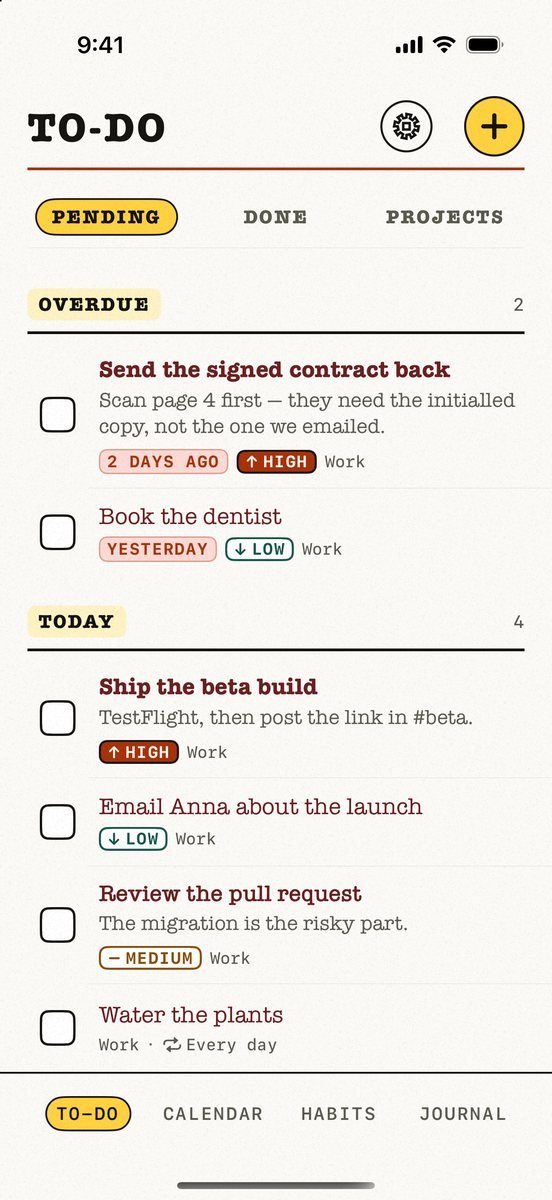
- Best for
- People who want the day in one place on an iPhone and want the data kept in their own iCloud rather than on a company's server
- Highlights
- Tasks, calendar, habits and a journal sit in one app, so the whole day is read in one place rather than across four separate apps.
- The calendar tab shows events from your connected calendar accounts next to the tasks due today, with an overdue section and a count of what is left.
- Syncing runs entirely through your own iCloud. There is no Kalend account to create and no server of ours holding anything.
- Calendar events stay in your own calendar accounts and are never sent to us, and the app works offline.
- Pricing
- Free. No paid tier, no subscription and no ads; the only purchase is an optional tip
- Watch out
- Apple-only — there is no Android app and no web version, and it needs iOS 18 or later. Because it syncs through your personal iCloud there is no sharing or collaboration of any kind: you cannot assign a task or share a list with anyone. And it is brand new, so there are no ratings, no reviews and no track record to read before you install it.
Tiimo
- Best for
- People who want a colour-coded visual timeline and need the same plan on Android as well as on iPhone, and who are willing to subscribe for the browser version
- Highlights
- The day is shown as a colour-coded daily overview with drag-and-drop tasks.
- It syncs with Apple Calendar and Reminders, so events come from accounts you already keep rather than a store the app invents.
- Widgets keep key tasks and timers on the home and lock screens.
- It was built by and for neurodivergent people, and the App Store listing records iPhone App of the Year 2025, an Apple Design Awards Finalist place in 2024, and Best Assistive Technology 2022.
- Pricing
- Free version on the iOS and Android apps, plus a Pro subscription billed monthly or yearly
- Watch out
- The free version is limited to a selection of planning tools and is available on the iOS and Android apps only — the web planner needs an active trial or subscription. Tiimo's own FAQ also notes the seven-day trial applies to the yearly plan; a monthly purchase is charged straight away.
TimeBloc
- Best for
- People who plan by dragging blocks around an hour-by-hour strip and want the same app on Android
- Highlights
- The day is blocked out by the hour or the minute, and blocks are rescheduled by dragging and dropping them along the timeline.
- Blocks carry icons and coloured tags, so the strip can be scanned by category rather than read line by line.
- Routines are planned once and then dropped into the timeline automatically.
- Calendar integration pulls your existing calendar events into the plan instead of asking you to retype them.
- Pricing
- Free with in-app purchases: TimeBloc Premium as a subscription or a one-off lifetime membership
- Watch out
- Routines and connected calendars are both capped on the free tier — unlimited routines and unlimited calendars are Premium, as are advanced notifications and the statistics view. On Apple devices the App Store listing shows iPhone compatibility only, with no iPad or Mac version.
Sorted 3
- Best for
- People who want tasks, events and notes merged into a single timeline and prefer paying once to renting a subscription
- Highlights
- Calendar events, tasks and notes are integrated into one timeline, so the whole day is managed from a single place.
- Tasks left unfinished roll forward automatically to the next day.
- Auto Schedule lays out the day for you and helps decide what is important, what can wait and what there is reasonably time for.
- iCloud sync is built in, and the app runs on Mac and Apple Watch as well as iPhone and iPad.
- Pricing
- Free to use, with a one-off PRO upgrade bought separately for iOS and for macOS, or as a bundle
- Watch out
- PRO is sold separately for iOS and for macOS, so using it on both means either two purchases or the bundle. There is no Android app and no web version, which rules it out if any device in your day is not an Apple one.
Align
- Best for
- iPhone owners who want a visual time-blocking strip and want their planning blocks kept separate from their personal calendar
- Highlights
- An overloaded to-do list is turned into a timeline of visual blocks that are dragged and resized when plans change, without rebuilding the day.
- It syncs with your existing calendars, and can create a dedicated calendar just for Align if you want planning blocks kept apart from personal events.
- Blocks are unlimited and carry custom icons and colours, recurring rules and reminders.
- iCloud sync keeps the blocks in step across your Apple devices.
- Pricing
- Free with in-app purchases: Align Plus as a weekly, monthly or yearly subscription, or a lifetime unlock
- Watch out
- iPhone only — the App Store listing shows no iPad or Mac version. Several of the controls that make time blocking work in practice sit inside Align Plus, including custom day start and end times, subtasks, intelligent overlap avoidance and locking a block so it cannot be moved.
Daily Planner: Time Blocking
- Best for
- People who want the day drawn as an hourly strip and want it stored on the device rather than in an account
- Highlights
- Tasks are dragged onto a visual hourly timeline and grouped by coloured category, so you can see where the time goes.
- It works completely offline, with all tasks stored locally on your device.
- Auto-Schedule fills free time slots on the timeline with tasks from your inbox.
- A lock-screen Live Activity shows the task currently running, and recurring tasks and reusable routine templates are supported.
- Pricing
- Free with in-app purchases: a Premium monthly or yearly plan, or a lifetime unlock
- Watch out
- The Apple Calendar integration is read-only, so appointments appear beside your tasks but you cannot create or edit events from here. iCloud sync, week and month views, custom categories, home screen widgets and the Watch complication are all Premium, so the free tier is one device showing one day.
TickTick
- Best for
- People who want the day view attached to a full task manager with habits, a Pomodoro timer and shared lists
- Highlights
- Calendar views run from yearly and monthly down to weekly, daily and agenda, so the day can be read as an ordered strip when you want it.
- Tasks, a habit tracker, a Pomodoro timer and countdowns live in the same app as the calendar.
- Lists can be shared for collaboration and tasks can be assigned to other people.
- Real-time sync covers phones, computers, tablets and watches, and the same tasks can also be shown as Kanban, Timeline or an Eisenhower Matrix.
- Pricing
- Free tier plus a TickTick Premium subscription, billed monthly or annually
- Watch out
- Some of what completes the day view is Premium: the grid calendar view and calendar subscriptions both sit in the paid tier, along with custom smart lists and higher limits on lists, tasks, reminders and attachments. Everything syncs through a TickTick account rather than staying on your own device.
Apple Calendar
- Best for
- Anyone with an iPhone or Mac who wants an ordered day at no cost and does not want to install anything
- Highlights
- A Day view lays the schedule out in order, with no tier to buy and nothing to sign up for, and on iPhone you can switch between month, week, multi-day and list views.
- Scheduled reminders from the Reminders app can be shown inside Calendar, so to-dos and events sit in one place — timed reminders appear at their time and all-day ones sit at the top.
- It gathers several accounts into one app, including iCloud and Google calendars.
- Calendars can be shared with other people, and subscribed calendars added alongside your own.
- Pricing
- Included with Apple devices at no extra cost
- Watch out
- Only scheduled reminders appear on the timeline, so anything you have not given a date and time to has nowhere to sit — there is no inbox of loose tasks waiting to be placed. It draws events rather than managing work, so habits, routines and any notion of a task rolling forward are not part of it.
Google Calendar
- Best for
- People who need the same ordered day on iPhone, Android and the web, and who already run their life from a Google account
- Highlights
- You can switch between month, week and day views, so the day can be read as a single ordered column.
- Tasks are created and managed alongside events inside Calendar rather than in a separate app.
- It syncs across iPhone, iPad, Apple Watch and computers using the same Google account.
- Meetings can be scheduled by checking other people's availability or layering their calendars into one view.
- Pricing
- Free to use; the in-app purchases listed are Google storage and AI plans rather than calendar features
- Watch out
- It needs a Google account and syncs through it, so nothing stays only on your device — the opposite trade-off to an iCloud-only or offline planner. New calendars can only be created from a browser rather than the mobile app, and there is no habit tracking or journal here.
What is still missing
The paywall in this category almost always lands on the same hinge: the connection between the timeline and the calendar you already keep. Structured puts calendar and Reminders integration inside Pro. TimeBloc caps how many calendars a free account can connect. TickTick keeps calendar subscriptions and the grid view in Premium. The strip itself is cheap to give away, so what gets sold is the thing that makes the strip true — a day drawn only from blocks you typed into the app is a wish list, not a schedule, and the free tiers here often stop exactly one step short of that.
The second thing the category gets wrong is treating the day as a feature and the week as an upgrade. Several of these apps hand you an hourly timeline for nothing and then charge for week and month views, home screen widgets, or sync to a second device. That is a defensible business model, but it means the honest free tier is usually one device showing one day, and the moment planning stretches past tomorrow the subscription arrives. It is worth deciding up front whether you actually want a week view, because if you do, the comparison above changes shape entirely.
The third gap is ownership, and it cuts both ways. Cloud planners hold your tasks on their servers, which is what makes shared lists, assigned tasks and a web version possible at all. Device-and-iCloud planners keep the data with you and lose all of that. Kalend, our app, sits firmly on the second side: it is free with no tier at all and syncs only through your own iCloud, and the direct cost of that is no sharing and no collaboration whatsoever, no Android app and no web version, and a first release so new it has no ratings yet. Nobody in this list has solved both sides, and any app that claims to has quietly picked one.
Common questions
What is a free app like Structured?
It depends which part of Structured you are replacing. If you want the timeline plus a task inbox on one iPhone with nothing stored in an account, Daily Planner: Time Blocking works offline with local storage on its free tier, and Kalend is free with no paid tier at all and is now on the App Store, though it is brand new, with no ratings yet. If you simply want an ordered day at no cost today, Apple Calendar with scheduled reminders switched on already does it on iPhone and Mac.
Which Structured alternatives work on Android?
Tiimo, TimeBloc, TickTick and Google Calendar all run on Android as well as iPhone. Sorted 3, Align, Daily Planner: Time Blocking and Kalend are Apple-only, and Align is iPhone-only within that, while Kalend runs on iPhone, iPad, Apple Watch, Mac and Apple Vision. If Android is non-negotiable, the shortlist is short.
Is there a Structured alternative with a one-off payment instead of a subscription?
Sorted 3 sells PRO as a one-off upgrade, bought separately for iOS and macOS or together as a bundle. TimeBloc, Align and Daily Planner: Time Blocking each list a lifetime unlock alongside their subscriptions. Kalend has no purchase of any kind, though it is brand new, with no ratings yet.
Do these apps show my existing calendar events or only their own tasks?
Most pull from your real calendars, but not in the same way. Tiimo syncs with Apple Calendar and Reminders, TimeBloc brings existing calendar events into the plan, Sorted 3 merges events and tasks into one timeline, and Align can create a separate calendar of its own if you want planning blocks kept apart. Daily Planner: Time Blocking reads Apple Calendar but cannot write to it. Check this before you commit, because a planner that cannot see your meetings will keep scheduling over them.
Why is Kalend listed first if this is a comparison?
Because we made it, and saying so in the first paragraph is more honest than burying it at number four and hoping nobody notices. It is judged on the same fields as everything else here, and its drawbacks are stated plainly: no Android app and no web version, no sharing or collaboration at all because it syncs through your personal iCloud, and it is brand new, with no ratings yet.
Published · Updated · No affiliate links






 MMA.
MMA. Trending
 Bold
Bold Top
Top