Disclosure: Kalend is ours.
Short answer
Our pick is Kalend — one app for tasks, calendar, habits and a journal, with nothing to buy later. Free with nothing to unlock: no paid tier, no adverts; the only purchase is an optional tip. The closest alternatives are Apple Reminders, Things 3 and Streaks. All 9 are compared below, each with a stated drawback.
There are four ways an iPhone planner gets paid for, and only one of them is a price. It can be free and carry adverts, in which case your attention is the product. It can be free with a paid tier, where the download costs nothing and the features you will actually want sit behind a subscription or an unlock. It can be paid once, which by definition rules out adverts because the developer already has your money. Or it can be free with nothing to sell at all, which usually means somebody is subsidising it or it is built into the phone. Every entry below is placed in one of those four.
Notice which bucket is missing. Nothing on this list is advert-supported, and that is the point of screening this way rather than by price: search "free planner" and the results are a mix of buckets one and two, and the listing pages do not sort themselves. Pricing is described in words here rather than figures, because App Store prices move by country and by sale and a number in a blog post goes stale within a month. If what you want is simply a shortlist of free daily planners rather than a breakdown of who pays for them, that is a different post and we have written it: https://thebighead.ca/blog/plan-your-day-iphone-free/
At a glance
| App | Best for | Pricing |
|---|---|---|
| Kalend (ours) | One app for tasks, calendar, habits and a journal, with nothing to buy later | Free with nothing to unlock: no paid tier, no adverts; the only purchase is an optional tip |
| Apple Reminders | The bucket-four option already on your phone, if a task list is all you need | Free, built into iOS, with no in-app purchases listed |
| Things 3 | Paying once for a task manager and never seeing an upgrade prompt again | Paid once, bought separately for each Apple platform |
| Streaks | Habit tracking on its own, paid for once | Paid once, with no in-app purchases listed |
| Structured | Seeing the whole day as a timeline instead of a list | Free tier plus Structured Pro, sold monthly, yearly or as a lifetime unlock |
| Sorted 3 | One timeline for events and tasks, with a one-off unlock rather than a subscription | Free tier plus a one-time Pro unlock, bought separately for iOS and macOS |
| TickTick | Tasks, calendar and habits in one app, on more than just Apple devices | Free tier plus a TickTick Premium subscription, monthly or annual |
| HabitKit | A visual habit grid with the data kept on the phone | Free tier plus HabitKit Pro, sold monthly, yearly or as a lifetime unlock |
| Day One | The journalling half of a planner, with encryption treated as a feature | Free tier plus a subscription, offered at two paid levels |
The apps in detail
Kalend
Ours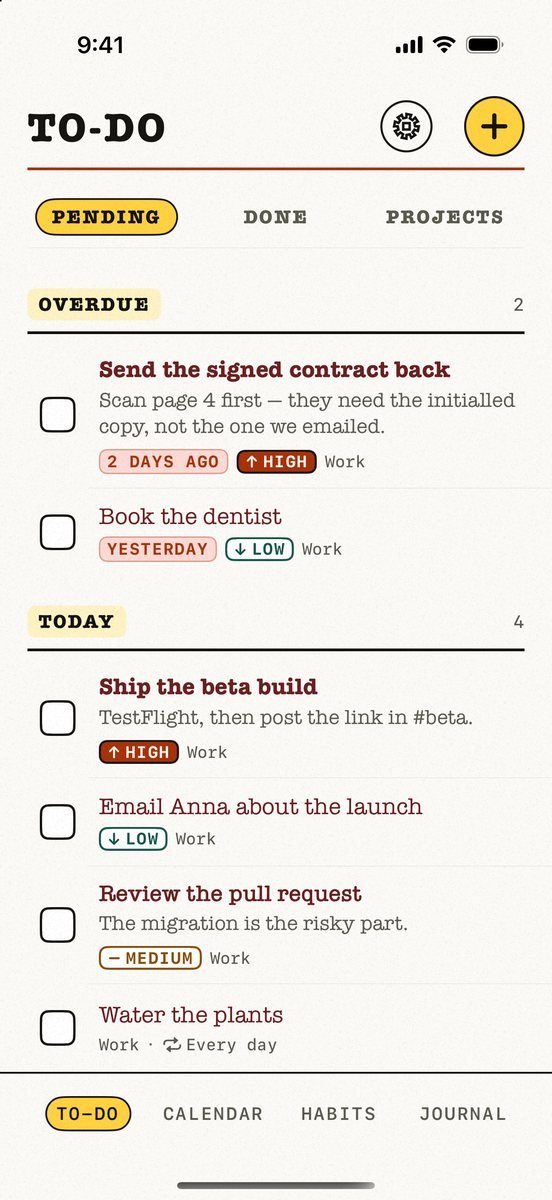
- Best for
- One app for tasks, calendar, habits and a journal, with nothing to buy later
- Highlights
- Four tools in one app — tasks, calendar, habits and a journal — rather than four separate downloads each with its own paywall
- Syncs through your own iCloud: there is no Kalend account to create and no server of ours holding your tasks or journal entries
- Offline-first, so every feature works without a connection and changes catch up when you reconnect
- Sits in the fourth bucket by design — with no paid tier there is nothing to hold back, and with no advertiser there is nothing to sell
- Pricing
- Free with nothing to unlock: no paid tier, no adverts; the only purchase is an optional tip
- Watch out
- Apple only: it runs on iPhone, iPad, Apple Watch, Mac and Vision, but there is no Android version and no web version, and it needs iOS 18 or later. Because it syncs through your personal iCloud there is no sharing or collaboration of any kind — you cannot assign a task to anyone or share a list. And it is brand new, so there are no ratings, no reviews and no track record to judge it by yet.
Apple Reminders
- Best for
- The bucket-four option already on your phone, if a task list is all you need
- Highlights
- Apple lists no in-app purchases at all, so there is no tier structure and nothing held back
- Shared lists, and reminders you can assign to other people
- Smart Lists filter automatically by tag, date and priority, alongside Today, Scheduled, Flagged and Completed
- Grocery lists sort items into sections such as dairy and produce, and list templates can be saved and shared
- Pricing
- Free, built into iOS, with no in-app purchases listed
- Watch out
- Apple's own description covers lists, tags, sharing and location reminders — it is a reminders app rather than a day planner. There is no habit grid, no journal and no time-blocked timeline of the day, so building a full planner setup around it means running other apps alongside.
Things 3
- Best for
- Paying once for a task manager and never seeing an upgrade prompt again
- Highlights
- A paid download with no in-app purchases listed, which places it firmly outside both the advert bucket and the tier bucket
- Areas and Projects with headings and deadlines, for work that runs longer than a day
- Today and Upcoming lists, with repeating to-dos and calendar events shown together
- Sync through Things Cloud, plus mail-to-Things forwarding, an Apple Watch app with dictation, and Siri and Shortcuts support
- Pricing
- Paid once, bought separately for each Apple platform
- Watch out
- The Mac listing states plainly that the iPhone, iPad, Apple Watch and Vision Pro apps are sold separately, so one purchase covers one platform rather than your whole setup. There is also no free version, so you commit before you have used it.
Streaks
- Best for
- Habit tracking on its own, paid for once
- Highlights
- Tracks up to twenty-four daily tasks, each with its own streak count
- Reads from the Health app to tick off water, caffeine, workouts, steps and distance without you touching the phone
- Shared tasks, which the listing frames as letting other Streaks users encourage you
- Negative tasks for habits you are trying to stop, plus timed tasks, daily notes and Apple Watch complications
- Pricing
- Paid once, with no in-app purchases listed
- Watch out
- The listing is entirely about daily tasks and streaks — there is no calendar, task list with due dates, or journal alongside it — and twenty-four tasks is a hard ceiling if you track a lot. Being paid up front also means there is no free version to try the interface first.
Structured
- Best for
- Seeing the whole day as a timeline instead of a list
- Highlights
- A drag-and-drop timeline of the day, with an Inbox for capturing things quickly and placing them later
- The free tier includes sub-tasks with notes, a Pomodoro timer, Live Activities and interactive widgets
- Accessibility work is in the free tier too: VoiceOver, Voice Control, a dyslexia-friendly font and multiple languages
- Colour coding and a large icon set for telling the parts of a day apart at a glance
- Pricing
- Free tier plus Structured Pro, sold monthly, yearly or as a lifetime unlock
- Watch out
- Two things most people would call basics sit behind Pro: connecting your calendars and Reminders, and recurring tasks and routines. If your week repeats — and most weeks do — the free tier runs out faster than the download suggests.
Sorted 3
- Best for
- One timeline for events and tasks, with a one-off unlock rather than a subscription
- Highlights
- Calendar events, tasks and notes share a single timeline rather than living in separate tabs
- Pro is a one-time in-app purchase, not a recurring charge — a different shape of bucket two from the subscription apps here
- Auto Schedule, which the listing describes as a way to work out what you can realistically get done in a day
- A fourteen-day extended trial is listed as a free in-app purchase, so the paid tier can be tested before you buy
- Pricing
- Free tier plus a one-time Pro unlock, bought separately for iOS and macOS
- Watch out
- PRO is per platform: the listing sells Get PRO on iOS and Get PRO on macOS as separate in-app purchases, with an iOS + macOS bundle as a third option. The listing does not spell out which features sit behind PRO, so the fourteen-day extended trial — itself listed as a free in-app purchase — is the only way to find out where the line falls before you buy.
TickTick
- Best for
- Tasks, calendar and habits in one app, on more than just Apple devices
- Highlights
- Task list, calendar, habit tracking and a Pomo timer in a single app
- List sharing and collaboration, with a task list shareable to up to 29 members
- An Eisenhower Matrix view for sorting by urgency against importance
- TickTick states real-time sync across phone, computer, tablet and watch, so it is not tied to one ecosystem
- Pricing
- Free tier plus a TickTick Premium subscription, monthly or annual
- Watch out
- The free tier is usable, but the dividing line is not visible from the listing. TickTick's own upgrade page puts these behind Premium: more calendar views, setting both a start and an end date on a task, subscribing to third-party calendars, the Filter feature, checklist-item reminders, task progress and historical statistics, agenda widgets and additional themes. You tend to meet that line after you have already moved your whole system in.
HabitKit
- Best for
- A visual habit grid with the data kept on the phone
- Highlights
- Tile-based grid charts, so a month of one habit reads in a single glance
- The listing states that all your data belongs to you and stays on your phone
- Import and export are built in, so a year of history is not trapped inside the app
- Up to three reminders per habit, a calendar view for filling in missed days, and archiving for habits you are pausing
- Pricing
- Free tier plus HabitKit Pro, sold monthly, yearly or as a lifetime unlock
- Watch out
- It does one job — habits — so tasks, calendar and journal all live in other apps. The compatibility list also covers iPhone, Mac and Apple Vision but not iPad, and the Mac build requires an Apple M1 chip or later. And it is free-with-a-paid-tier rather than free outright, so it is worth checking exactly what the Pro unlock covers before you build months of history inside the free version.
Day One
- Best for
- The journalling half of a planner, with encryption treated as a feature
- Highlights
- End-to-end encryption on entries, with Face ID, Touch ID or a passcode on the app itself
- Daily prompts, customisable templates, streak tracking and an On This Day view of previous years
- Imports mindfulness minutes from the Health app and automates through Siri Shortcuts, with Spotify, Strava, Fitbit and others coming in via IFTTT applets rather than direct connections
- Exports to PDF and plain text, and can print entries as a physical book
- Pricing
- Free tier plus a subscription, offered at two paid levels
- Watch out
- It is a journal rather than a planner — no task list, no day timeline — so it sits beside your planner instead of replacing it. There are also two paid levels above the free tier rather than one, and unlimited photo and video storage sits in the paid Silver tier, which is where most people's journals eventually go.
What is still missing
The category has quietly agreed that "free" means bucket two, and the App Store listing is not built to tell you otherwise. A listing shows a price of nothing and a line reading In-App Purchases, and that line is identical whether the purchase unlocks a cosmetic icon or unlocks recurring tasks. You cannot tell from the outside whether the free tier is a usable app or a demonstration of one, and you usually find out three weeks in, after you have typed a hundred tasks into it. Every free-tier app above is honest about having a paid tier; none of them make it easy to know in advance which side of the line the feature you personally need falls on.
The apps that are free with nothing to sell get there by having someone else pay. Apple Reminders is free because Apple sells phones. Kalend is free because it is a side project of a small studio, and we should say plainly what that costs you: there is no Android and no web version, it has no sharing or collaboration whatsoever because it syncs through your own iCloud rather than through a server we run, and it is brand new, with no ratings and no track record yet. Those are not trade-offs we are working around — the second one falls directly out of the sync design and is not going to change. An app with no revenue also has no obligation to keep going, which is a real risk to weigh even when the code runs entirely on your own device.
What almost nobody publishes is the thing you would most want: what happens to your data when you stop paying, or when the app stops. Export is the honest test of an ad-free claim, because an app that cannot sell you adverts and cannot lock you in has to keep you by being worth using. A handful of the apps here name import and export directly on the listing. The rest leave you to find out. Until that is a standard line on every listing, screening on how an app makes money is the closest proxy available — an advert-supported app is monetising your attention now, a tiered app is monetising your switching costs later, and a paid app has already been paid.
Common questions
Which of these apps are free with nothing at all to buy later?
Only one, strictly: Apple Reminders shows no in-app purchases on its App Store listing at all. Kalend, our own app, comes closest after it — no tier and no adverts, and its only purchase is an optional tip that unlocks nothing — though it is brand new, with no ratings yet. Things 3 and Streaks sit in a different bucket again: they are paid once, which rules adverts out by the model rather than by promise. Structured, Sorted 3, TickTick, HabitKit and Day One are all free to download with a paid tier above the free one.
Why do so many free planner apps have adverts?
Because someone has to pay for the servers, the App Store fee and the developer's time, and if the user is not paying, an advertiser is. The tell is usually on the listing itself: an in-app purchase named something like "Remove Ads" means the free version shows them. It is worth reading the in-app purchase list before downloading rather than after, because the names are more informative than the description.
Does Apple Reminders have ads or in-app purchases?
Apple's App Store listing for Reminders shows no in-app purchases at all. It is free because it is part of iOS, which is a genuinely different funding model from a free app made by an independent developer. The trade-off is scope rather than money — the listing describes lists, tags, sharing and location reminders, not habit tracking, journalling or a time-blocked day view.
Is a paid planner app better than a free one?
It is not about better, it is about what the developer has to do next. Once you have paid once, the developer has no reason to interrupt you, and no reason to keep a feature back. A free-tier app has to keep some features on the other side of the paywall for the model to work at all, so the question to ask is not what the app can do but which of the things you need are on your side of the line. A one-time purchase is also a smaller commitment over five years than a monthly subscription, even when it looks larger today.
What is the catch with a completely free planner app with no paid tier?
Usually one of three things: it is subsidised by a platform holder, it is a side project, or it is collecting something. Check the third one first — an app that syncs through your own iCloud account rather than through the developer's server has no data to collect, which is how Kalend and Apple Reminders work. The real catch with a side project is longevity and scope: Kalend, for example, has no Android and no web version, cannot share or assign anything to another person, and is brand new, with no ratings and no track record yet.
Published · Updated · No affiliate links






 MMA.
MMA. Trending
 Bold
Bold Top
Top