Disclosure: Kalend is ours.
Short answer
Our pick is Kalend — someone who wants their to-dos, their own appointments, their habits and a journal in one free iPhone app, with no account to create. Free — no subscription, no ads, no paid tier; the only purchase is an optional tip. The closest alternatives are TickTick, Habitica and Lunatask. All 8 are compared below, each with a stated drawback.
Apple Reminders is not bad at tasks. The reason people go looking for a replacement is nearly always the same one, and it has nothing to do with tasks: Reminders has no idea what a habit is.
Set something to repeat daily — stretching, flossing, ten minutes of reading — and Reminders treats each day as a fresh chore to be cleared. Miss three days and you get three overdue rows in red, which is a punishment rather than information. There is no streak, no record of the days you did manage it, and no way to say "three times a week is the target" and then see whether you hit it. Reminders is built to be emptied. A routine is not a thing you empty.
So this list has one entry requirement: tasks and habits have to live in the same app, in a view you would genuinely open every morning. Dedicated habit trackers are covered in a separate roundup, and pure task apps in the to-do list one. Everything below does both.
Before you move anything, though, know what you are giving up. Reminders does four things that most of these apps do not. Natural-language entry, so typing "bins out every second Tuesday at 7pm" parses into a real repeating task without touching a date picker. Shared lists, which work with anyone who has an Apple account and cost nothing. Location triggers — remind me when I get home, remind me when I get in the car — which almost nothing else on iPhone does properly. And real, free, already-installed apps on Mac, iPad and Watch, with Siri wired in throughout.
Of the eight below, only TickTick covers natural language and shared lists, and none of them touch Apple on location triggers. That is the actual trade. If those four things are the reason you open Reminders, the honest advice is to keep Reminders for tasks and put a habit tracker next to it.
Where an app has a free tier, we have stated the habit ceiling in the table and again in each entry. Five habits, seven habits, two habits — those numbers stop being footnotes the moment habits are the reason you are switching.
One note on method. Every figure below was checked against the App Store listing and the developer's own pricing page on 18 August 2026. Where the two disagree, or where a free limit appears only in marketing copy and not on the store listing, we have flagged it in the entry rather than repeating the number as though it were settled. Caps and prices in this category change quietly, so treat these as a starting point and confirm inside the app before you spend a weekend moving anything.
At a glance
| App | Best for | Pricing | Free habit cap |
|---|---|---|---|
| Kalend (ours) | Tasks, appointments, habits and a journal in one free app | Free, no subscription | None |
| TickTick | The closest thing to a drop-in Reminders replacement | Free tier plus subscription | 5 habits |
| Habitica | Routines that only stick when there is a game attached | Free, optional subscription | None |
| Lunatask | Encrypted tasks with habits, mood and journalling | Free tier plus subscription | 7 daily habits |
| Griply | Habits that serve a larger goal | Free tier plus subscription | 2 habits, 2 goals |
| SingularityApp | Tasks, notes, planner and habits on every platform | Free tier plus two paid tiers | About 3 (unconfirmed) |
| Amazing Marvin | Assembling your own productivity system | Subscription only | No free tier |
| Journal it! (LiveIt) | Tasks, habits and a written entry on one timeline | Free tier plus subscription | None claimed (unverified) |
The apps in detail
Kalend
Ours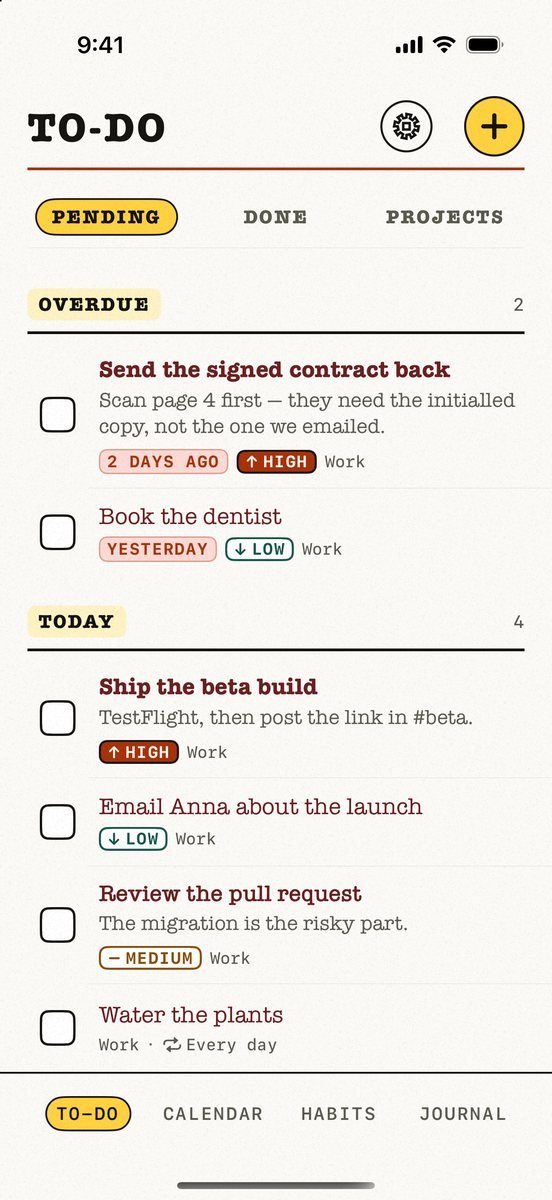
- Best for
- Someone who wants their to-dos, their own appointments, their habits and a journal in one free iPhone app, with no account to create
- Highlights
- Four tabs — To-Do, Calendar, Habits, Journal — so a recurring routine is tracked as a habit rather than nagging forever as an overdue task
- Habit schedules cover daily, weekdays, N per week and every N days; streaks forgive an unscheduled day, with a month history grid and a 365-day record strip
- No habit cap and no account: sync runs through your own iCloud, with no server of ours and no analytics
- The Calendar tab holds your own appointments inside the app; Apple and Google events are an optional, opt-in, read-only overlay
- Apple Watch app, Home Screen and Lock Screen widgets, and Siri/Shortcuts App Intents
- Pricing
- Free — no subscription, no ads, no paid tier; the only purchase is an optional tip
- Free habit cap
- None
- Watch out
- It went on the App Store on 17 August 2026, so it is brand new: no ratings, no reviews and no track record to judge it by. No Android and no web version — it needs iOS 18 or later — nothing for teams or shared lists, no natural-language email capture, and the habit statistics are deliberately simple.
TickTick
- Best for
- The closest thing to a drop-in Reminders replacement that also carries a genuine habit tracker
- Highlights
- Habits live in the same app as lists, calendar view and Pomodoro timer, so routines and tasks never split across two apps
- Handles the Reminders habits people miss most: natural-language date entry when typing a task, and shared lists
- Habit streaks and check-ins, with a calendar view that shows tasks and events together
- Broadest platform coverage of anything here — iPhone, iPad, Mac, Watch, Android, Windows and web
- Pricing
- Free tier plus a subscription
- Free habit cap
- 5 habits
- Watch out
- The free tier stops at five habits — TickTick's own App Store listing sells "Add more than 5 habits" as a Premium feature — and free accounts are also capped on lists and tasks per list, with the richer habit statistics and two-way calendar sync held back for subscribers. If habits are the reason you are switching, you will meet the paywall quickly.
Habitica
- Best for
- People who only stick with a routine when there is a game attached to it
- Highlights
- Habits, Dailies and To-Dos sit as three lists on one screen — Dailies are the habit engine, and there is no cap on how many you create
- Core habit tracking is genuinely free; the subscription buys pets, gear and gems, not features
- Parties, guilds and boss battles give social accountability that no Reminders alternative here matches
- Still actively developed — the iOS app shipped a version 4.x update in the first week of August 2026
- Pricing
- Free, with an optional subscription and gem purchases that are cosmetic rather than functional
- Free habit cap
- None
- Watch out
- Everything runs through a Habitica account on their servers, so there is no local-only or iCloud-only option, and the RPG layer is not something you can switch off. If you do not want an avatar taking damage for a missed floss, it is a great deal of ceremony wrapped around a checklist — and it has no location-based reminders.
Lunatask
- Best for
- Privacy-minded switchers who want habits, mood and journalling attached to the same to-do list
- Highlights
- End-to-end encrypted, and the free plan states its habit allowance plainly: seven daily habits
- Tracks both current and record streaks, so an unbroken run is visible rather than implied
- Mood tracker and journalling sit alongside tasks, which is unusual in a task app
- Recurring and scheduled tasks, task estimates and a Pomodoro timer for the ordinary to-do work
- Pricing
- Free tier plus a subscription; a lifetime option exists but only via the desktop apps and it is expensive
- Free habit cap
- 7 daily habits; weekly habits are paid
- Watch out
- Seven daily habits is the free ceiling, and weekly habits are a paid feature — so a "three times a week" routine, the exact thing Reminders handles badly, needs a subscription. The free plan also limits you to two Areas of Life, and the interface is utilitarian rather than pleasant.
Griply
- Best for
- Habits that are meant to serve a larger goal rather than float on their own
- Highlights
- Goals, habits and tasks are one connected system — a habit rolls up into the goal it belongs to
- Unlimited tasks even on the free tier, so it is only the habit and goal side that is metered
- Flexible habit scheduling, from every weekday to a set number of times per week
- Habit statistics and progress charts rather than a bare tick-box
- Pricing
- Free tier plus a subscription; a one-off lifetime purchase is also sold
- Free habit cap
- 2 habits and 2 goals
- Watch out
- The tightest free tier in this roundup: two goals and two habits, with habit targets, subgoals and time-blocking behind the subscription. The lifetime purchase is the expensive way out of that. The App Store review count is also small, so there is less collective experience to draw on than with TickTick.
SingularityApp
- Best for
- Someone who wants tasks, notes, a daily planner and habits in one app that also runs on Windows or Linux
- Highlights
- To-do list, calendar and daily planner, notes, checklists, Pomodoro and a habit tracker in a single app
- Runs almost everywhere, including Apple Watch and Wear OS as well as desktop and web
- Actively maintained — the iPhone app was updated within the week of writing
- Most of the task-management side is usable without paying, so the free tier is not a demo
- Pricing
- Free tier plus two separate paid tiers
- Free habit cap
- Reported at about 3 habits, not stated on the App Store listing
- Watch out
- The free habit allowance is reported to stop at around three habits, and that figure is not spelled out on the App Store listing, so check it in the app before you migrate anything. Two paid tiers on top of the free one make it genuinely hard to work out what you are buying.
Amazing Marvin
- Best for
- Tinkerers who want to assemble their own productivity system, with habit tracking as one of the parts
- Highlights
- A real habit tracker sitting beside the to-do lists, with streak counts and open habits surfaced in the day view
- Habits can be quantified — "do 50 press-ups" prompts you for the number — not merely ticked off
- Around a hundred toggleable "strategies", so you switch on only the machinery you want
- Properly documented in its own help centre, which is rarer than it should be
- Pricing
- Subscription only — there is no free tier, just a trial
- Free habit cap
- No free tier at all
- Watch out
- There is no free tier at all, so there is no free habit cap to quote — you subscribe or you go without, after a two-week trial. Habits are switched off until you enable the strategy yourself, the iPhone app is a companion to a desktop and web-first product rather than the main event, and the volume of options is a genuine time sink.
Journal it! (now branded LiveIt)
- Best for
- People who want the day's tasks, habits and a written entry on one timeline — the closest in shape to what Kalend does
- Highlights
- Six item types — entry, note, task, goal, habit and tracker — all land on one daily timeline
- Habit tracking and journalling share a screen, so reflection and streaks are not in separate apps
- The developer advertises no habit cap on the free tier, which would make it the only free-and-uncapped option here besides Habitica
- Shipping constantly — the iPhone app was updated the same day this was checked
- Pricing
- Free tier plus a subscription, with lifetime purchases also offered
- Free habit cap
- None claimed by the developer, but unverified
- Watch out
- The "unlimited habits on free" claim comes from the developer's own marketing rather than the App Store listing, so verify it before migrating. The app is dense to the point of clutter with six item types competing for attention, it is mid-rebrand from Journal it! to LiveIt (which makes it awkward to search for or get support on), and the store lists several different subscription and lifetime price points.
What is still missing
None of the eight is a straight upgrade on Reminders, and it is worth being blunt about the shape of the category. TickTick gets closest on features and then meters the habits at five. Griply understands better than anyone how a habit ladders up into a goal, and gives you two of them. Amazing Marvin will do very nearly anything you can imagine and charges every month forever to do it.
The pattern is consistent: task management is the free part and habits are the upsell. That is not an accident. Tasks are what people try an app with; habits are what people stay for, and what they will pay to keep once there is a hundred-day streak sitting inside the app.
Kalend is our answer to that, which is why it is first here rather than buried mid-list. Four tabs, no habit cap, no account, no subscription and no analytics, with habits scheduled daily, on weekdays, N times a week or every N days, and streaks that forgive a day the habit was never scheduled for.
The honest cost is most of the list at the top of this page. No shared lists, no location triggers, no natural-language email capture, no Android or web version, nothing for teams, and no track record whatsoever — it only went on the App Store on 17 August 2026, so nobody has had time to form an opinion of it yet. If shared lists are what you actually need, TickTick is the right answer and we would rather say so than pretend otherwise.
Whichever way you go, the cheap way to test a switch is to move one week of real routines rather than your entire system. Take the three recurring things Reminders currently nags you about, set them up as habits in whatever you are trying, and leave your actual task lists exactly where they are. A week is long enough to find out whether opening a habit view is something you will keep doing, and it costs nothing if the answer turns out to be no. Migrating four years of lists first, and only then discovering you do not look at the streaks, is how people end up back in Reminders with a subscription still running.
Common questions
What is the best free Apple Reminders alternative that also tracks habits?
If free and uncapped is the requirement, the list is short: Kalend, Habitica and possibly LiveIt. Kalend has no habit cap and no account to create. Habitica's Dailies are unlimited, but everything runs through their servers with an RPG layer you cannot switch off. LiveIt advertises no cap, though only in its own marketing. TickTick is the better all-round Reminders replacement, but its free tier stops at five habits.
Can Apple Reminders track habits on its own?
Not really. You can set a task to repeat daily and tick it off, but a missed day becomes an overdue task rather than a gap in a record. There are no streaks, no "three times a week" targets and no history view. People do fake it with tags and a smart list, but nothing counts the run for you.
What does Apple Reminders still do better than these apps?
Four things. Natural-language entry as you type a task, shared lists that work with anyone who has an Apple account, location-based triggers, and free first-party apps on Mac, iPad and Watch with deep Siri integration. Only TickTick matches more than one of those, and none of the eight match Apple on location triggers.
Are any of these usable without creating an account?
Only Kalend. It keeps everything on the device and syncs through your own iCloud, so there is nothing to sign up for. Every other app here needs an account on the developer's servers, including the free ones — Habitica especially, since the whole game state lives there.
How many habits do I get for free in each app?
Kalend and Habitica have no cap. LiveIt advertises no cap, but only on its own site. Lunatask gives seven daily habits, with weekly habits behind the subscription. TickTick gives five. SingularityApp is reported to stop at around three and does not state it on the App Store. Griply gives two. Amazing Marvin has no free tier at all.
Will I lose my Reminders lists if I switch?
No. Reminders stays on the phone until you delete it, and none of these apps touch your Reminders database. Most import from a CSV or from another task app rather than from Reminders directly, so the sane approach is to keep Reminders installed for a month, move lists across by hand, and stop opening it once nothing is left.
Which of these work on Mac and iPad as well as iPhone?
Seven of the eight go beyond the iPhone. TickTick, Lunatask, SingularityApp, Amazing Marvin, LiveIt and Griply all have an iPad app and a desktop or web version between them — LiveIt and SingularityApp go as far as Windows. Habitica has an iPad app and a full web version but no Mac app. Kalend runs on iPhone, iPad, Apple Watch, Mac and Apple Vision, so it does match the Mac and iPad coverage you get free with Reminders; what it has no answer for is Android or the web.
Should I just use a separate habit tracker alongside Reminders instead?
It is a legitimate answer and often the better one, especially if Reminders already handles your tasks well. The argument for one app is simply that a second app is a second thing to remember to open, and the routine you forget to check is the routine you stop doing. If you would rather split them, our habit tracker roundup covers the dedicated options.
Published · Updated · No affiliate links







 MMA.
MMA. Trending
 Bold
Bold Top
Top