Disclosure: Kalend is ours.
Short answer
Apple Journal if you only use iPhone, iPad and Mac: it is free, already installed and needs no account beyond your Apple Account. Day One if you want your journal on Android or Windows too, and don’t mind paying to sync more than one device (its free tier is one device and one photo per entry). If you’d rather the journal sat next to your tasks, calendar and habits, our pick is Kalend: completely free, no account. All 6 apps are compared below, each with a stated drawback.
Kalend is our app. It is entry one of the shortlist below because we made it, not because it won a test, and we would rather say that in the first paragraph than bury it. The part of this page doing the real work is the head-to-head the shortlist is built around: Day One and Apple Journal, judged on the same fields, using only what each company publishes on its own site and App Store listing.
Those two are not competing on the same terms. Day One is a subscription product with a free Basic tier that limits you to one photo per entry and one device, so syncing an iPhone and a Mac is a paid feature. Apple Journal is already installed, costs nothing, lists no in-app purchases, and needs no account beyond the Apple Account already signed in on the phone, but it goes no further than iPhone, iPad and Mac. The choice is less about which has more features and more about whether you want a paid product that follows you onto Android and Windows, or a free one that stops at the edge of Apple's ecosystem.
The four entries after them are for readers whom neither suits: people who freeze at a blank page and want a grid of prompts, people who want check-ins and breathing exercises around the writing, people who want a short guided daily entry rather than paragraphs, and people who would rather the journal sat beside their tasks and calendar. The same question keeps coming back at every entry, so it is worth deciding early — a subscription product, the app already on the phone, or something that keeps entries in your own iCloud with nothing to sign up for.
At a glance
| App | Best for | Pricing |
|---|---|---|
| Kalend (ours) | Keeping the journal in the same app as your tasks, calendar and habits, with no account to create | Completely free — no subscription, no premium tier and no ads; the only purchase is an optional tip |
| Day One | A long-running journal with photos, video and audio that follows you onto every platform you own | Free Basic tier plus paid Silver and Gold subscriptions |
| Apple Journal | Starting today on the iPhone you already have, with nothing to buy and no separate journal account to create | Free, with no in-app purchases listed |
| Grid Diary | People who stall at a blank page and want a page of prompts laid out in a grid | Free download with monthly and annual subscription options |
| stoic. | Guided reflection where the prompts, check-ins and breathing exercises do the structuring | Free to journal, with premium and AI subscriptions and a lifetime option |
| Reflectly | A short guided daily check-in with follow-up questions based on what you wrote | Free with an auto-renewing subscription and a trial period |
The apps in detail
Kalend
Ours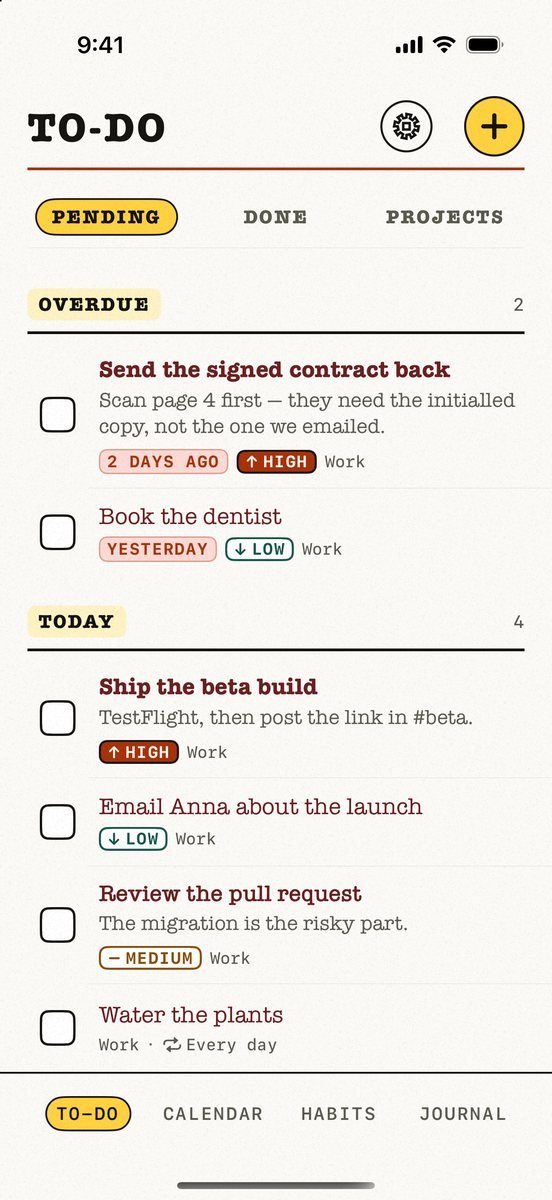
- Best for
- Keeping the journal in the same app as your tasks, calendar and habits, with no account to create
- Highlights
- A journal, a to-do list, a calendar and a habit tracker in one native app, running on iPhone, iPad, Apple Watch, Apple Silicon Macs and Apple Vision, so the day you planned and the day you write about sit in the same place
- Entries sync through your own iCloud — there is no Kalend account, no sign-up and no server of ours holding your writing
- Offline-first: every feature works with no connection, and calendar events stay in the accounts you already use rather than being duplicated
- Free outright, with no paid tier to upgrade to and nothing gated behind a trial
- Pricing
- Completely free — no subscription, no premium tier and no ads; the only purchase is an optional tip
- Watch out
- Apple only — there is no Android version and no web version, and it needs iOS 18 or later. Because it syncs through your personal iCloud, there is no sharing and no collaboration of any kind: you cannot share a journal, share a list or assign a task to anyone else. It is also brand new, released on 17 August 2026, so it has no ratings, no reviews and no track record to check.
Day One
- Best for
- A long-running journal with photos, video and audio that follows you onto every platform you own
- Highlights
- End-to-end encryption listed on every tier, passcode and biometric lock, automatic backups, and the stated ability to export your data at any time
- Entries take photos and video; audio recording with transcription, drawings, handwritten entries made with Apple Pencil, a finger or a stylus, and PDF embedding and scanning are listed under the paid Silver tier
- Multiple journals with a daily prompt and prompt library, templates, tags, favourites, search filters, a map view, streaks and an On This Day view
- Export to PDF and plain text, printed books, and imports from Health and Siri Shortcuts, with the Strava, Zapier and IFTTT integrations sitting in the paid Silver tier
- Pricing
- Free Basic tier plus paid Silver and Gold subscriptions
- Watch out
- The free Basic tier is capped at one photo per entry and one device — syncing to a second device sits in the paid Silver tier, so an iPhone-and-Mac setup is a paid configuration rather than a free one. Audio recording and transcription, drawings and the third-party integrations are listed under Silver as well, so a good part of the feature list sits behind the subscription rather than in the free tier.
Apple Journal
- Best for
- Starting today on the iPhone you already have, with nothing to buy and no separate journal account to create
- Highlights
- Free on the App Store with no in-app purchases; the listing states iOS 17.2 or later on iPhone and iPadOS 17.2 or later on iPad, and the description says entries sync between iPhone, iPad and Mac
- Journalling suggestions created using on-device intelligence, grouping outings, photos, workouts and media into moments you can start an entry from, with a choice of what information is enabled for suggestions
- Entries hold photos, video, audio recordings and places, plus content from apps such as News, Music and Safari; state of mind is logged to the Health app and writing time is saved automatically as Mindful Minutes
- Locks with Face ID, Touch ID or your device passcode, and an Insights view shows journalling streaks, the days you journaled and other stats
- Pricing
- Free, with no in-app purchases listed
- Watch out
- It stops at Apple's ecosystem — no Android, no Windows, no web — so entries do not travel to a non-Apple phone or a work PC. Apple also states that Journal entries are not included in unencrypted iPhone backups, so a routine backup will not contain them unless you make an encrypted backup, which Apple says requires a Mac or a PC. Export is either the whole journal at once as a ZIP from Settings, or individual entries saved as PDFs to Files or printed — there is no interchange format aimed at moving into another app.
Grid Diary
- Best for
- People who stall at a blank page and want a page of prompts laid out in a grid
- Highlights
- Prompted journalling from a question library, or prompts you write yourself, arranged in a customisable grid
- A nine-grid Mandala-inspired layout, with day, week, month and year dimensions for planning and review
- Exports your diary in PDF, MD, JPG and other formats, and supports importing and exporting templates
- Health app integration that can insert steps or activity energy into an entry and save journalling time as meditation minutes, with passcode lock and extra colour themes in the paid membership
- Pricing
- Free download with monthly and annual subscription options
- Watch out
- Sync between devices, passcode lock and the extra colour themes sit inside the paid membership, so the free version is effectively a single-device diary. The grid is also the whole idea here — if what you want is a long unstructured paragraph about your day, the structure works against you rather than for you.
stoic.
- Best for
- Guided reflection where the prompts, check-ins and breathing exercises do the structuring
- Highlights
- Guided journals, suggestions and prompts across topics including productivity, gratitude and stress
- Daily mood and emotion check-ins feeding a Trends section, with Apple Health integration for mindful minutes and sleep
- Meditations, breathing exercises and sleep guidance sit alongside the writing rather than in a separate app
- iCloud sync across devices, passcode and biometric protection, and export intended for sharing with a therapist
- Pricing
- Free to journal, with premium and AI subscriptions and a lifetime option
- Watch out
- The structure is the product. Morning and evening prompts, quotes and check-ins shape what you write, which suits some people and gets in the way for anyone who just wants a dated blank page. The listing also sells separate premium and AI subscriptions on top of the free journalling, so read which one you are buying.
Reflectly
- Best for
- A short guided daily check-in with follow-up questions based on what you wrote
- Highlights
- Describes itself as a journal using artificial intelligence to help you structure and reflect on daily thoughts and problems
- Mood tracker that surfaces mood correlations and graphs over time
- Personalised follow-up questions drawn from your own entries rather than a fixed prompt list
- Daily, weekly and monthly overviews with insights and reminders
- Pricing
- Free with an auto-renewing subscription and a trial period
- Watch out
- It is built around a short guided check-in rather than free-form writing, so it is a poor fit if you want to type several paragraphs. The subscription auto-renews unless it is cancelled at least 24 hours before the period ends, which the listing spells out, so a trial you do not want needs cancelling deliberately.
What is still missing
The feature this category tends to charge for is sync, which is worth knowing before you start writing. Day One's free Basic tier allows unlimited entries and unlimited journals but only one device and one photo per entry, and its pricing page lists journalling across all your devices under the paid Silver tier. Grid Diary puts syncing between devices inside its membership, so the free version is effectively a single-device diary. stoic. and Reflectly both let you write for nothing and sell subscriptions on top. Apple Journal sits apart from that pattern: the listing shows no in-app purchases, and its description states that entries sync between iPhone, iPad and Mac. If a journal with no subscription at any point is what you are after, that is the subject of a separate post of ours at /blog/free-private-journal-apps-iphone/.
For the two apps this page is actually about, the decision comes down to where the entries live and how they get out. Day One's listing covers export to PDF and plain text plus printed books. Apple's own support pages describe either the whole journal at once as a ZIP from Settings, or, on iOS 18 or later, individual entries saved as PDFs to Files or printed. Neither is a format you would move between apps casually, so the platform question decides it: Day One runs on Android, Windows and the web as well as Apple devices and charges a subscription for the multi-device sync that makes that worth having, while Apple Journal charges nothing and, per its description, syncs between iPhone, iPad and Mac. Pick the way you would pick a filing cabinet — assume you will be in it for years, on whatever devices you own by then.
The last gap is the sign-up itself. Several of these apps want an account before you have written a sentence, and an account means a company server holding your diary. Kalend, ours, takes the other route: entries sync through your own iCloud, there is no Kalend account, and the journal sits next to your tasks, calendar and habits rather than in a separate app. The cost of that design is real and worth stating plainly — there is no Android or web version, personal-iCloud sync means there is no sharing or collaboration at all, and it is brand new, released on 17 August 2026, so it has no ratings and no track record to check. If you need your journal on Windows or Android, Day One is the honest answer on this page.
Common questions
Is Day One better than Apple Journal?
It depends on one thing: whether you need your journal off Apple devices. Apple Journal is free with no in-app purchases and, per its App Store description, syncs between iPhone, iPad and Mac, so if those are the only devices you use you are already covered. Day One earns its subscription if you want the same journal on Android, Windows or the web, or if you want more than one photo per entry — Day One's free Basic tier is limited to one photo per entry and one device, and its pricing page lists journalling across all your devices under the paid Silver tier.
Can I keep using Day One's free tier on one device indefinitely?
Yes. Day One's pricing page lists Basic as the free tier, with unlimited journal entries, unlimited journals, end-to-end encryption, the daily prompt and prompt library, journal templates, and search and filters — on one device, with one photo per entry. What is not in it is the part most setups need next: journalling across all your devices, audio recording and transcription, drawings, PDF embedding and scanning, and the Strava, Zapier and IFTTT integrations are all listed under Silver. So a free single-device Day One is a genuine option; a free two-device Day One is not.
Does Apple Journal have journalling prompts, and how much control do I have over them?
Yes, and they are central to the app rather than an add-on. The App Store description invites you to "choose from suggested moments" to start an entry, with outings, photos, workouts and media grouped using on-device intelligence, and it states that you choose what information you want to enable for suggestions — so the material feeding the prompts is under your control, and you can still start an entry yourself. Day One handles the same problem differently: its free Basic tier includes a daily prompt and a prompt library, and its Gold tier adds AI-written prompts and summaries.
Can I move my Apple Journal entries to another app?
Yes, in two ways. Apple provides an export in Settings — open Settings, tap Apps, tap Journal, then Export All Journal Entries, which collects everything, including photos, locations and other media, into a single ZIP file. On iOS 18 or later you can also save individual entries as PDFs in the Files app, or print them. Separately, Diarium's App Store listing advertises importing directly from Apple Journal, alongside Day One, Diaro, Journey, Daylio, Diarly, Daybook and Evernote, if you want your history to land inside another journal rather than in a folder.
Does Apple Journal work on iPad and Mac?
Yes. The App Store listing shows Journal on iPhone and iPad, requiring iOS or iPadOS 17.2 or later, and its description states that entries sync between iPhone, iPad and Mac over iCloud. There is no Android, Windows or web version, so it is not a route to reading your diary on a work PC. One thing worth knowing before you rely on it: Apple notes that Journal entries are not included in unencrypted iPhone backups, so a standard backup will not contain them unless the backup is encrypted.
Published · Updated · No affiliate links








 MMA.
MMA. Trending
 Bold
Bold Top
Top