Disclosure: Kalend is ours.
Short answer
Our pick is Kalend — a diary that sits next to the rest of your day. Free — no subscription, no ads, no paid tier; the only purchase is an optional tip. The closest alternatives are Apple Journal, Diarium and Day One. All 9 are compared below, each with a stated drawback.
Search for a free journal app and the lists quietly mix three things: apps that are free forever, apps that are free for a fortnight, and apps you buy once. All three get filed under "free", because all three cost nothing at the moment you tap Get.
So every entry here carries a tag — free (no paid tier exists), one-time (you buy it and own it) or freemium (a free tier with a subscription above it) — and it sits in the table rather than buried in the prose.
The question those lists never answer is the one that matters later: if you stop paying, can you get your entries out, and in what format? Three years of a diary is not something you re-type. Every entry below states its export format, and a few are worse than the marketing suggests.
A journal is also the most sensitive file on your phone — more revealing than the photos, because it is the part you did not say out loud. Where it lives, and whether it locks, deserves more thought than it gets.
At a glance
| App | Best for | Cost model | Entries come out as |
|---|---|---|---|
| Kalend (ours) | A diary that sits next to the rest of your day | Free, no paid tier | Nothing documented |
| Apple Journal | Already on the phone, and free forever | Free, no paid tier | PDF and print |
| Diarium | The deepest feature set you can buy outright | One-time Pro unlock | DOCX, text, HTML, JSON |
| Day One | The free tier worth taking seriously | Freemium, annual tiers | CSV and JSON — free tier |
| Journey | The same diary on every platform | Freemium, four ways to pay | DOCX and PDF |
| Daylio | Logging a day in seconds rather than sentences | Freemium, one-off option | CSV and PDF |
| How We Feel | A non-profit app with no paid tier at all | Free, no paid tier | CSV, re-importable |
| Obsidian | Entries as plain files you already control | Free for personal use | Already Markdown files |
| iA Writer | Buy the writing tool once and own it | One-time, no free tier | DOCX, PDF, HTML |
The apps in detail
Kalend
Ours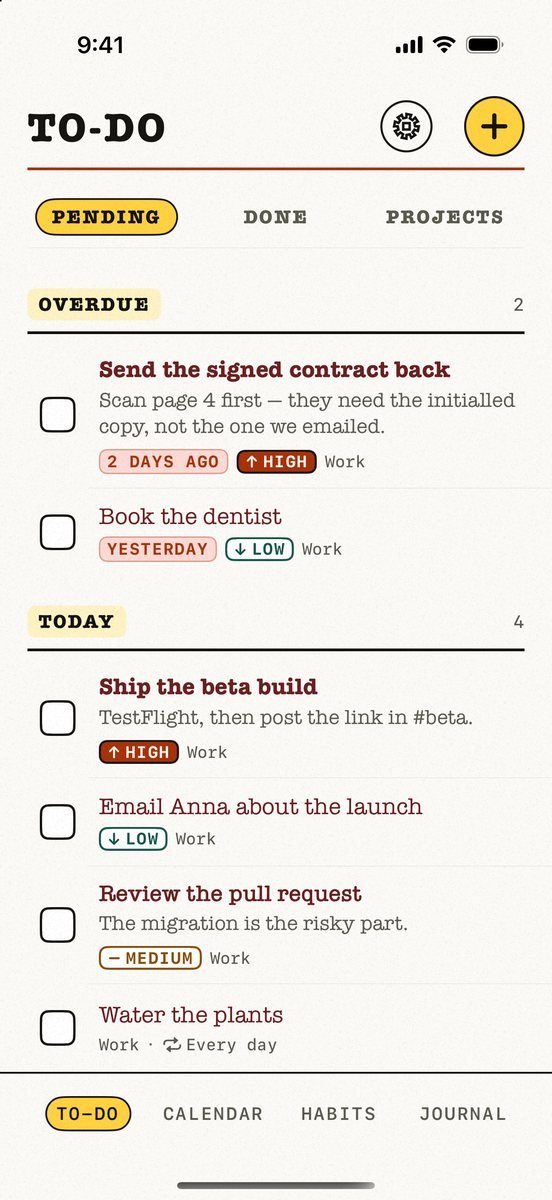
- Best for
- A diary that sits next to the rest of your day
- Highlights
- A private diary with live bold and italic, month browsing and search
- Four tabs — To-Do, Calendar, Habits, Journal — in one app
- Syncs through your own iCloud: no account, no server of ours, no analytics
- Apple Watch app, widgets and Siri Shortcuts
- Pricing
- Free — no subscription, no ads, no paid tier; the only purchase is an optional tip
- Export
- Nothing documented — we do not currently advertise one
- Watch out
- Brand new: Kalend was released on 17 August 2026, so it has no ratings and no reviews yet. The journal is text only, there is no Android or web version, no collaboration features, no natural-language email capture, and the habit statistics are deliberately simple.
Apple Journal
- Best for
- Already on the phone, and free forever
- Highlights
- Sold by Apple, with no in-app purchases at all
- Photos, video, audio with transcription, sketches and mood logging
- Passcode, Touch ID or Face ID lock; end-to-end encrypted through your iCloud
- A documented save-as-PDF or print route for an entry
- Pricing
- Free — no paid tier, no in-app purchases, ships with iOS
- Export
- PDF and print
- Watch out
- Bound entirely to Apple's ecosystem — no Android, no Windows, no web. And the documented way out is PDF and print: fine as an archive, awkward if you want the entries editable elsewhere.
Diarium
- Best for
- The deepest feature set you can buy outright
- Highlights
- Developer Timo Partl states it plainly: Pro is one-time, with no subscription
- Exports DOCX, plain text, HTML and JSON — the widest range here
- Syncs via your own OneDrive, Google Drive, Dropbox, iCloud or WebDAV
- Photos, audio, attachments, templates, tags, map views and a Face ID lock
- Pricing
- Free to start, then a one-time Pro unlock — charged per platform, not per month
- Export
- DOCX, plain text, HTML and JSON
- Watch out
- Cloud sync, Word export, widgets and unlimited attachments all sit behind the Pro unlock, so the free version is a trial rather than a free tier. And Pro is licensed per platform, so an iPhone and a Mac means buying it twice.
Day One
- Best for
- The free tier worth taking seriously
- Highlights
- The free Basic tier allows unlimited entries, though only one journal
- End-to-end encryption included free, which most rivals hold back
- A structured CSV or JSON export on the free tier
- Prompts, templates, search, tags, streaks and On This Day, all free
- Pricing
- Free tier with paid annual Silver and Gold subscriptions above it
- Export
- CSV and JSON, both on the free tier
- Watch out
- The free limit is not the writing, it is the device count: Basic works on one device, so an iPhone and an iPad cannot sync without subscribing. Free entries are also capped at one photo each.
Journey
- Best for
- The same diary on every platform
- Highlights
- Runs on iOS, Android, Mac, Windows, web and Chrome OS
- Exports DOCX and PDF; syncs via Google Drive or a self-hosted destination
- End-to-end encryption offered on Journey Cloud Sync
- Supports iOS Journaling Suggestions; paid tiers raise the media limit
- Pricing
- Free tier with monthly, annual, lifetime and one-off Premium purchase options
- Export
- DOCX and PDF
- Watch out
- The free tier is thin where it matters — cross-device sync, daily reminders and most media attachments are membership features, leaving a single-device notepad. The pricing ladder is the most confusing here, and it is easy to buy the wrong one.
Daylio
- Best for
- Logging a day in seconds rather than sentences
- Highlights
- Log a day by tapping a mood and activity icons, writing nothing
- Stored locally on the phone by default; Google Drive backup is optional
- Exports CSV as well as PDF, and CSV still opens in a spreadsheet years later
- A one-off purchase sits alongside the subscriptions
- Pricing
- Free with a Premium tier, taken monthly or yearly, or bought outright once
- Export
- CSV and PDF
- Watch out
- A mood tracker with a notes field rather than a diary, and the writing surface is cramped. Worse for a privacy-led list: the PIN lock, the one thing that makes a journal private on a shared phone, is Premium-only.
How We Feel
- Best for
- A non-profit app with no paid tier at all
- Highlights
- From a non-profit, developed with Yale's Center for Emotional Intelligence
- The App Store listing shows no in-app purchases whatsoever
- Data stays on the device unless you opt into anonymised research sharing
- Exports as CSV and re-imports on a new device
- Pricing
- Free — no in-app purchases listed, no ads, no premium tier
- Export
- CSV, and it re-imports
- Watch out
- An emotional check-in rather than a diary — each entry is brief by design. Read the research opt-in before enabling it — it is the one setting that sends anything off the device.
Obsidian
- Best for
- Entries as plain files you already control
- Highlights
- Entries are plain Markdown files, so the export question disappears
- Its pricing page states free without limits, and no sign-up required
- No in-app purchases on iOS; sync free through an iCloud vault or Git
- Daily notes, backlinks, graph view, community plugins and themes
- Pricing
- Free without limits for personal use; Sync and Publish are optional subscriptions
- Export
- None needed — the files were never inside anything
- Watch out
- Not a journal app but a notes system you assemble into one: anyone expecting to open it and start a diary meets an empty vault and a plugin list. Setup on mobile is real work, and the free route means configuring iCloud or Git sync yourself.
iA Writer
- Best for
- Buy the writing tool once and own it
- Highlights
- No in-app purchases at all — the purchase is the whole product
- Plain text and Markdown, so each entry outlives the app itself
- Files sit in iCloud, searchable and backed up outside the app
- Exports DOCX, PDF and HTML, and publishes to WordPress or Medium
- Pricing
- Paid once — one up-front App Store purchase, no in-app purchases, no subscription; check the current price on the App Store listing
- Export
- DOCX, PDF and HTML, and the source is plain text anyway
- Watch out
- No free tier and no trial on iOS, so you pay before knowing whether you like it — the opposite of every other entry here. And it is a writing app, not a journal: no calendar view, no month browsing and no entry lock.
The bit nobody tests: leaving
Read the nine entries and a pattern falls out. The apps asking least of your wallet have the best answer to "how do I get out" — Obsidian and iA Writer because the entries were never locked inside anything, How We Feel and Daylio because CSV is boring and permanent. The most polished options have the worst: Journey exports only DOCX and PDF, and Apple leans on print.
Day One is the honourable exception: encryption and a full CSV or JSON export both sit on the free tier, so you can write in it for five years, never pay a penny, and still walk away with everything.
Our own Kalend leads this list on price and privacy, but the export column is where it is weakest, and that matters more here than the missing photos. We do not advertise an export yet, so the honest description is that it suits someone who wants a text diary beside their tasks, calendar and habits — not someone building an archive to move in a decade. For photos and templates, Diarium does it better for one payment, and Apple's Journal does it for nothing.
Common questions
What is the best free journal app for iPhone with no subscription?
Apple Journal, for most people: already installed, no paid tier above it, and it handles photos, audio, sketches and a Face ID lock. How We Feel and Obsidian are the other two here with no paywall anywhere in them. Kalend is free with nothing held back too, but it is brand new, with no ratings yet.
Is the Apple Journal app free?
Yes, entirely. It ships with iOS 17.2 and later, and its App Store listing shows no in-app purchases at all, so there is no premium version waiting further down the road. The catch is not money — it is that the app exists only on Apple hardware.
Which journal apps store entries only on my device?
Daylio stores locally by default, with Google Drive backup optional. How We Feel keeps data on the device unless you opt into anonymised research sharing. Obsidian's entries are plain files in a folder you pick, and Kalend syncs through your own iCloud with no account. Day One and Journey use the vendor's cloud once sync is on.
What happens to my entries if I stop paying?
That depends on the export format, which is why every entry above states one. Diarium exports JSON, Day One gives CSV and JSON free, and Daylio and How We Feel export CSV. Apple's route is PDF and print, which archives well but is awkward to re-import. Obsidian and iA Writer never have the problem: the entries were plain files all along.
Is a one-time purchase better than a subscription for a journal?
Usually. A diary is not a service — nothing needs to run on someone else's computer for you to write about your day. Diarium and iA Writer can both be bought outright, and Daylio quietly offers a one-off purchase too. Check Diarium's small print first: Pro is licensed per platform, so an iPhone plus a Mac means paying twice.
What is a good alternative to the Apple Journal app?
Diarium is the closest full-featured replacement that never bills monthly, and it imports directly from Apple Journal. Day One suits you better if you want prompts, templates and polish. Journey makes sense if you might leave iPhone one day, and Obsidian if being locked in is the thing that worries you.
Do any of these work without creating an account?
Apple Journal uses your existing iCloud rather than a separate sign-up. Diarium syncs through your own OneDrive, Google Drive, Dropbox, iCloud or WebDAV with no Diarium account. Obsidian needs no sign-up at all, and Kalend has no account. Day One and Journey both require a vendor account before anything syncs.
Which of these lock, if someone else picks up my phone?
Apple Journal locks behind a passcode, Touch ID or Face ID, and Diarium offers a password, PIN, Face ID or Touch ID. Daylio has a PIN lock but keeps it behind Premium, which is an odd place for the one feature that makes a diary private. iA Writer has no entry lock at all.
Published · Updated · No affiliate links








 MMA.
MMA. Trending
 Bold
Bold Top
Top