Disclosure: Kalend is ours.
Short answer
Our pick is Kalend — someone who wants all four pillars in one free iPhone app and doesn't want to hit a paywall decision six weeks in. Free — no subscription, no ads, no paid tier; the only purchase is an optional tip. The closest alternatives are TickTick, Structured and Brite. All 9 are compared below, each with a stated drawback.
Search for an app that combines a to-do list, a calendar, habits and a journal and almost every result is published by a company selling one. That is not automatically dishonest, but it does explain a pattern: the free tier gets described in adjectives rather than numbers. "Generous free plan" is doing a lot of work when the actual number is three habits.
So this roundup leads with the numbers. Every app below is listed with what its free tier really caps and what the upgrade really costs, in one table, before you read a word of opinion. Bullet stops at three habits. TickTick stops at five and charges for the habit statistics. Brite's free plan will not show you a month view — in a planner. Those are the facts that decide whether an app works for you, and they are usually the ones buried furthest down the page.
The second thing worth being blunt about is which of the four pillars each app genuinely does. A task manager with a notes field is not a journal. A planner that reads your Apple Calendar is a calendar viewer, not a calendar. Three of the nine apps here have no journal at all, and one keeps the calendar behind the paywall — which matters, because those are frequently the two pillars people came looking for.
Prices below are what the developers themselves published as of today, 18 August 2026, in US dollars, since that is how most of these apps price regardless of where you live. Subscription pricing moves, so treat the figures as the shape of the deal rather than a quote. Where an app sells a one-time lifetime purchase as well as a subscription, we have said so, because for a planner you intend to keep for a decade that is usually the cheaper decision.
At a glance
| App | Pillars it really does | What the free tier caps | Price to lift the cap |
|---|---|---|---|
| Kalend (ours) | Tasks · Calendar · Habits · Journal | Nothing — there is no paid tier | Free |
| TickTick | Tasks · Calendar · Habits (no journal) | Calendar grid view is Premium; 5 habits, and habit statistics are Premium | US$3.99/month or US$35.99/year |
| Structured | Tasks · Calendar · Routines (no journal) | Calendar and Reminders sync is Pro, and so are recurring tasks; timeline, inbox, subtasks and widgets are free | US$6.99/month, US$29.99/year, or US$99.99 once |
| Brite | Tasks · Calendar · Habits · Mood diary | 3 habits, 5 projects, and no week or month calendar view | US$4.50/month, or US$3.29/month billed annually |
| Bullet | Tasks · Events · Habits · Notes | Habits limited (the developer indicates 3); no subtasks, repeats, tags, images or search | Subscription — the App Store lists yearly tiers from US$14.99 to US$35.99 — or a lifetime purchase |
| LiveIt | Tasks · Calendar · Habits · Journal | Planner, tasks, goals, habits and timeline are all in the free tier | About US$2/month or US$19.99/year, or a one-time lifetime licence |
| Lunatask | Tasks · Habits · Journal (calendar is paid) | 7 habits, 2 areas of life, and no calendar integration at all | About US$8/month, or US$6/month billed annually |
| Obsidian | All four, but only once you build them | Nothing — the core app has no feature caps | Free; optional paid Sync and Publish add-ons |
| Amazing Marvin | Tasks · Calendar · Habits (no journal) | There is no free tier — 14-day trial only | US$8/month billed annually (US$96/year) — the priciest here |
The apps in detail
The order below is not a ranking of quality. Our own app is first because publishing it in the middle would be a way of hiding it, and after that the list runs roughly from the apps most people will get on with to the ones that ask the most of you. Read the "watch out" line before the highlights — it is the part that decides whether an app is right for you, and it is the part every other roundup leaves out.
Kalend
Ours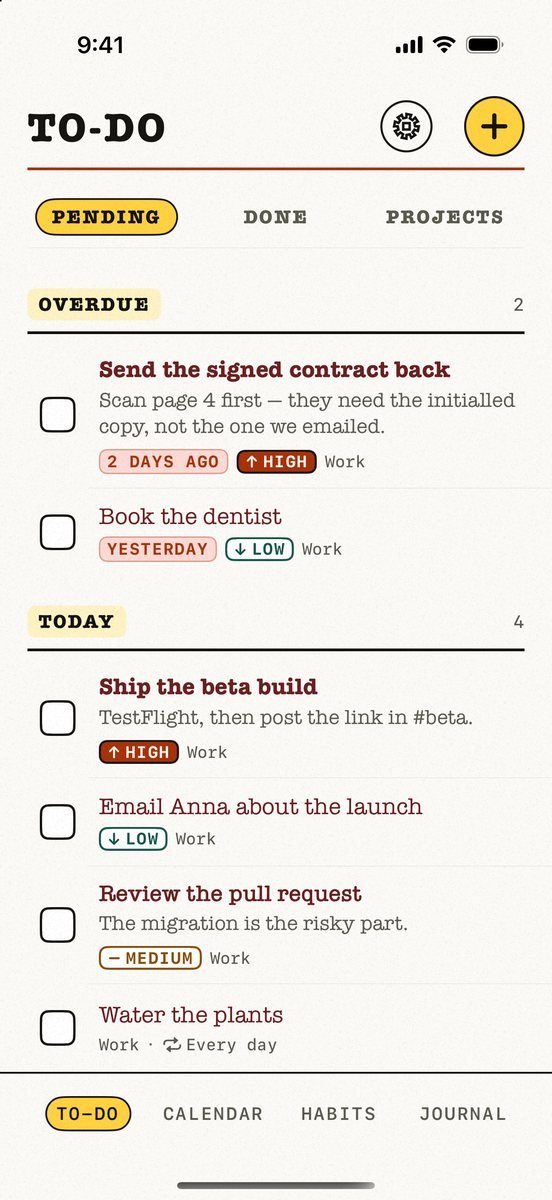
- Best for
- Someone who wants all four pillars in one free iPhone app and doesn't want to hit a paywall decision six weeks in.
- Pillars
- All four, and none of them a capped preview of a paid version.
- Highlights
- Four tabs, four pillars: To-Do, Calendar, Habits and Journal.
- The Calendar holds your own appointments inside the app; your Apple or Google events are an optional, opt-in, read-only overlay you switch on in Settings, so it isn't just a calendar viewer.
- Habits run on real schedules — daily, weekdays, N per week, every N days — with streaks that forgive an unscheduled day, a month history grid and a 365-day record strip.
- Journal is a private diary with live bold and italic as you type, month-by-month browsing and search.
- Apple Watch app, Home Screen and Lock Screen widgets, and Siri/Shortcuts App Intents; sync runs through your own iCloud — no Kalend account, no server of ours, no analytics.
- Pricing
- Free — no subscription, no ads, no paid tier; the only purchase is an optional tip.
- Platforms
- iPhone, iPad, Apple Watch, Mac (Apple Silicon) and Apple Vision, with widgets, Siri and Shortcuts. On the App Store since 17 August 2026; it needs iOS 18 or later.
- Watch out
- It only launched on 17 August 2026, so it is brand new, with no ratings, no reviews and no track record to weigh. Apple platforms only — no Android, no web. No team or sharing features, so you cannot share a list or hand a task to anyone; the habit statistics are deliberately simple, and there is no natural-language or email capture.
TickTick
- Best for
- People whose centre of gravity is the to-do list, who want a habit tracker close by rather than a diary.
- Pillars
- Three of four. Tasks are the point, the calendar and habits are real features, and there is no journal.
- Highlights
- The strongest task manager in this roundup: flexible recurring rules, Eisenhower matrix, subtasks, smart lists.
- Built-in calendar views including a yearly heatmap, plus a Pomodoro timer and countdowns.
- Habit tracker is genuinely part of the app, not a separate download.
- Syncs across iPhone, iPad, Mac, Apple Watch, Android and the web, so it survives a phone switch.
- Very heavily reviewed on the App Store — 4.9 from roughly 45,000 ratings, which is a real track record.
- Pricing
- Free tier plus subscription (the App Store listing today shows Premium at US$3.99/month or US$35.99/year).
- Platforms
- iPhone, iPad, Mac, Apple Watch, Android, web.
- Watch out
- Its calendar grid view and calendar subscriptions are Premium, so on the free plan you get a task manager with a habit list, not the combined planner this roundup is about. Habits are capped at five and their statistics are Premium too. There is no journal at all — the nearest thing is a description field on a task, which is not a diary. The free habit tracker stops at five habits and the habit statistics are Premium, so the pillar most people arrive for is the one that gets capped first.
Structured
- Best for
- People who think in a timeline rather than a list and want the day laid out hour by hour.
- Pillars
- Three of four, fused into one view instead of three tabs. No journal.
- Highlights
- Lays tasks, calendar events and routines on one visual timeline instead of three separate lists.
- Reads your existing calendars and Apple Reminders, so it plugs into what you already keep — though that sync is a Pro feature, not a free one.
- Habits and routines sit on the same timeline as everything else, which is why people actually do them.
- Free tier is generous for the task half of the app: timeline, inbox, subtasks, Pomodoro timer, Live Activities and interactive widgets.
- 4.8 from more than 160,000 ratings, plus an Apple Editors' Choice badge — this is the most-proven app on the list.
- Pricing
- Free with a paid Pro tier — the App Store listing today shows US$6.99/month, US$29.99/year, or a US$99.99 lifetime purchase.
- Platforms
- iPhone, iPad, Apple Watch, Mac.
- Watch out
- Calendar and Reminders sync — the thing that turns it from a list into a planner — is Pro-only, and so are recurring tasks, so the free version is a day timeline for tasks you enter yourself. It also covers three of the four pillars: there is no journal of any kind, so reflection means a second app. And because everything is a timeline block, it is poor at anything you want to see as a plain month grid or a long list.
Brite
- Best for
- Someone who wants tasks, calendar, habits and a mood journal in one place and is willing to pay for it.
- Pillars
- All four on the paid plan. On the free plan the calendar is half-present, since week and month views are Premium.
- Highlights
- Actually attempts all four pillars: tasks and projects, calendar, habit tracker and a mood diary in one app.
- Notes editor and a goal tracker sit alongside, so weekly planning happens without leaving the app.
- Habits carry colours, icons, priority flags and a Pomodoro timer on the paid plan.
- Available on iPhone, Android and the web, so it isn't a one-platform bet.
- Pricing
- Free with a paid tier — subscription, listed on Brite's own pricing page today at US$4.50/month or US$3.29/month billed annually (about US$39.50 a year).
- Platforms
- iPhone, iPad, Android, web.
- Watch out
- The free tier is tight in a way that bites early: three active habits, five projects, and — strangest of all — only the Schedule and Day calendar views. Week and month views are Premium, so the free version of a planner cannot show you a month.
Bullet: Journal, Daily Planner
- Best for
- Paper bullet-journal people who want the same rapid-logging idea on a phone.
- Pillars
- All four, but as four entry types in one running log rather than four separate tools.
- Highlights
- Built around the bullet journal method: to-dos, notes, events and habits as four entry types in one log.
- The notes are the journal — reflection is a first-class part of the app rather than a bolt-on.
- Runs on iOS, Android and the web, and the developer states plainly that user data is not for sale.
- A small indie app (Mui Studio) with a 4.7 rating, so it has direction rather than committee design.
- Pricing
- Free with a paid tier — the App Store listing shows yearly tiers from US$14.99 to US$35.99, plus a one-time lifetime purchase.
- Platforms
- iPhone, iPad, Android, web.
- Watch out
- Premium takes back a lot: subtasks, repeating tasks, tags, images and search are all paid — and a journal you cannot search is half a journal. The free tier also limits how many habits you can run at once (the developer's site indicates three). With only a few hundred App Store ratings, it is a genuinely small operation.
LiveIt (formerly Journal it!)
- Best for
- Journal-first people who want the planner built around the diary rather than the other way round.
- Pillars
- All four, weighted towards the journal — and the free tier includes all of them.
- Highlights
- The best journal in the roundup: a rich daily timeline with mood tracking and reflection prompts.
- Day planner with time blocking that syncs with Apple Calendar and Reminders.
- Tasks move through five stages, and habits and goals are separate trackers rather than one blurred feature.
- Works fully offline across iOS, Android, macOS and the web, syncing when it reconnects.
- Free tier includes the planner, tasks, goals, habits and timeline with no ads.
- Pricing
- Free with a paid tier — Pro is about US$2/month or US$19.99/year, plus a one-time lifetime licence sold on the App Store.
- Platforms
- iPhone, iPad, Android, macOS, web.
- Watch out
- It renamed itself from Journal it! to LiveIt, so most of the reviews and tutorials you will find online describe an app with a different name and a different interface — hard to research before committing. It is also the most feature-dense thing here: five task stages, goals, collections and trackers is a lot of scaffolding if you only wanted four tabs.
Lunatask
- Best for
- Privacy-minded people who want the journal and mood tracking encrypted end to end.
- Pillars
- All four on paper. On the free plan the calendar is absent, so it functions as three.
- Highlights
- End-to-end encrypted on every plan, free included — LiveIt is the only other app here that offers it, and only to Pro subscribers.
- Genuinely does all four: tasks, habit tracking with current and record streaks, a journal with templates and mood tracking, and notes.
- Journal and notebooks can be PIN-protected separately from the rest of the app.
- Task handling is opinionated in a useful way — Eisenhower matrix, work-in-progress limits, automatic prioritisation.
- Runs on iOS, Android, Windows, macOS and Linux.
- Pricing
- Free with a paid tier — subscription (about US$8/month, or US$6/month billed annually), no card needed for the free plan.
- Platforms
- iPhone, iPad, Android, Windows, macOS, Linux.
- Watch out
- Calendar integration is Premium-only — on the free plan the calendar pillar simply is not there, which is the one most people came for. Free also caps you at seven habits and two areas of life, and the interface is dense enough to need a weekend to learn.
Obsidian
- Best for
- People who would rather build their own system once than rent someone else's forever.
- Pillars
- All four, but every one of them is something you assemble rather than something you open.
- Highlights
- The core app is free with no feature caps — no habit limit, no task limit, no paywalled month view.
- Everything is plain-text Markdown in a folder you own, readable in fifty years without Obsidian.
- Daily Notes gives you the journal; community plugins add task management, a calendar view and habit tracking.
- iCloud vaults are supported on iPhone, so you can sync without paying for Obsidian Sync.
- Pricing
- Free for personal use; optional paid add-ons (Sync, Publish) that nothing else depends on.
- Platforms
- iPhone, iPad, Android, macOS, Windows, Linux.
- Watch out
- It is not an app that does these four things — it is a kit you assemble into one, and the plugin setup on an iPhone is fiddly and easy to break. Official Sync is a paid subscription; skip it and you are managing an iCloud folder and its conflicts yourself. Anyone who wants to open an app and just start is going to bounce off it.
Amazing Marvin
- Best for
- Power users — often ADHD users — who want to switch productivity strategies on and off until one sticks.
- Pillars
- Three of four, and the iPhone version is a companion rather than the full product.
- Highlights
- Built as a pile of toggleable "strategies" rather than one fixed workflow, so you can reshape it as your habits change.
- Habit and goal tracking, calendar sync and day planning are all first-party features, not integrations.
- ADHD-specific tools that nothing else here has: Super Focus Mode, Task Jar, Procrastination Wizard, accountability pledge.
- Runs on Mac, Windows, web, iOS and Android.
- Pricing
- Subscription only — US$8/month billed annually, or US$96 a year. No free tier, only a 14-day trial with no card required.
- Platforms
- iPhone, iPad, Android, Mac, Windows, web (the iOS app is a companion to the desktop app).
- Watch out
- There is no free tier at all — when the 14-day trial ends you either subscribe or lose access, and at US$96 a year it is the most expensive option in this roundup. The iOS app is an "On the Go" companion to the desktop app rather than the full product, and there is no real journal — day notes are the closest it gets.
What is still missing
Line the caps up and a pattern falls out. The pillar an app caps first is almost always the pillar it added last. TickTick is a task manager, so habits get the limit. Brite sells planning, so it paywalls the month view. Lunatask was built around private notes and encryption, so the calendar is the part you rent. Nobody caps the thing they are best at, which means the free tier is a fairly reliable map of what the company actually cares about.
There is also a gap nobody in this category has closed. Every app here treats the four pillars as four boxes sitting side by side; none of them makes the pillars talk to each other in a way that changes what you see. A missed habit does not become a task. A journal entry does not attach itself to the day it describes so you can find it later by looking at your calendar. Structured comes closest by putting everything on one timeline, and it pays for that by having no journal at all. Until someone joins them up properly, "all-in-one" mostly means "four apps sharing a login".
The other thing worth weighing is what you are handing over. Tasks are dull, a calendar is mildly revealing, but a journal plus two years of habit ticks — therapy, medication, drinking, sleep — is one of the more sensitive files you will ever create. Of the nine, only Lunatask encrypts it end to end on the free plan — LiveIt does it too, but only if you pay for Pro — and only Obsidian leaves it as files on disk you can read without the vendor.
Kalend is our answer to the caps question specifically: four tabs, all four pillars, no paid tier to reach, sync through your own iCloud rather than a server of ours. The honest cost of that is everything in its "watch out" above — it is brand new, with no ratings yet, it is Apple-only, and it has no collaboration and no natural-language capture. If you need something proven this afternoon, Structured has 160,000 ratings and an Editors' Choice badge, and it is the safer pick.
Common questions
What is the best planner app for iPhone?
Our pick is Kalend: tasks, calendar, habits and a journal in one free app, with no subscription, no ads and no paid tier. The closest alternatives are TickTick, Structured and Brite.
Is there a genuinely free app that combines a to-do list, calendar, habits and a journal?
Kalend is free with no paid tier at all, but it only launched on 17 August 2026, so it has no ratings and no track record yet. Obsidian's core app is free with no feature caps, but you assemble the four pillars yourself from plugins. Everything else on this list either caps a pillar on the free plan or has no journal to begin with.
Which of these apps genuinely does all four pillars, and which one is missing?
All four: Kalend, Brite, Bullet, LiveIt, Lunatask and Obsidian. Missing the journal entirely: TickTick, Structured and Amazing Marvin — a description field on a task or a day note is not a diary. Lunatask is the awkward case: it has all four, but the calendar is Premium-only, so the free plan is effectively three.
What does each free tier actually cap?
Brite caps three habits, five projects, and only the Schedule and Day calendar views. Bullet limits habits (the developer's site indicates three) and paywalls subtasks, repeating tasks, tags, images and search. TickTick caps five habits, puts habit statistics behind Premium, and — the one that matters most here — reserves the calendar grid view and calendar subscriptions for Premium too, so its free tier is a task list rather than a planner. Lunatask allows seven habits and two areas of life, and no calendar at all. Amazing Marvin has no free tier, only a 14-day trial.
Can I get an all-in-one planner without a subscription?
Three routes. Kalend has no paid tier to buy. Obsidian is free for personal use, with optional paid Sync you can skip by using an iCloud vault. Structured, Bullet and LiveIt each sell a lifetime purchase on the App Store, so you can pay once instead of monthly. TickTick, Brite, Lunatask and Amazing Marvin are subscription-only for their full versions.
Do these apps replace Apple Calendar, or just show it?
Most only show it. Structured, LiveIt and TickTick read your existing calendars, which means the event still lives in Apple Calendar or Google Calendar and the planner is a viewer. Kalend stores your own appointments inside the app and treats your Apple or Google events as an optional, opt-in, read-only overlay. Which behaviour you want depends on whether you already keep a calendar you trust.
Which one has the best journal?
LiveIt, by a clear margin — a rich daily timeline with mood tracking and reflection prompts, because the app was built around the diary. Lunatask is the choice if privacy is the point, since its journal is end-to-end encrypted and can be PIN-protected separately. Kalend's journal is plainer: live bold and italic while you type, month-by-month browsing and search, and nothing else.
Is one all-in-one app better than four separate apps?
Only if you actually use all four. A dedicated task manager will beat any all-in-one at tasks, and a dedicated journal will beat any all-in-one at journalling. The argument for one app is friction: four apps means four places to open, four sync setups and, usually, more than one subscription. If you only genuinely use two of the pillars, buy the best two apps instead.
What happens to my data if I stop paying?
Worth checking before you commit a year of entries. Obsidian is the safest answer, because your notes are plain Markdown files in a folder you own and remain readable without the app. Kalend stores everything in your own iCloud with no account of ours. With the subscription apps, expect to keep read access to existing data while losing the features that exceed the free caps — which for a planner can mean losing the month view or your habit statistics.






 MMA.
MMA. Trending
 Bold
Bold Top
Top