Disclosure: Kalend is ours.
Short answer
Our pick is Kalend — tasks, appointments, habits and a diary in one app rather than four, with no account anywhere. Free — no subscription, no ads, no paid tier; the only purchase is an optional tip. The closest alternatives are Apple Reminders, Things 3 and Due. All 8 are compared below, each with a stated drawback.
Search for a productivity app that does not require an account and you get back a wall of raw App Store listings, each promising some mix of three things: no account, works offline, collects no data. Those are not one idea. They are three separate promises, and an app can keep one while quietly breaking the other two.
No account means you can install it and use everything you paid for without creating a login — no email, no password, no "continue with Google". Works offline means it does its job on a plane, because the data sits on the phone. Collects no data is the strictest, and the one people wrongly assume follows from the other two. It does not: an app can need no login, run entirely offline, and still ship usage data, a device identifier and crash reports to somebody else on every launch.
So each entry below was checked against its App Store privacy label — the panel Apple makes every developer fill in — not the marketing copy. Labels are self-declared and change between releases, so treat them as a sworn statement rather than an audit. Each entry also says where the data physically sits — "your own iCloud" and "our servers" are very different answers.
At a glance
| App | Best for | Pricing |
|---|---|---|
| Kalend (ours) | Tasks, appointments, habits and a diary in one app | Free, no subscription |
| Apple Reminders | A task list and nothing else, with no second sign-up | Free, included with iOS |
| Things 3 | The best-made task manager on iPhone | Paid once, per platform |
| Due | Reminders and timers you genuinely cannot ignore | Paid once plus upgrade pass |
| GoodTask | Keeping data in Reminders with far better filtering | Free with a paid unlock |
| Streaks | Habit tracking with almost nothing collected | Paid once |
| Structured | Seeing the whole day as a visual timeline | Free with a paid tier |
| Obsidian | Building your own system in plain text | Free for personal use |
The apps in detail
Kalend
Ours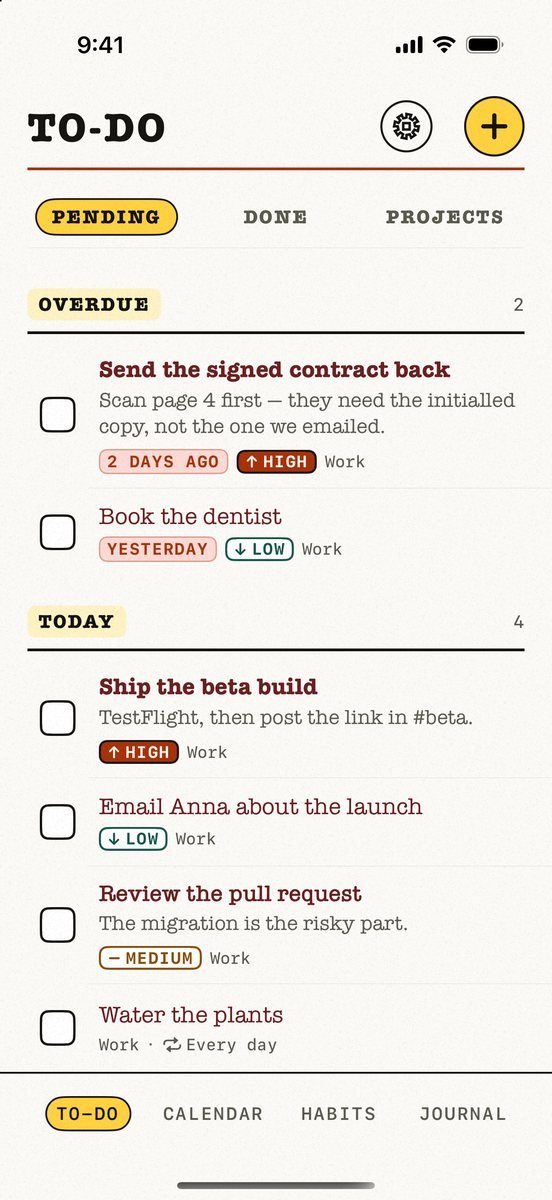
- Best for
- Tasks, appointments, habits and a diary in one app rather than four, with no account anywhere
- Platforms
- iPhone, iPad, Apple Watch, Mac and Apple Vision — Apple only
- Highlights
- Four tabs — To-Do, Calendar, Habits, Journal — so it replaces a stack rather than adding to it
- The Calendar stores your own appointments; Apple and Google events are an optional, opt-in, read-only overlay
- No Kalend account and no server of ours: sync runs through your own iCloud, and there is no analytics
- Habit schedules, forgiving streaks, a month grid and a 365-day strip, plus a Watch app, widgets and App Intents
- Pricing
- Free — no subscription, no ads, no paid tier; the only purchase is an optional tip
- Watch out
- Brand new: it reached the App Store on 17 August 2026, so there are no ratings and no reviews yet and no track record to judge it by. It needs iOS 18 or later. No Android or web version, no collaboration features, deliberately simple habit statistics, and no natural-language or email capture.
Apple Reminders
- Best for
- A task list and nothing else, with no second sign-up
- Platforms
- iPhone, iPad, Mac, Watch, Vision Pro, plus iCloud.com
- Highlights
- No separate account — it uses the Apple Account already on the phone
- Fully local if you want: switch iCloud sync off and nothing leaves the device
- Lists, sub-tasks, due dates, location reminders, Siri and widgets built in
- Its own label is not blank either: User Content and a user ID declared as linked to you, plus usage data for analytics that is not
- Pricing
- Free, included with iOS
- Watch out
- The app every other task manager here was built to escape: filtering and review are thin, and local-only really is local-only — no backup, no second device.
Things 3
- Best for
- The best-made task manager on iPhone, if a free sync account is acceptable
- Platforms
- iPhone, iPad, Mac, Watch and Vision Pro — Apple only
- Highlights
- Works completely on one device with no account; the sign-up only appears for sync
- Actively maintained: 3.22 is the current release, updated within the last few weeks
- Paid once, with no subscription and no in-app purchases on the listing
- Pricing
- Paid once, and bought separately for each platform
- Watch out
- The label is not the clean one people assume: User Content is declared linked to your identity, because Things Cloud holds your to-dos on their servers. Cultured Code's own pages say encryption at rest does not shield data from authorised employees. Three platforms, three purchases.
Due
- Best for
- Nagging reminders and timers you genuinely cannot ignore
- Platforms
- iPhone, iPad and Apple Watch, with a separately purchased Mac app
- Highlights
- The listing says it plainly: no account to sign up for, and the developer cannot access your reminders
- Sync, if you want it, runs over your own iCloud or Dropbox
- Auto-snooze re-nags at intervals until you actually mark the thing done
- Pricing
- Paid once, with an optional annual upgrade pass
- Watch out
- The label is not empty: usage data for analytics, plus crash and diagnostics, not linked to you. The pricing catches people out too — feature updates run on that annual pass, and the Mac app is another purchase. It is a reminder app, not a planner.
GoodTask
- Best for
- Keeping data in Apple Reminders while getting far better filtering and views
- Platforms
- iPhone, iPad, Apple Watch and Mac (Mac sold separately)
- Highlights
- No GoodTask account exists — it reads and writes Apple's own Reminders and Calendars
- Uninstall it and every task is still in Apple's app — no export to negotiate
- Smart lists, quick actions and templates give you the filtering Reminders never grew
- Pricing
- Free to use, with a paid unlock for the full feature set
- Watch out
- A front end inherits Apple's limits, and sync problems are usually iCloud's to fix. The label is busier than the local-first framing suggests: purchases, identifiers, usage data and diagnostics, with analytics among the purposes — and it is the one entry here we could not verify end to end.
Streaks
- Best for
- Habit tracking, with the cleanest privacy label of any paid app here
- Platforms
- iPhone, iPad, Apple Watch and Mac
- Highlights
- The label declares crash data only, not linked to you — no analytics, no identifiers
- Sync runs through your own iCloud; there is no Streaks account to create
- Paid once with nothing listed on top; Health data ticks some habits off
- Pricing
- Paid once, with no in-app purchases listed
- Watch out
- It caps the number of tracked tasks on purpose — philosophy, not a bug. Habits only: no projects, no calendar, no notes. And iCloud-only sync means no Android, no web and no sharing.
Structured
- Best for
- Seeing the whole day as a single visual timeline
- Platforms
- iPhone, iPad, Apple Watch and Mac, plus a browser-based web app
- Highlights
- No account required to use it — the developer's own help pages confirm sign-up is optional
- iCloud sync is the default on Apple devices
- Structured Cloud, the part that wants an email address, is opt-in
- Structured Web puts the same timeline in a browser — the only way it leaves Apple hardware
- Pricing
- Free with a paid tier — subscription or a one-time lifetime unlock
- Watch out
- The clearest case of the promises coming apart. The label declares Email Address and User Content as linked to your identity, plus purchase history, a user ID, usage and crash data. Turn Structured Cloud on and your schedule moves to the developer's servers, and the useful features are behind the paid tier.
Obsidian
- Best for
- Building your own system in plain text, for the strongest data-ownership story here
- Platforms
- iPhone, iPad, Mac, Windows, Linux and Android
- Highlights
- The only fully empty privacy label here: the developer collects no data from this app
- Every note is a Markdown file in a folder you control
- No account at any point, including sync via your own iCloud vault or Git
- Community plugins turn it into a planner, a task manager or a habit log
- Pricing
- Free for personal use, with an optional paid sync subscription
- Watch out
- It is not a task app. Out of the box it is an empty folder, and building a planner from it means choosing plugins and maintaining them yourself. Obsidian Sync is a subscription, and personal-use-free carries commercial licensing conditions.
What the labels actually show
Line the eight up and the promises separate cleanly. All eight start without an account, and all eight work offline. On collection the field splits: Obsidian declares nothing, Streaks declares crash data alone, and Reminders, Due, GoodTask and Structured each declare a list that would surprise anyone who read only the listing — Structured most of all.
The second split is your iCloud versus somebody's server. Reminders, Kalend, Due, GoodTask, Streaks and Structured take the first route, so the developer never holds the container. Things takes the second, and Cultured Code is unusually straight that encryption at rest does not put data beyond authorised staff.
Choosing is mostly a question of scope. Want a list? Reminders, or GoodTask on top of it. Want to be nagged? Due. Want to own the files outright? Obsidian, accepting that you build the app yourself. Kalend is for the narrower case where four apps have become tiresome — and its honest cost is no track record, no Android or web, and no exit from Apple.
Common questions
Which iPhone productivity apps genuinely require no account?
Apple Reminders, Kalend, Due, GoodTask, Streaks and Obsidian have no account of their own. Things 3 is account-free on one device. Structured works without one, but its optional cloud account is what unlocks the web app.
Is no account the same thing as no data collection?
No, and that is the trap. An app can need no login, run offline and still send analytics, an identifier and crash reports every launch. Due, GoodTask and Structured all declare collected data; only Obsidian's label is empty.
What is the most private to-do list app on iPhone?
By the labels, Obsidian collects nothing and Streaks declares only crash data. Kalend collects nothing either, though we are not the ones to grade our own app. For a plain list, Reminders with iCloud sync off never leaves the phone.
Do these apps work offline with no signal?
All eight do, because each stores its data locally. What differs is afterwards: six sync through your own iCloud, Things uses its own Things Cloud, and Obsidian syncs however you configure it.
Can I sync iPhone to iPad without creating an account?
Yes, if the app uses your own iCloud rather than the developer's server. Reminders, Due, GoodTask, Streaks and Structured all do. Kalend uses your iCloud too, and its iPhone, iPad, Watch, Mac and Vision apps all sync through it. Things is the exception: its sync needs a free Things account.
What happens to my tasks if the developer disappears?
With Obsidian, nothing — the notes are Markdown files in a folder you control. With GoodTask nothing either, because the tasks live in Reminders. Apps with their own database need an export; check one exists.
Is Apple Reminders good enough on its own?
For a lot of people, yes. It is already there, uses the Apple Account you have, and handles lists, sub-tasks, due dates and location reminders. The usual reasons to leave are weak filtering and review.
Which of these still works if I switch to Android?
Obsidian, and only Obsidian: it runs on Android with the same plain-text files. Structured's apps are Apple-only, though its opt-in cloud account gets you a browser-based web app, which puts your schedule on the developer's servers. Everything else here is Apple-only.
Published · Updated · No affiliate links




 MMA.
MMA. Trending
 Bold
Bold Top
Top