Disclosure: Kalend is ours.
Short answer
Our pick is Kalend — writing the line straight after you tick the habit that reminded you to write it. Free, with no paid tier or subscription; the only purchase is an optional tip. The closest alternatives are Apple Journal, Quick Journal and Inkwell. All 9 are compared below, each with a stated drawback.
Three abandoned diaries is not a discipline problem, it is a bar problem: the entry you pictured was always longer than the entry you had time for. So this list screens on friction rather than on features. How fast does a blank entry open, is there a prompt waiting when your head is empty, and how much does the app ask you to decide before it lets you type? Kalend is ours. We built it, and we have listed it first rather than sliding it in at number four and hoping you did not notice. It is judged on the same fields as everything else here and carries the same kind of drawback, because a roundup that flatters its own product is worth nothing to you.
The method matters more than the app, so here it is up front. Pick a length you would be embarrassed to call a diary entry, about one line. Attach it to something you already do every day without thinking, brushing your teeth or putting the phone on charge, so the writing has a fixed cue instead of a free-floating intention. And decide now that six words counts. "Long day, nothing happened, ate too much bread" is a real entry. The people who keep a diary for years are not writing more than that most nights, they are simply not skipping.
Because friction is the test, price is not the filter here. An app you pay for can win an entry if a blank page is two taps away, and a free one loses ground if it wants a mood, three tags and a photo before it will let you type. Read the watch_out on each entry as carefully as the highlights. Most of the things that end a journalling habit are in that column: a sync that only starts once you pay, a listing that will not tell you which half is free, or an app that turns out to be a wellness suite with a text box somewhere inside it.
At a glance
| App | Best for | Pricing |
|---|---|---|
| Kalend (ours) | Writing the line straight after you tick the habit that reminded you to write it | Free, with no paid tier or subscription; the only purchase is an optional tip |
| Apple Journal | Being handed something to write about before you have thought of anything | Free |
| Quick Journal | Opening straight onto a blank page with nothing to answer first | Free, with no in-app purchases listed |
| Inkwell | Starting the entry from the Home Screen, with no account and no connection in the way | Free download with Inkwell Pro in-app purchases sold monthly, annually and as a one-off |
| Daylio | Days when you are not going to type anything at all | Free download with paid Premium in-app purchases at several tiers |
| DayGram | A one-line habit that is never allowed to grow into a chore | Free download with a one-time Premium purchase |
| Grid Diary | People who stall on a blank page and need a question instead | Free tier plus a subscription |
| Stoic | Fixing the writing to a morning and an evening slot | Free tier plus in-app purchases |
| Finch | Wanting something to register that you turned up at all | Free tier plus in-app purchases |
The apps in detail
Kalend
Ours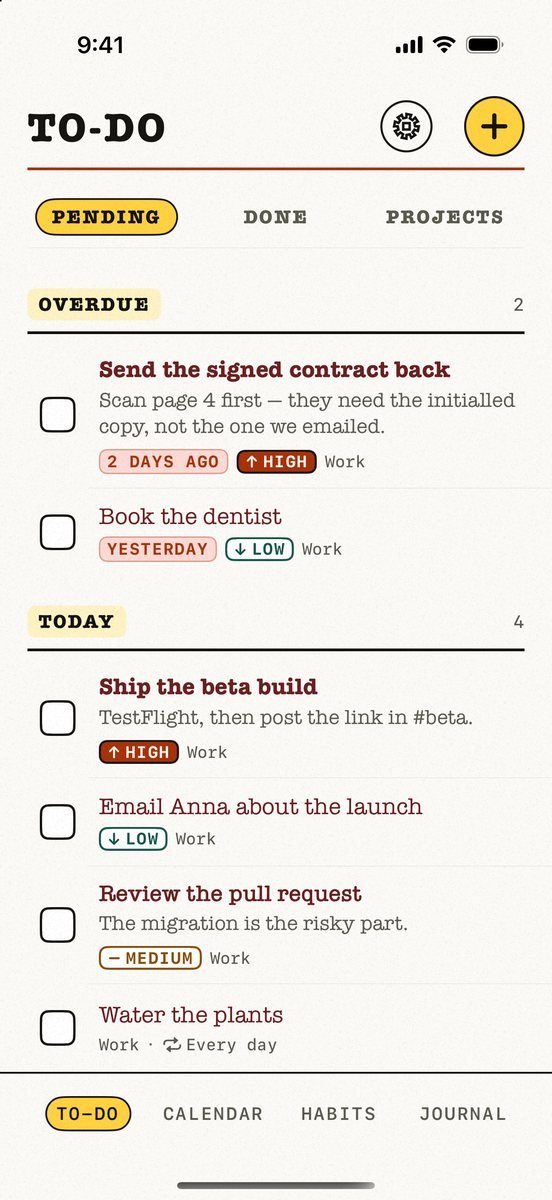
- Best for
- Writing the line straight after you tick the habit that reminded you to write it
- Highlights
- The journal sits in the same app as the habit tracker, so the daily habit you tick can be the cue for the entry rather than a separate reminder you learn to swipe away
- Home Screen and Lock Screen widgets put the app one tap from wherever you already are, and Siri handles "add task" and "log habit"
- Entries are plain writing with headings, lists and checkboxes, newest entry first, so a one-line day and a long one live in the same stream and read back like a book
- Described on its own page as "every feature is free", with no subscription, no premium tier and no ads; the only purchase is an optional tip, so nothing about the diary is held back until you pay
- Offline-first, and it syncs between your own devices through your personal iCloud with no Kalend account and no sign-up, so an entry written on a train is not waiting on a connection
- Pricing
- Free, with no paid tier or subscription; the only purchase is an optional tip
- Watch out
- Apple only, with no Android and no web version, so it cannot be your diary on a Windows laptop, and it needs iOS 18 or later. Because it syncs through your personal iCloud there is no sharing or collaboration of any kind, so a shared journal with a partner is impossible. It is also brand new, so there are no ratings, no reviews and no track record to judge it by yet.
Apple Journal
- Best for
- Being handed something to write about before you have thought of anything
- Highlights
- Journaling Suggestions let you "choose from suggested moments to start your journal entry with intelligently grouped outings, photos, workouts, media and more", which removes the blank-page decision entirely
- Reflection prompts are offered to "focus on gratitude, kindness, purpose, and more" when the suggested moments do not fit the day
- You can "set a schedule or receive notifications at convenient times", so the cue can be pinned to a time you already keep free
- Entries can be protected with your device passcode, Touch ID or Face ID, and the listing states they are stored in iCloud so they are automatically backed up
- Pricing
- Free
- Watch out
- The Insights view shows "journaling streaks, the days you journaled, and other fun stats", so a run of missed days is displayed back to you, which is the exact thing that ends some people's habit. It is also Apple-only and requires iOS 17.2 or later, so there is nothing to carry the diary over to if you switch phones.
Quick Journal
- Best for
- Opening straight onto a blank page with nothing to answer first
- Highlights
- The developer describes it as "the simplest way to keep a journal", and the composer is the whole product rather than a screen you reach through others
- You can customise "your journal's theme, fonts, app icon, layout, and even where the composer button is placed", so the tap that starts an entry can sit under your thumb
- Widgets are offered "to help you write or keep track of your entries", so the entry can begin from the Home Screen
- A half-finished thought is not lost: "You can always come back to an entry later by saving it as a draft, just swipe down and the entry will be saved", and the listing states the developer does not collect any data from this app
- Pricing
- Free, with no in-app purchases listed
- Watch out
- There are no prompts and no mood picker, so on a night when your head is empty the app hands you nothing at all — the blank page is the entire design, which is the point and also the limit. The listing does not mention a passcode or Face ID lock either, so the diary is only as private as the phone it sits on, and the customisation on offer is decoration rather than anything that helps you write.
Inkwell
- Best for
- Starting the entry from the Home Screen, with no account and no connection in the way
- Highlights
- The listing promises a "Home screen widget – start writing with one tap", and describes the writing itself as "Reflect in seconds – optimized for quick daily writing"
- Getting started is stripped back to "No registration. No verification. No internet connection needed.", so the first entry does not sit behind a sign-up
- Sync is optional and stays yours: "Your iCloud, your control – optional sync between your devices only", with "Full export" and Markdown support listed
- Mood tracking, gratitude prompts and "Smart reminders" are available when you want a cue, and the privacy section states the developer does not collect any data from this app
- Pricing
- Free download with Inkwell Pro in-app purchases sold monthly, annually and as a one-off
- Watch out
- The listing does not say which of the features it names sit behind Inkwell Pro, so what the free version actually includes is not clear until you have installed it, and Pro is sold as monthly, annual and lifetime purchases. The compatibility block lists iPhone, Mac and Apple Vision but not iPad. It is also a mood tracker and a prompt app as well as a diary, so there is more built around the writing than the one-tap widget suggests.
Daylio
- Best for
- Days when you are not going to type anything at all
- Highlights
- The core loop is "pick your mood and add activities", which the developer describes as a way to "keep a private journal without having to type a single line"
- Its own site puts the entry at "two taps – pick mood and activities", with notes, writing templates, photos and voice memos as optional extras rather than required fields
- Reminders are built in, and a PIN lock, fingerprint or Face ID can be turned on for the whole app
- Entries are stored locally on the device, with PDF and CSV export if you want the record out, and weekly, monthly or yearly charts built from what you log
- Pricing
- Free download with paid Premium in-app purchases at several tiers
- Watch out
- What you accumulate is mostly mood and activity data rather than sentences, so if you actually want to read your own writing back in a year you have to remember to add the note every time, and the app does not require it. Premium is sold as several in-app purchase tiers over the free version, though the free version is not time-limited — the listing carries the developer's own line "You don't require subscription to use it".
DayGram
- Best for
- A one-line habit that is never allowed to grow into a chore
- Highlights
- The whole premise is the one-line-a-day format, described by the developer as capturing "each day in one quiet line with a private, distraction-free E-Ink journal"
- The paper-like E-Ink style writing view is deliberately plain, so there is little to configure before you start typing
- Premium is a one-time purchase rather than a subscription, covering iCloud sync, themes and borders, multiple photos per entry, handwriting OCR and PDF export
- No ads, a password and Face ID lock, search across past entries, and the listing states it does not collect data
- Pricing
- Free download with a one-time Premium purchase
- Watch out
- iCloud sync, photo attachments, themes and PDF export all sit behind the Premium purchase, so the free version is a single-device diary with no backup across your other Apple devices. The one-line format is also the point, which means it is a poor fit on the occasional night when you do want to write at length.
Grid Diary
- Best for
- People who stall on a blank page and need a question instead
- Highlights
- The entry is a customisable grid of prompt questions rather than an empty box, so each cell is a small answerable thing
- A question library is included and you can "customize your own prompts for deeper self-reflection", so the prompts can be reduced to the two you will actually answer
- Daily, weekly, monthly and yearly templates, so a weekly review can carry the weeks you did not write anything
- Home screen widgets covering one to nine grid cells, which puts the questions in front of you without opening the app
- Pricing
- Free tier plus a subscription
- Watch out
- The grid asks several questions at once, which is more to fill in than a single line, and on a tired night that can read as a form rather than a diary. Membership is a subscription, so the full template and organisation set is an ongoing cost.
Stoic
- Best for
- Fixing the writing to a morning and an evening slot
- Highlights
- Built around a two-cue day: a personalised daily planner in the morning and a prompt to "reflect on your actions with our habit tracker in the evening"
- Guided journals with prompts across productivity, happiness, gratitude and stress, so the topic is chosen for you
- Entries can be text, voice notes or pictures, which covers the nights when typing is the thing stopping you
- You can "protect your journal with a passcode, TouchID, or FaceID", and entries sync across your devices through iCloud
- Pricing
- Free tier plus in-app purchases
- Watch out
- The app bundles meditation, breathing exercises, sleep tracking, dream journaling, affirmations and an app blocker around the diary, so there is a lot to walk past to reach a text box. It also keeps habit streaks, which makes a break in the routine visible.
Finch
- Best for
- Wanting something to register that you turned up at all
- Highlights
- Includes "guided bullet journaling prompts to clear the mind, track important moments", which is a smaller ask than an open diary page
- Mornings open with a quick mood check-in, so there is a low-effort action available on the days you will not write
- A goal tracker and guided breathing sit alongside the writing, so the app has something to offer when the words do not come
- Insights combine your mood tracker, bullet journal tags, goal tracker and quizzes, so short tagged entries still count towards something
- Pricing
- Free tier plus in-app purchases
- Watch out
- The diary is one part of a self-care pet game, so the writing arrives wrapped in a character, rewards and a set of exercises. If you want a plain text box with a date on it, that is a lot of surrounding structure to accept. Paid in-app purchases sit over the free tier.
What is still missing
The category measures the wrong thing at the wrong moment. Most of the defaults here are built for the entry you meant to write rather than the one you have thirty seconds for: Apple Journal opens with suggested moments assembled from your day, Grid Diary opens with a grid of questions, Stoic opens with a guided journal, Daylio opens with a mood scale. Each is defensible on a quiet Sunday and each is a step on a Tuesday night. Only three apps here treat the very short entry as the normal case rather than the fallback: DayGram, whose entire format is one quiet line a day, Quick Journal, which its developer calls "the simplest way to keep a journal", and Inkwell, which offers a "Home screen widget – start writing with one tap". Each pays for it somewhere. DayGram is a poor fit on the night you do want to write at length, Quick Journal hands you nothing when your head is empty, and Inkwell's listing does not say which parts of it are free. What is still missing is an app that treats the one-line night as the normal case and the long night as the exception, without giving up the rest of a diary to do it.
Prompts and mood pickers are worth separating from the writing itself. Daylio is explicit that its two-tap mood-and-activity entry is the product and the note is optional, which is honest and suits the nights you will not type. Grid Diary opens with a grid of questions, Apple Journal offers suggested moments, and Stoic frames the day as a morning slot and an evening one. All of those genuinely help someone who freezes on an empty page. The question to ask of any of them is whether the prompt is a door or a turnstile: can you reach a blank line without answering anything first? That is the difference that decides whether an app survives a busy month, and it is not something a feature list tells you — you find it out on the first tired night.
We have the same problem to declare. Kalend puts the journal next to the habit tracker precisely so the cue and the writing live in one place, and it is free with nothing held back, but there is no Android version and no web version, it has no sharing at all because it syncs through your own iCloud, and it is brand new, with no ratings and no track record yet. That last one matters for this particular post: if you are trying to restart a habit this week, you are taking our word for how the app behaves rather than anyone else's. Pick whichever app here you will actually open tonight, keep the entry to one line, and swap later if you want to. If price rather than speed is your actual question, we have gone through the ones that never ask for money in free journal apps for iPhone with no subscription.
Common questions
What do I write in a journal when nothing happened?
Write that nothing happened, in those words, and add one concrete detail from the day. What you ate, who you spoke to, what the weather did, what you were putting off. Uneventful days are most of a life and they are the ones you will have no memory of in five years, so they are arguably the ones worth recording. The instinct to skip an ordinary day is the main reason diaries die in week three, because it quietly teaches you that an entry has to be earned. If a blank page still stops you, use an app that offers a prompt, such as Apple Journal's reflection prompts or Grid Diary's question library, and answer only one question.
Is it better to journal at night or in the morning?
Whichever one you already have a fixed, unavoidable moment in. Night entries capture more detail because the day is finished, but they compete with tiredness, and a tired person writes nothing rather than something short. Morning entries are calmer and are usually about the day before, which loses some detail but gains reliability, and they suit people who are alert early. If you have tried and abandoned both, try attaching the entry to a physical routine instead of a time, so it happens after the teeth or after the kettle rather than at nine o'clock. Stoic is built around morning and evening slots if you want the app to hold the structure for you.
How long should a journal entry be if I have no time?
One sentence is a legitimate entry, and treating it as one is the whole technique. Six words written on 200 nights beats a page written on twelve. DayGram is built entirely on the one-line-a-day format if you want an app that will not let you feel the entry is too short, Quick Journal opens onto a blank composer with nothing to fill in first, and Daylio will accept an entry as two taps with no typing at all on the nights when even a sentence is too much. The point of keeping the bar this low is that the habit survives the bad weeks, and the long entries then appear on their own when you have something to say.
I have missed two weeks. Do I start again?
No, just write today's entry and leave the gap in place. Backfilling two weeks from memory is a large job that you will not do, and the plan to do it is usually what stops you writing tonight. A gap in a diary is information rather than damage. If your app shows a streak counter that makes the gap hard to ignore, that is a reason to consider a different app rather than a reason to feel you have failed: Apple Journal and Stoic both surface streaks, while Daylio's calendar and DayGram's one-line book show what you did write without counting what you did not. We have gone through which apps handle a broken run sensibly in habit trackers that forgive a missed day.
Are paid journalling apps worth it if I keep quitting?
Not usually as a first move, because paying for an app does not create the cue that the habit needs, and the sunk cost tends to produce guilt rather than entries. Start free. Apple Journal is free on iOS 17.2 or later, Quick Journal is free with no in-app purchases listed, and Daylio, DayGram, Inkwell, Grid Diary, Stoic and Finch all have free tiers you can test the habit on. Where paying does earn its place is once you have kept it up for a couple of months and hit a specific wall, usually sync across devices, export, or having the diary on a computer as well as a phone. Buy the fix for the problem you actually have.
Published · Updated · No affiliate links










 MMA.
MMA. Trending
 Bold
Bold Top
Top