Disclosure: Kalend is ours.
Short answer
Our pick is Kalend — keeping tasks, a calendar, habits and a journal in one place with no account to create. Free. No paid tier, no subscription and no ads; the only purchase is an optional tip. The closest alternatives are Tiimo, Structured and Sorted³. All 9 are compared below, each with a stated drawback.
Kalend is our app — we build it here at thebighead.ca — and we have listed it first. That is the disclosure, and it matters for how you read the rest: every app below is judged on the same three questions and written up with the same fields, including the field for what it cannot do. Kalend fails the first of those questions — it does not make time visible — and it cannot be shared with anyone at all; both are written out in its entry rather than buried at the end.
The three questions come from what people with ADHD report going wrong with planners, rather than from a feature checklist. The first is the wall of text: capture works, so everything goes in, and within a fortnight opening the app means reading forty lines before you can do anything. The second is invisible time. A due date tells you a task is today; it says nothing about today already having six hours committed elsewhere. The third is the collapse. One missed day breaks a streak, the streak was the reason to open the app at all, and the whole system goes with it.
So each entry below is judged on whether the app makes time visible, whether it can show one thing at a time instead of everything at once, and what it does on the morning after you miss. Features, platforms and pricing models come from each app's own App Store listing, help pages or website, and the source URLs are recorded against every entry. Prices move often enough that we describe the pricing model in words rather than quote a figure that will be wrong by the time you read it.
At a glance
| App | Best for | Pricing |
|---|---|---|
| Kalend (ours) | Keeping tasks, a calendar, habits and a journal in one place with no account to create | Free. No paid tier, no subscription and no ads; the only purchase is an optional tip. |
| Tiimo | Turning a day into something you look at rather than read | Free to download with a Tiimo Pro subscription for the full feature set. |
| Structured | Seeing the whole day as one timeline instead of a list of due dates | Free with a Structured Pro in-app purchase, offered monthly, yearly or as a one-off lifetime unlock. |
| Sorted³ | Rebuilding the day in a few gestures when the morning has already gone sideways | Free with an optional one-off PRO in-app purchase. The iOS and macOS PRO unlocks are sold separately, with a bundle available. |
| TickTick | A habit target that survives one bad day because it was never a daily target | Free plan plus a TickTick Premium subscription. An education discount is offered to eligible students and teachers. |
| Todoist | Getting a thought out of your head in the four seconds before it goes | Free Beginner plan, plus Pro and Business subscriptions. |
| Habitica | People for whom an external reward loop is the only reliable way to start | Free, with an optional subscription and optional in-app gem purchases. |
| Finch | Days when the realistic goal is getting out of bed, not clearing a project | Free with an optional Finch Plus subscription and a separate Guardian Program purchase. |
| Apple Reminders | A capture box that is already installed, already syncing and never needs setting up | Free. Included with iOS. |
The apps in detail
Kalend
Ours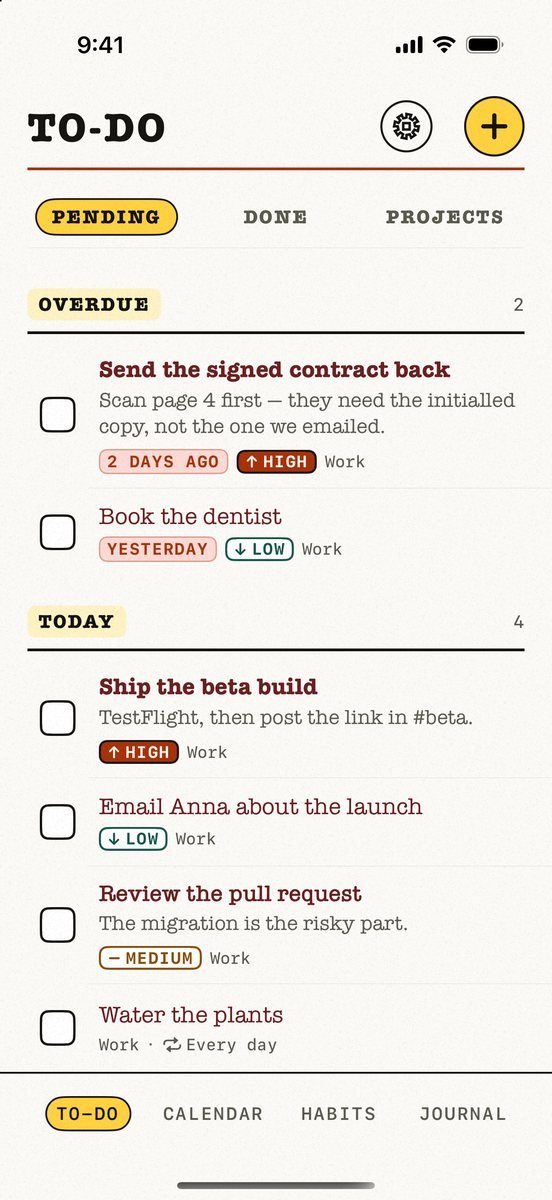
- Best for
- Keeping tasks, a calendar, habits and a journal in one place with no account to create
- Highlights
- Four tools in one app — tasks, calendar, habits and a journal — so a thought does not have to be routed to the right app before it can be written down
- Syncs through your own iCloud. There is no Kalend account, no sign-up and no server of ours holding your data
- Works fully offline, so the planner opens whether or not there is signal
- Free with no paid tier at all, so nothing you rely on can move behind an upgrade later
- It does not draw the day as a timeline — the calendar shows what is booked, but a task carries a date rather than a duration, so Kalend does not answer whether today has room for one more thing
- Pricing
- Free. No paid tier, no subscription and no ads; the only purchase is an optional tip.
- Watch out
- Apple platforms only — it runs on iPhone, iPad, Apple Watch, Mac and Apple Vision, but there is no Android version and no web version, and it needs iOS 18 or later. Because it syncs through your personal iCloud, there is no sharing and no collaboration of any kind: you cannot assign a task to anyone or share a list with a partner, a parent or a support worker. It is also brand new — version 1.0 arrived on 17 August 2026 — so there are no ratings and no reviews yet to judge it by.
Tiimo
- Best for
- Turning a day into something you look at rather than read
- Highlights
- The schedule becomes a visual timeline with colour-coded, drag-and-drop blocks rather than a list of due times
- Widgets and Live Activities keep the current timer and the next item on screen without opening the app
- An AI co-planner takes what you type or say, breaks it into steps and estimates time for each one
- A focus timer counts down the block you are in, and it syncs with Apple Calendar and Reminders so existing commitments show up
- Pricing
- Free to download with a Tiimo Pro subscription for the full feature set.
- Watch out
- Tiimo Pro is a recurring subscription rather than a one-off unlock, and the benefits Tiimo lists for Pro include unlimited AI planning and syncing with personal calendars — so calendar sync, one of the reasons to use it, sits on the paid side. The visual system also asks for setup time up front, choosing colours and icons, which is work at the exact moment you have least of it.
Structured
- Best for
- Seeing the whole day as one timeline instead of a list of due dates
- Highlights
- Tasks and calendar events land on a single visual timeline you can drag items around on, so a full day looks full before you agree to anything else
- Imports your existing calendar and syncs with Apple Reminders, which keeps the timeline honest about what is already booked
- Subtasks and notes let one large item be opened up into steps instead of sitting on the list undone
- A built-in focus timer runs Pomodoro-style intervals or the task's own duration, and accessibility options include VoiceOver, Voice Control and a dyslexia-friendly font
- Pricing
- Free with a Structured Pro in-app purchase, offered monthly, yearly or as a one-off lifetime unlock.
- Watch out
- It plans one person's day: neither the website nor the App Store listing describes shared or collaborative planning, so there is no way to hand an item to someone else. The timeline is also only as useful as the durations you give it, and estimating duration is the step most people skip.
Sorted³
- Best for
- Rebuilding the day in a few gestures when the morning has already gone sideways
- Highlights
- Tasks, calendar events and notes sit on one timeline, so there is a single place that answers what is next
- Auto Schedule works out what actually fits in the time left around fixed commitments, rather than leaving you to guess
- Magic Select is a gesture for moving a run of items at once, which is what a derailed day needs — not editing twelve rows one at a time
- Calendar events, tasks and notes are integrated into one timeline — the App Store listing describes formatted notes, attachments and drawings on any event or task, and iCloud sync across the Apple devices you use
- Pricing
- Free with an optional one-off PRO in-app purchase. The iOS and macOS PRO unlocks are sold separately, with a bundle available.
- Watch out
- Apple platforms only — no Android and no web — and PRO is purchased separately for iOS and for macOS, so using it on both means two unlocks. The App Store listing describes no collaboration or shared lists, so this is a system for planning one person's day. Auto Schedule also depends on you giving each task an estimated duration, which is the step most people skip.
TickTick
- Best for
- A habit target that survives one bad day because it was never a daily target
- Highlights
- Habits can be set to Daily on chosen weekdays, or to Weekly with a frequency, so 'three times this week' is a valid goal rather than a failed daily one
- TickTick's own write-up of the habit feature also describes checking off a habit on a past day, so a missed Tuesday can be filled in rather than left as a gap
- A Pomodoro timer is built into the same app as the tasks, so starting does not mean opening a second app
- Natural-language input picks up dates and times as you type, and calendar views run from a single day out to the year
- Pricing
- Free plan plus a TickTick Premium subscription. An education discount is offered to eligible students and teachers.
- Watch out
- Habits, focus timer, calendar views, the Eisenhower matrix and full task management all live in one app, which is a large surface to arrive at on a low-capacity day. Part of that surface sits behind Premium, so the free plan is not the whole thing.
Todoist
- Best for
- Getting a thought out of your head in the four seconds before it goes
- Highlights
- Quick Add reads a task written in ordinary language, including the date, so capture does not mean tapping through a date picker
- Today and Upcoming are separate views, which is the difference between seeing eleven things and seeing everything you have ever written down
- Filters, labels, priorities, sections and subtasks let one enormous list be cut into views small enough to act on
- Vacation Mode puts Karma on hold, and Todoist's help says that with it on you 'shouldn't have to worry about losing your Karma daily or weekly streaks' — a documented way to take time off
- Pricing
- Free Beginner plan, plus Pro and Business subscriptions.
- Watch out
- Todoist attaches dates to a list rather than laying the day out as time — the calendar layout is listed as a Pro feature, not a Beginner one. The free Beginner plan is capped at 5 personal projects and 3 filter views, which is restrictive if cutting the list into views is the thing that makes it usable for you.
Habitica
- Best for
- People for whom an external reward loop is the only reliable way to start
- Highlights
- Three separate task types — Habits, Dailies and To-Dos — so a repeating routine and a one-off errand are not competing for space on the same list
- A customisable avatar levels up as you complete tasks, with collectible gear and pets as rewards, and inclusive options including wheelchairs, hair styles and skin tones
- Parties let you team up with friends for accountability and fight foes by completing tasks, which puts other people between you and quietly dropping the app
- Guilds connect people with shared goals, and Challenges are shared task lists you can pull into your own
- Pricing
- Free, with an optional subscription and optional in-app gem purchases.
- Watch out
- Progress is displayed through colour-coded tasks and streak counters, so a bad run is shown back to you in the interface rather than absorbed by it — which is exactly the mechanic that ends a lot of systems. There is also a fair amount to configure before the first task gets done: three task types, an avatar, and a Party if you want the accountability part.
Finch
- Best for
- Days when the realistic goal is getting out of bed, not clearing a project
- Highlights
- The premise is that you look after a pet by looking after yourself, which moves the reward away from a number going up
- Daily check-ins combine a quick mood check, goal tracking, mood journalling, breathing exercises and short quizzes in one short session
- Guided bullet journalling prompts are there to clear the head and record moments, rather than to produce a task list
- Insights combine mood journalling, tags, the goal tracker and quiz answers into a picture of how the weeks are actually going
- Pricing
- Free with an optional Finch Plus subscription and a separate Guardian Program purchase.
- Watch out
- It is a self-care app with goal tracking attached, not a planner — there is no timeline, no calendar and no time blocking, so it will not tell you whether today has room for what you agreed to. Expect to run it alongside something else rather than instead of it, and the deeper content sits behind Finch Plus.
Apple Reminders
- Best for
- A capture box that is already installed, already syncing and never needs setting up
- Highlights
- Built-in Smart Lists such as Today gather what is due without you maintaining a view, and custom Smart Lists filter by tag, date, time, location, flag or priority
- Tags can be added to any reminder and appear as buttons in a tag browser at the bottom of the lists view, so one list can be sliced several ways
- Sections and subtasks break a list up, and a column view lets you drag an item from one section to another
- A list can be shared, and individual reminders can be assigned to a specific person you share it with, then reassigned or unassigned later
- Pricing
- Free. Included with iOS.
- Watch out
- There is no timeline and no duration field — a reminder is a due time, not a block of time — so the day stays invisible until a notification arrives, which is precisely the failure this list is about. Collaboration also requires everyone involved to be signed in to an Apple Account with Reminders switched on in iCloud, and some features are unavailable on non-iCloud accounts.
What is still missing
The category still treats a missed day as a data event rather than a design problem. Most of these apps record the gap accurately, and the accuracy is the problem: the interface shows the failure back to you every time you open it, on the one morning when what you needed was a way in. Very little exists in the way of a deliberate re-entry — no reduced view, no 'start from today', no reset that does not feel like destroying the evidence. TickTick's weekly frequency setting, which is documented on its own site, and Todoist's Vacation Mode, documented in its help centre, both address this directly, and both share a flaw: you have to configure them before the bad week, which is the week nobody is configuring anything.
Visible time is the second unsolved piece, and it is half solved at best. Timeline views do exist — Structured, Sorted³ and Tiimo are all built on one — but a timeline only tells you the truth if the app knows how long things take, and duration is the field people are worst at filling in. Apps that insist on it get abandoned during setup; apps that do not ask stay lists with a nicer background. Tiimo's AI co-planner is one attempt at supplying the number for you — its site says the AI 'builds step-by-step plans and estimates time for you'. Sorted³ takes the other route: you give each task a duration and Auto Schedule arranges the day around it, which is honest but puts the hardest step first.
Kalend does not solve any of this either, and the first of the three questions is where it fails outright: it does not make time visible. A task carries a date rather than a duration, and there is no timeline, so Kalend will not tell you whether today has room for one more thing. What it does do is put tasks, calendar, habits and a journal in one app and keep all of it in your own iCloud with no account to create, which removes one ordinary reason people drop a system — there is no login to have forgotten in March. But it is Apple-only: it runs on iPhone, iPad, Apple Watch, Mac and Apple Vision, and there is no Android version and no web version. It has no sharing and no collaboration of any kind, because personal iCloud has nowhere to put a shared list, so you cannot assign a task or let anyone see one. And it is brand new — free on the App Store since 17 August 2026, with no ratings or reviews yet. If a partner, a parent or a support worker needs visibility of your list, Kalend is the wrong app and Apple Reminders, Todoist or TickTick are the ones on this page that can do it.
Common questions
What is the best ADHD planner app for iPhone?
It depends which of the three failures is the one that keeps ending your systems. If the day is invisible until it has gone, pick something built on a timeline — Structured, Sorted³ or Tiimo all put tasks and calendar events on the same line. If the list itself is the problem and you need capture to be instant, Todoist's Quick Add or Apple Reminders will do that without any setup. If it is the collapse after a missed day, TickTick lets a habit be set to a weekly frequency rather than a daily one, so 'three times this week' is the target the app measures against. Kalend is ours, and it fits the case where you want tasks, calendar, habits and a journal in one iPhone app with no account and no subscription — provided nobody else needs to see any of it, and provided you do not need the day drawn as time.
Does gamification actually help with ADHD?
Nobody on this page, ourselves included, is in a position to make a clinical claim about that, and none of the app listings we checked make one either. What can be said from the listings is what the mechanics are. Habitica shows progress through streak counters and levels, and adds Parties so other people are involved in whether you finish. Finch attaches the reward to caring for a pet rather than to a number, and its structure is built around short daily check-ins rather than a running tally. That difference is worth paying attention to when you choose: a system built on a counter has a bad day built into it, because the counter has to go back to zero eventually. A system where the outcome is a pet you looked after has less to lose.
I abandoned my planner a month ago. How do I start again?
Do not reopen the old list first — that is the wall of text, and it will end the attempt in under a minute. Archive or complete everything in bulk, then put in only what is happening today. Second, set repeating things to a weekly count rather than a daily one where the app supports it, so the target is 'three times this week' and a Tuesday off is not a failure. TickTick supports a weekly frequency rather than a daily one. Third, turn on the pause feature before you need it: Todoist's Vacation Mode puts Karma on hold and its help says you shouldn't have to worry about losing daily or weekly streaks while it is on — but only if you switch it on. Expect the first week back to be a capture-only week; scheduling can wait.
Do I need a separate habit tracker as well as a planner?
Not necessarily, but only some of these combine the two in one app. TickTick has habit tracking alongside its tasks and calendar, Habitica's Dailies are habits and tasks in the same system, and Kalend includes habits next to its tasks, calendar and journal. Structured, Sorted³, Todoist and Apple Reminders are planners and task managers rather than habit trackers, so pairing them with something else is normal. Running two apps is a real cost though — it is two things to open on a day when opening one is already hard — so if you know you will only ever open one, choose the one that covers both.
Are there free ADHD planner apps for iPhone that do not need an account?
Apple Reminders is already on the phone at no cost, though sync and any sharing require an Apple Account with Reminders switched on in iCloud. Kalend, ours, is free with no paid tier and has no account of its own at all — it syncs through your own iCloud, works offline, and no server of ours holds the data. The trade-off is stated in its entry above: no Android and no web version, nothing can be shared or assigned, no timeline to show you where the day has gone, and it is brand new on the App Store, with no ratings yet. Habitica and Finch are both free to use with optional paid extras, but both involve creating an account.
Published · Updated · No affiliate links







 MMA.
MMA. Trending
 Bold
Bold Top
Top