Disclosure: Kalend is ours.
Short answer
Our pick is Kalend — a student who wants coursework, habits and a journal in one free app and does not need a timetable imported. Free, with no paid tier and no subscription; the only purchase is an optional tip. The closest alternatives are myHomework Student Planner, MyStudyLife and Power Planner. All 9 are compared below, each with a stated drawback.
Kalend is our own app, and we have listed it first. That is a placement decision, not a verdict, so it is worth saying plainly before you read anything else: Kalend is a general planner, not an academic one. It will hold your essay deadlines and your revision blocks, but it does not import a timetable and it does not track grades. If those two things are what you came for, the four academic planners that follow Kalend are where you should be looking, and every claim there comes from the app's own App Store listing or its own website.
The split matters more than the ranking. An academic planner models the things a course is actually made of: a term with a start and an end, classes that repeat on a rotating or period-based timetable, assignments attached to a class rather than to a date, and in some cases the grades those assignments produce. A general planner knows nothing about any of that. It knows tasks, dates and lists, and coursework is just more of the same. Both work. They fail differently.
Pick the academic kind if your week is set by a timetable you did not choose and your stress is spread across a term rather than a day, or if you want to know what a mark on one essay does to a module average. Pick the general kind if coursework is one part of a life that also has a job, a commute and a household, and you would rather run all of it in one place than keep a second app open for university. Nine apps follow, all usable without paying, with the free-tier limits stated where the maker publishes them.
At a glance
| App | Best for | Pricing |
|---|---|---|
| Kalend (ours) | A student who wants coursework, habits and a journal in one free app and does not need a timetable imported | Free, with no paid tier and no subscription; the only purchase is an optional tip |
| myHomework Student Planner | A student whose school runs block or period timetables rather than fixed weekly times | Free with ads, plus an optional annual upgrade that removes them; theme packs sold separately |
| MyStudyLife | A student on a rotating timetable who wants exams and revision planned alongside classes | Free with an optional subscription (MyStudyLife+), billed monthly or annually |
| Power Planner | A student who wants marks recorded per class and a running weighted GPA on the phone | Free with an optional one-time premium purchase, described as lifetime with no subscription |
| Egenda | A student who wants a plain homework list by class and nothing else running in the background | Free, with no in-app purchases listed |
| Todoist | A student running coursework, a part-time job and a household from one task list | Free tier (Beginner) plus a Pro subscription, monthly or yearly |
| TickTick | A student who wants tasks, habits and focus sessions in one general planner | Free tier plus a Premium subscription, monthly or annual |
| Apple Reminders | A student who wants something already on the phone, with nothing to install and nothing to pay | Free, built into iOS |
| Google Calendar | A student whose timetable already arrives as a calendar file from the university | Free, with in-app purchases for Google storage and AI subscription plans |
The apps in detail
Kalend
Ours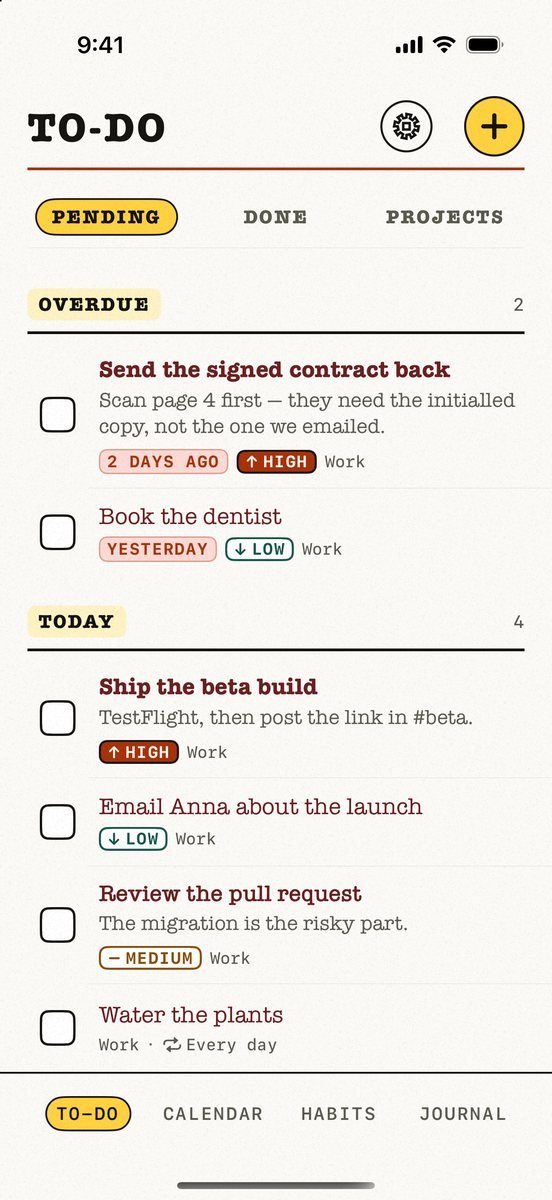
- Best for
- A student who wants coursework, habits and a journal in one free app and does not need a timetable imported
- Highlights
- Four tools in one app: tasks, calendar, habits and a journal, so revision streaks and deadlines sit next to each other rather than in separate apps
- No account and no sign-up. Data syncs through your own iCloud, so there is no server of ours holding your coursework
- Works fully offline, which covers lectures in basements and trains without signal
- No ads and no upsell, so nothing is held back behind a student discount that expires
- Pricing
- Free, with no paid tier and no subscription; the only purchase is an optional tip
- Watch out
- It is a general planner, so there is no timetable import and no grade tracking at all. It is Apple-only, with no Android version and no web version, and it needs iOS 18 or later. Because it syncs through your personal iCloud there is no sharing or collaboration of any kind, so a group project cannot be assigned or shared. It is also brand new, with no ratings and no reviews yet.
myHomework Student Planner
- Best for
- A student whose school runs block or period timetables rather than fixed weekly times
- Highlights
- Tracks classes, homework, tests and assignments together, with a calendar display of what is due
- Supports time-based, block and period-based schedules, which covers timetables that rotate rather than repeat weekly
- Core tracking works without network connectivity, so the planner opens in a lecture hall with no signal
- An optional myHomework account adds homework reminders, web access and the ability to join a teacher's Teachers.io class to receive assignments and announcements
- Pricing
- Free with ads, plus an optional annual upgrade that removes them; theme packs sold separately
- Watch out
- Several things students assume are standard need a free myHomework account: sync across devices, web access and due-date reminders. The maker describes the free tier as free with ads and the paid upgrade as an annual, ad-free account that also unlocks file attachments, external calendar access, planner sharing and all themes; bought individually, theme packs are separate purchases.
MyStudyLife
- Best for
- A student on a rotating timetable who wants exams and revision planned alongside classes
- Highlights
- Class scheduler handles weekly and rotating schedules, so a two-week or day-letter timetable does not have to be entered twice
- Separate exam calendar with a revision planner and reminders, rather than treating an exam as another to-do
- Classes, assignments, exams and schedules sync across your devices, with iCal integration for pulling the schedule into a calendar app
- Includes a built-in Pomodoro timer and home screen widgets, plus an Xtra Planner for extracurricular commitments
- Pricing
- Free with an optional subscription (MyStudyLife+), billed monthly or annually
- Watch out
- It is account-based and built around cloud sync, so it is not a local-only planner, and a set of features sits behind the MyStudyLife+ subscription, with family plans sold in bands by number of students (1, 2, or 3–5). The current listing requires iOS 17 or later, which rules out older hand-me-down iPhones.
Power Planner
- Best for
- A student who wants marks recorded per class and a running weighted GPA on the phone
- Highlights
- Tracks grades per class and calculates a weighted GPA, with multiple semesters available on the paid tier
- A What If? mode for modelling a mark before you have it is listed on the maker's site as currently available on the PC version only
- Semesters, class times and room locations are first-class, so the whole weekly schedule shows in one view
- Free online account syncs the planner between desktop, phone, tablet and any web browser, and it integrates with Google Calendar
- Pricing
- Free with an optional one-time premium purchase, described as lifetime with no subscription
- Watch out
- The free tier is capped where it matters for grade tracking: the listing states a maximum of five grades per class and one semester, and premium is what lifts both. Sync also depends on creating an optional online account, so a student who wants everything kept on-device is using it in a reduced form.
Egenda
- Best for
- A student who wants a plain homework list by class and nothing else running in the background
- Highlights
- Assignments are typed as homework, projects, quizzes or tests rather than being one undifferentiated list
- Assignments are sorted by class, due date or completion, so a week can be read either by subject or by deadline
- Daily reminders cover what is due, and notes on an assignment hold group members or the detail of what was actually set
- Pricing
- Free, with no in-app purchases listed
- Watch out
- The version history on the listing shows the last update as version 1.3.1 in October 2018, so this is an app being run rather than developed. The listing describes no cloud sync, accounts or backup and gives no privacy details to Apple, so treat the data as living on the one device.
Todoist
- Best for
- A student running coursework, a part-time job and a household from one task list
- Highlights
- Quick Add reads typed entries in plain language, so "Submit report every Friday at 4pm #Work" becomes a repeating task with a project attached
- Sub-tasks and sections break a dissertation or a long project into stages inside one project
- Labels filter across projects, which is how you pull every "reading" item out of six different modules at once
- The free tier allows five collaborators per personal project, with shared projects, task assignment and comments, so a group project can be run on it
- Pricing
- Free tier (Beginner) plus a Pro subscription, monthly or yearly
- Watch out
- The free tier is capped at five personal projects and three filter views, with 5 MB uploads and one week of activity history, and modules have a habit of eating project slots. It has no academic model at all: no timetable, no term, no grades, so a rotating schedule has to be rebuilt as recurring tasks by hand.
TickTick
- Best for
- A student who wants tasks, habits and focus sessions in one general planner
- Highlights
- Tasks, habit tracking and a built-in Pomo focus timer sit in one app, which suits revision blocks measured in sessions
- Cloud sync across devices, so the phone list and the laptop list stay the same list
- Habit goals cover the repeat-daily side of revision that a deadline list does not capture
- Calendar functionality includes month, day, three-day and week views once unlocked, plus a yearly heatmap
- Pricing
- Free tier plus a Premium subscription, monthly or annual
- Watch out
- Free accounts get the list view; the other calendar views, custom filters, checklist-item reminders and calendar widgets are Premium. A free account can share a list with one other person, and Premium raises that to 29 members. Free attachment uploads are limited to one per day at up to 10 MB. There is no term structure and no grade tracking, so coursework is just tasks with dates.
Apple Reminders
- Best for
- A student who wants something already on the phone, with nothing to install and nothing to pay
- Highlights
- Lists with section headers and sub-tasks, so one module can hold its own reading, essay and seminar prep items
- Tags cut across lists, which is how you see every deadline in a week that lives in six different module lists
- Smart lists for Today, Scheduled, Flagged, All and Assigned to Me are built in and need no setup
- Lists can be shared and collaborated on with tasks assigned to specific people, which covers group work without a second app
- Pricing
- Free, built into iOS
- Watch out
- There is no academic structure whatsoever: no timetable, no term, no exam type and no grades, so a course has to be modelled as lists and tags by hand. Several of the organising features, including Auto-Categorize, depend on newer iOS versions and Apple Intelligence, so an older iPhone gets a plainer app.
Google Calendar
- Best for
- A student whose timetable already arrives as a calendar file from the university
- Highlights
- Multiple calendars in one view, so a timetable feed, a work rota and personal events layer without merging
- Tasks can be created and managed alongside events, so a deadline sits on the same grid as the lecture it follows
- Shared calendars let other people view, add or modify events, which suits a project group agreeing a meeting time
- Events are added automatically from Gmail, including travel and accommodation bookings, plus customisable views and widgets
- Pricing
- Free, with in-app purchases for Google storage and AI subscription plans
- Watch out
- It is a calendar, not a coursework tracker: no assignment types, no term model and no grades, so a mark or a submission is only ever an event with a title. The in-app purchases on the listing are Google account subscriptions — storage plans and an AI plan — rather than calendar features, and getting a university timetable in still depends on your institution publishing a calendar feed.
What is still missing
The academic planners solve the term and drop the rest of the life. A timetable, an exam date and a running average are all modelled properly, and then the part-time shift, the rent reminder and the doctor's appointment have nowhere to go, so they end up in a second app and the student is checking two places every morning. The general planners do the opposite: one place for everything, and coursework flattened into dated tasks that carry no sense of which module they belong to or how much of the final mark they are worth. That gap is why a lot of students end up running one of each.
Getting a timetable in is the friction point in this category. Where a university publishes a calendar feed, none of the planners listed here describe ingesting it into their own class model, so you either subscribe to it in a calendar app, where it stays disconnected from your assignments, or you retype the contact hours into a class scheduler by hand. Kalend does not solve this either, and it is worth being direct about that: it has no timetable import and no grade tracking, it is Apple-only with no Android or web version, and because it syncs through your own iCloud it cannot share anything with a project group. It is a general planner that happens to be free with no account, and that is the whole of what it offers a student.
The third failure only shows up at the end. A planner tied to an account tied to a student email is only as reachable as that account, and a free tier that felt generous while you were enrolled can turn into a paywall once a student discount lapses. None of the listings here state what happens to stored coursework once an account lapses, and export is not described on any of them. Before you commit a degree's worth of deadlines to any of them, find the export and try it once. The apps that keep data on your own device or in your own cloud account avoid this by construction.
Common questions
Is there a free online planner for students?
Power Planner: its free online account syncs the planner between desktop, phone, tablet and any web browser, with an optional one-time premium. Kalend, our pick, is an iPhone and iPad app with no web version.
Is there a student planner app that tracks grades?
Yes. Power Planner tracks grades per class and calculates a weighted GPA, though its free tier is capped for grade tracking (details in its entry above).
What is the best free student planner app for iPhone?
It depends which of the two kinds you need, which is why this list is split. If you want classes, terms and marks modelled properly, look at the academic planners: myHomework supports time, block and period-based schedules, MyStudyLife handles weekly and rotating timetables with an exam calendar and revision planner, and Power Planner records grades per class with a weighted GPA. If coursework is only one part of a busy life, a general planner such as Todoist, TickTick, Apple Reminders or Kalend will hold it as tasks and dates, with no timetable and no grades. Neither kind is the right answer for everyone.
Can I use a free student planner app for group projects?
Some of them, and it is worth checking before you commit, because each app draws the line in a different place. Apple Reminders lets you share a list and assign tasks to specific people at no cost. Todoist's free tier allows five collaborators per personal project with shared projects, task assignment and comments. Google Calendar allows shared calendars that others can view, add to or modify, which is enough for agreeing meeting times. TickTick lets a free account share a list with one other person, with larger groups on Premium. Kalend has no sharing or collaboration of any kind, because it syncs through your own personal iCloud, so it cannot be the app your group works in.
How do I make a revision timetable on my phone for free?
There are two routes. The academic route is MyStudyLife, which pairs an exam calendar with a revision planner and reminders, so revision is planned against exam dates you have already entered rather than kept in a separate list. The general route is to treat revision as a repeating commitment rather than a deadline: TickTick pairs habit goals with a built-in Pomo timer for session-based revision, and Kalend covers the same ground with habits alongside its calendar. Google Calendar works if you prefer to block out hours visually, though the blocks stay unconnected to the module they belong to.
What happens to my planner when my student email expires?
That depends entirely on how the app stores your data, and it is worth deciding before you start rather than after you graduate. Apps built around a maker's own account, including MyStudyLife and the optional accounts in myHomework and Power Planner, keep your coursework on their servers, so continued access is governed by their terms and by whether you can still sign in. Apple Reminders lives in your Apple Account rather than a university one. Kalend has no account at all and syncs through your own iCloud, so nothing of yours sits on a server we control. Whichever you pick, find the export function and test it once while you still have access.
Do I still need a student planner if I already use a to-do list app?
Only if you want the things a to-do app structurally cannot do. A general to-do app will hold deadlines perfectly well, and Todoist's sub-tasks and sections split a dissertation into stages while labels pull every reading task out of six modules at once. What it will not do is model a rotating timetable, distinguish an exam from an essay, or tell you what a mark is worth. If you have ever wanted to know your running average mid-term, add Power Planner alongside what you already use rather than replacing it, since it is free to download and grade tracking is the one job the general apps do not attempt.
Published · Updated · No affiliate links






 MMA.
MMA. Trending
 Bold
Bold Top
Top