Disclosure: Kalend is ours. The advice works with any app, or with pen and paper.
In short
Start with the anchors you already have — when you wake, eat and sleep — then add three to five small habits, each tied to something you already do. Write them down in the order you’ll do them, and give it weeks, not days: one study measured a median of 66 days for a habit to feel automatic.
- Fix wake-up and bedtime first.
- Three to five small habits, not twenty.
- Plan the bad-day version before you need it.
Step 1: fix your anchors
A routine hangs off a few fixed points: when you get up, when you eat, when you work or study, and when you go to bed. Keep wake-up and bedtime roughly the same every day, weekends included. Everything else is easier once those stop moving.
Step 2: choose three to five small habits
Pick the few things that would make most days better, and make each one small enough to do on a bad day.
- A glass of water when you get up.
- A ten-minute walk after lunch.
- Ten minutes of tidying after dinner.
- Five minutes to plan tomorrow before you finish work.
- Ten pages of a book in bed.
Step 3: tie each habit to something you already do
A new habit sticks better when an old one triggers it. Write it as “After I…, I will…”: After I pour my coffee, I’ll drink a glass of water. After I close my laptop, I’ll plan tomorrow. The thing you already do becomes the reminder.
Step 4: write it down, in order
A routine you can see is a routine you follow. For example:
Morning: wake at 7 · water · shower · breakfast at the table · look at today’s three tasks.
Evening: walk after dinner · ten-minute tidy · plan tomorrow · phone on the charger · read in bed.
Start with just the morning or just the evening. Add the other half once the first feels normal.
Step 5: plan for bad days
Decide now what the minimum version is: one page instead of ten, a walk round the block instead of the gym. Research on habit formation (Lally et al., 2010) found that missing a single day did not derail forming a habit — the damage comes from giving up after the miss. Our guide to a habit tracker that doesn’t reset your streak covers why.
If you have ADHD
Make the routine visible and external: a list you can see, reminders at the moment to act, and steps short enough to start without thinking. Fewer steps that you actually do beat a perfect plan you forget by Wednesday.
How to do it in Kalend
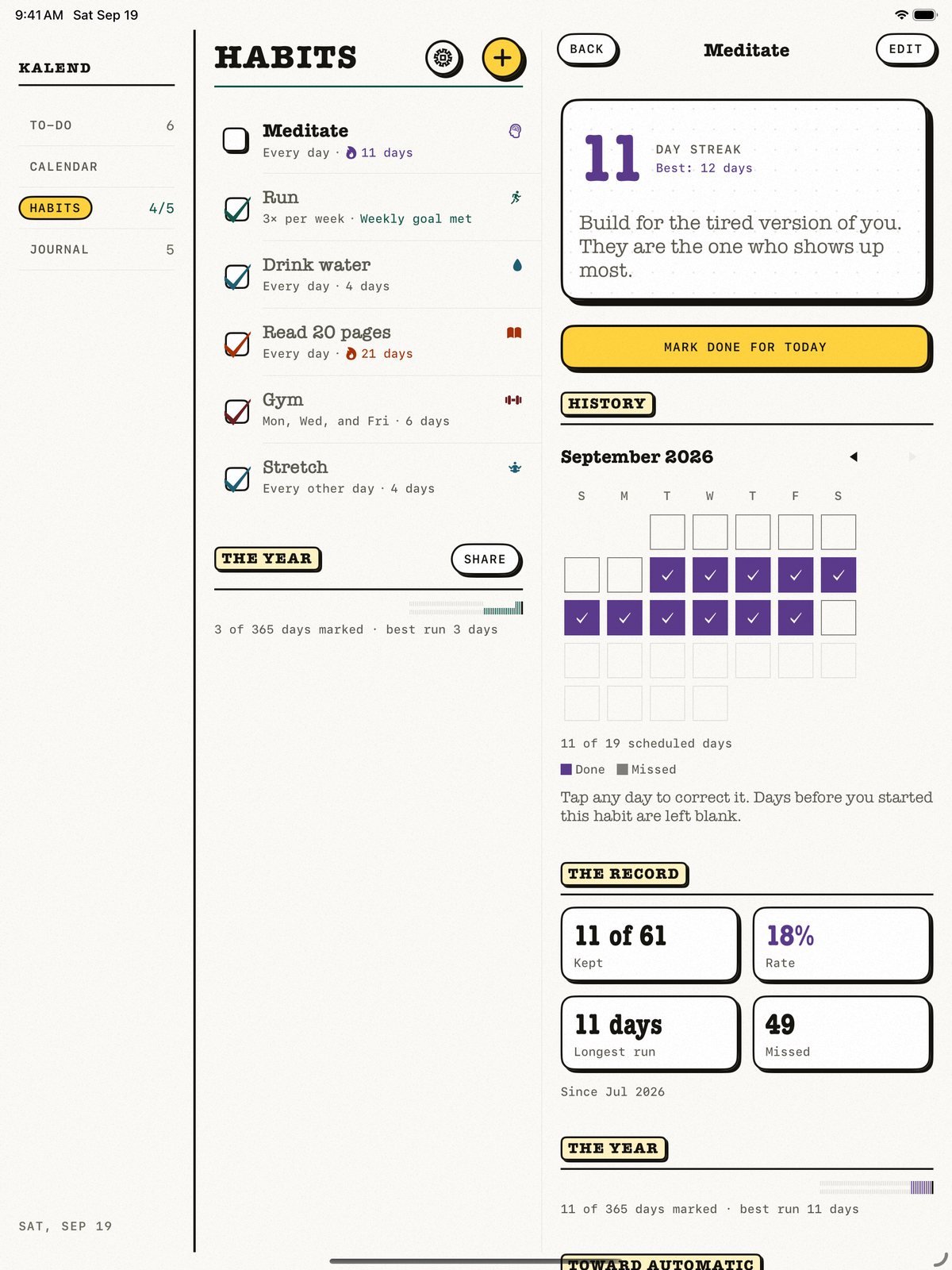
- Add each part of your routine as a habit. Start in a tap with ready-made habits like Drink water or Go for a walk, or write your own.
- Give each one its days. Every day, chosen weekdays, a few times a week or every few days — with a reminder in your own words if you want one.
- Put them in the order you do them. From Kalend 2.5, tap Arrange habits under your list and set your habits in any order.
- Tick them off where you are. Home Screen and Lock Screen widgets, the Apple Watch app, or Siri: “Log a habit in Kalend”.
Kalend is free, with no subscription and no ads. A grace day absorbs one missed day so it never breaks a streak, and Kalend shows your progress toward 66 days.
Common questions
How do I make a daily routine for myself?
Fix your wake-up and bedtime, pick three to five small habits, tie each one to something you already do, write them down in order, and decide on a minimum version for bad days.
How long does it take for a routine to stick?
A study by Lally and colleagues (2010) measured a median of 66 days for a behaviour to become automatic, with a range of 18 to 254 days.
What should a daily routine include?
Fixed wake and bed times, meals, some movement, a few minutes to plan, and a wind-down before sleep. Add only what you’ll actually keep.
What if I miss a day of my routine?
Do it again the next day. One miss doesn’t undo a habit; giving up after it does. In Kalend, a grace day keeps the streak.
Published · No affiliate links










 MMA.socialUFC fan ratings
 TrendingPunjabiPunjabi music charts
 BoldOpinionAnonymous hot takes