Disclosure: Gathr is ours. The advice works with any app, or with pen and paper.
In short
A common order is roka and engagement, then (for many Sikh families) a path, then mehndi, sangeet, jaago and maiyan in the days before, chooda on the morning, then the baraat and milni, the Anand Karaj or pheras, the doli, and the reception. Every family does it a little differently, so ask the elders on both sides early.
- The order below is common, not fixed — families and regions differ.
- Many functions happen separately at the bride’s and the groom’s homes.
- Each function needs its own time, place, dress code and guest list.
Before the wedding week
- Roka — the families formally agree to the match, often with gifts and sweets.
- Engagement — called kurmai or sagai, often with the chunni ceremony, where the groom’s family drapes a red chunni over the bride.
- Path — many Sikh families hold an Akhand Path or Sehaj Path at home or the gurdwara before the wedding.
The days before
- Mehndi (mehendi) — henna for the bride and the women of the family, with songs, dholki and boliyan.
- Sangeet — music and dancing, sometimes a separate night, sometimes folded into the mehndi. Our sangeet planning guide has a run-of-show.
- Jaago — usually a night or two before; relatives dance through the neighbourhood with a decorated pot of lit lamps, singing to “wake” everyone.
- Maiyan (vatna) — a turmeric paste rubbed on the bride and the groom, each at their own home.
The wedding day
- Chooda — in the morning, the bride’s maternal uncle gives her the red and white bangles, and kaleere are tied on.
- Sehra bandi and ghodi — the groom’s sehra is tied and he sets off, often on a mare.
- Baraat and milni — the groom’s side arrives, and relatives from both families meet and greet each other, often with garlands or gifts.
- Anand Karaj in Sikh families — four laavan around the Guru Granth Sahib, usually in the morning at the gurdwara. Hindu Punjabi families have the pheras around the sacred fire.
- Doli (vidaai) — the bride’s emotional send-off.
After: the reception
The reception is often the biggest party and the one with the longest guest list. Some families hold it the same evening; many hold it a day or two later, often hosted by the groom’s side.
How to plan all of it
The hardest part isn’t any one function; it’s knowing who is invited to what. A close cousin comes to everything, a colleague only to the reception, and the jaago may be for family and neighbours only. Keep one guest list and mark which functions each guest is invited to.
Give every function its own time, venue, dress code and someone in charge. Share the schedule with both families early, and confirm the gurdwara or mandir timing first, since the rest of the day is built around it.
Start with our wedding guest list guide.
Plan every function in Gathr
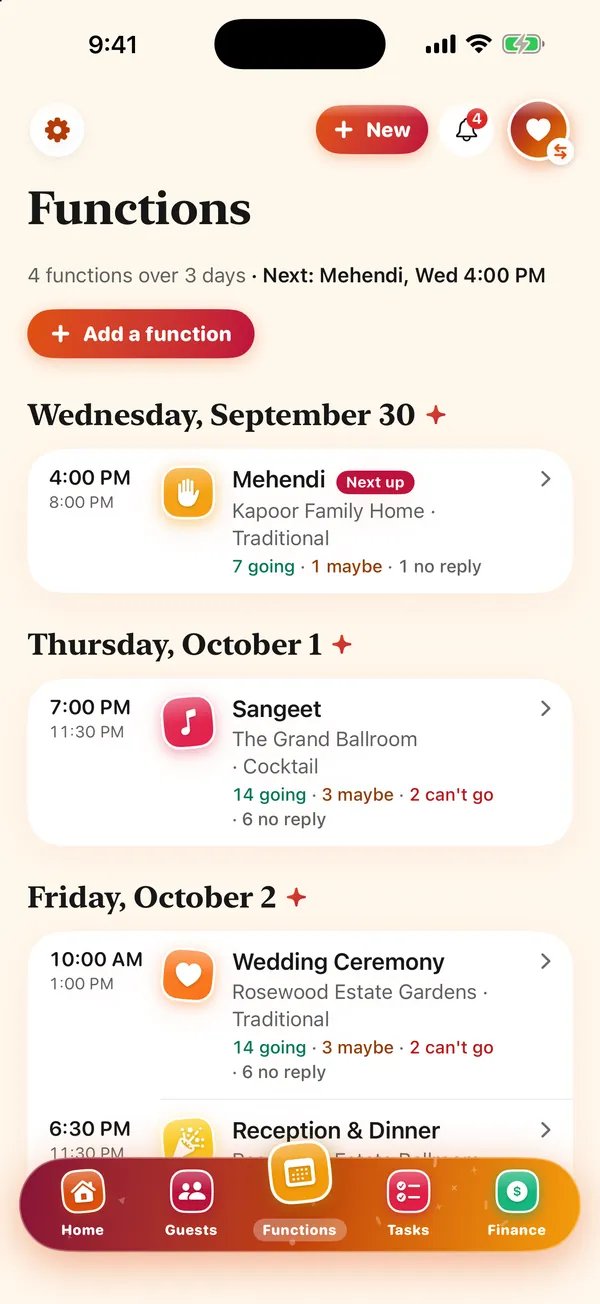
- Set up the wedding. It comes with its functions already laid out; add a function for the jaago, the path or anything else your families hold.
- Give each function its details. Its own time, place, dress code and guest list, so you know who is coming to what.
- Invite once, reply per function. Guests answer each function they’re invited to in one sheet — or tap “Going to all” — from a link in any browser.
- Plan it with family. Invite a co-host by link to edit the same guests, schedule and budget; on the day, what’s on now and next sits on your Lock Screen.
Pick the Marigold look and every screen, and your guests’ RSVP page, wears it. Gathr is free, with no ads and no charges to you or your guests. It never moves money; Finance is a record you keep.
Common questions
What are the Punjabi wedding functions in order?
Commonly roka, engagement (kurmai or chunni), a path for many Sikh families, mehndi, sangeet, jaago, maiyan, chooda, sehra bandi, baraat and milni, the Anand Karaj or pheras, the doli, and the reception. Families vary.
What is the difference between jaago and sangeet?
A sangeet is a night of music and dancing, usually at a venue or home. A jaago is a late-night procession where relatives dance through the neighbourhood with a decorated pot of lit lamps.
What happens at a Sikh wedding ceremony?
The Anand Karaj takes place in front of the Guru Granth Sahib, usually at a gurdwara in the morning, and the couple walks around it four times during the laavan.
How do I track guests for each wedding function?
Keep one list and mark which functions each guest is invited to. Gathr gives every function its own guest list and replies.
Published · No affiliate links










 MMA.socialUFC fan ratings
 TrendingPunjabiPunjabi music charts
 BoldOpinionAnonymous hot takes