Disclosure: SmartFolio is ours. The advice works with any app, or with pen and paper.
In short
Work out what share of your money sits in each holding, then look at the same thing by sector, region, currency and asset class. If one stock, one sector or one country makes up a big slice, a single bad event can hit most of your portfolio at once — that’s the concentration diversification is meant to avoid.
- Start with weights: largest holding and top 3.
- Then look by sector, region, currency and asset class.
- Count what’s inside your ETFs, not just the number of lines.
Step 1: weight of each holding
Weight = Holding value ÷ Total portfolio value × 100
List every position across every account at today’s value. Two numbers tell you a lot: your largest holding’s weight, and the combined weight of your top three. Use the checker below to work them out.
Step 2: look across sectors
Ten stocks can still be one bet. Five banks and five energy companies are ten names but two sectors. Group your holdings by sector and see whether one industry dominates.
Step 3: region and currency
Many investors lean heavily toward their home market — for Canadians, that often means banks, energy and materials. Check how much is in Canada, the US and the rest of the world, and which currencies your money is actually in.
Step 4: asset class
Stocks, bonds, cash and crypto behave very differently. Your mix of asset classes usually matters more to how bumpy the ride feels than which individual stocks you pick.
ETFs change the picture
A broad index ETF is one line in your account but can hold hundreds or thousands of companies, so a portfolio of three such ETFs can be more diversified than one with thirty individual stocks. The reverse also happens: owning several ETFs that track similar indexes adds lines without adding much variety. Look at what each fund holds.
How diversified you should be depends on your goals, timeline and comfort with risk — this guide shows how to measure it, not what your numbers should be. Not financial advice. If you hold investments in several places, tracking investments across multiple accounts comes first.
Concentration checker
A broad index ETF counts as one line here but can hold hundreds of companies. Not financial advice.
Check your diversification in SmartFolio
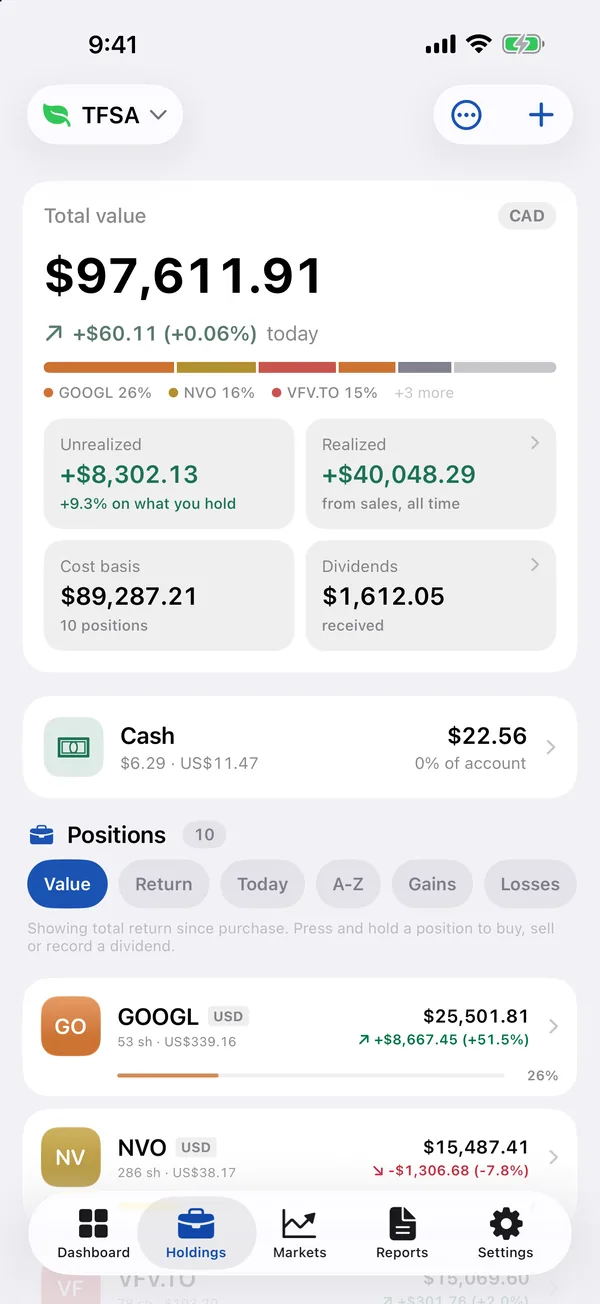
- Import every account. TFSA, RRSP, cash and crypto accounts — each can be its own portfolio.
- Open Holdings. Each position with its live price and its weight, under an allocation bar for the whole portfolio.
- See the allocation. By holding, sector, asset class, region and currency.
- Read the portfolio review. Information about how the portfolio is built and where the risk is concentrated.
SmartFolio is a tracker, not financial advice. It’s free, with no account and no ads, and every number is worked out on your device.
Common questions
How do I check if my portfolio is diversified?
Work out each holding’s share of the total, then group by sector, region, currency and asset class to see where your money is concentrated.
How do you measure portfolio diversification?
Simple measures are your largest holding’s weight, your top-3 weight, and the split by sector, region and asset class.
Is one ETF enough diversification?
A broad index ETF can hold hundreds of companies, but it may still be concentrated in one country or asset class. Look at what it holds.
Is there a free portfolio diversification checker?
Use the checker on this page for weights, or SmartFolio, which shows allocation by holding, sector, asset class, region and currency, free.
Published · No affiliate links









 MMA.socialUFC fan ratings
 TrendingPunjabiPunjabi music charts
 BoldOpinionAnonymous hot takes