Disclosure: Gathr is ours. The advice works with any app, or with pen and paper.
In short
Agree the total budget first, then pick one way to split it: by percentage, by event, by item, by guest count, or fixed contributions with the couple covering the rest. Write the agreement down and keep one shared record of what has been paid and who owes whom.
- Talk about the total before you talk about shares.
- Pick one split method and write it down.
- Keep one shared record so nobody keeps score in their head.
Who traditionally pays for what
Old Western etiquette had the bride’s family paying for the wedding and reception and the groom’s family paying for the rehearsal dinner. In many South Asian families, each side hosts its own pre-wedding functions, and the reception is often hosted by the groom’s family.
Today plenty of couples pay for much of it themselves, and families contribute what they can. Tradition is a starting point for the conversation, not a rule.
Five ways to split wedding costs
- By percentage. Each family and the couple cover an agreed share of every bill — say 40/40/20.
- By event. Each side pays for the functions it hosts. This suits weddings with a mehndi, sangeet, ceremony and reception.
- By item. One side covers the venue and food, the other the photographer, music and decor.
- By guest count. Work out the cost per guest and each side pays for the guests it invited.
- Fixed contributions. Each family gives a set amount and the couple covers the rest — the simplest way to keep control of the plans.
How to have the conversation
Have it early, before anything is booked. Ask what each family would like to contribute rather than telling them what they owe, and be clear about whether money comes with a say in the guest list or the plans.
Agree what happens if costs go over: does everyone keep the same percentage, or does the couple cover it?
Keep one record everyone can see
Most money arguments at weddings aren’t about the total; they’re about who paid the deposit, who still owes their share and whether it was ever paid back. Write down every expense, who paid it and how it’s split, and mark it when someone is paid back.
A wedding budget breakdown by category (venue, food, photos, outfits, decor, music) also shows quickly where the money is going.
Track the split in Gathr
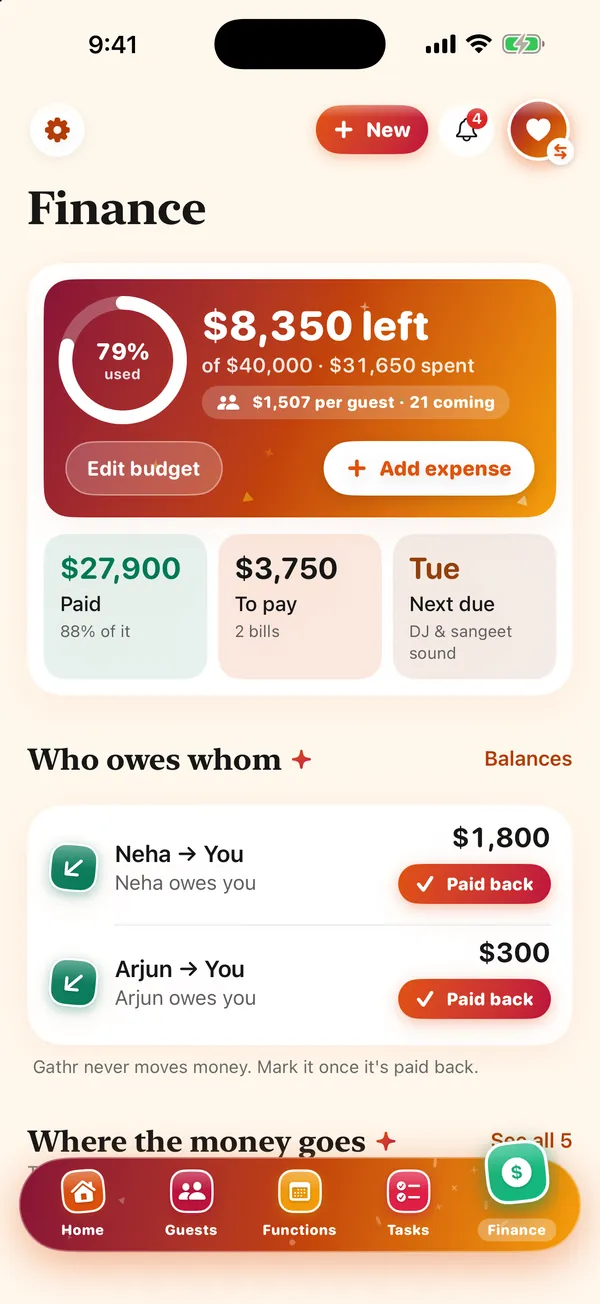
- Set the budget. Gathr shows what’s left, what’s paid, what’s due next and what each guest who’s coming costs you.
- Add each expense. Split it evenly or by percentage, and record deposits and part payments.
- See who owes whom. Gathr works it out, and you mark a bill or a pay-back as paid in one tap.
- Share it with a co-host. Invite your partner, a parent or your planner by link to see and edit the same budget.
Gathr is free, with no ads and no charges to you or your guests. It never moves money; Finance is a record you keep.
Common questions
Who pays for the wedding traditionally?
In old Western etiquette, the bride’s family paid for the wedding and reception. In many South Asian families each side hosts its own functions. Today many couples pay a large share themselves.
What is the fairest way to split wedding costs?
The one everyone agrees to up front. Splitting by event or by guest count feels fair to many families because each side pays for what it hosts or invites.
How do couples split wedding costs with their parents?
Often with fixed contributions from each family and the couple covering the rest, or an agreed percentage of every bill.
Is there an app to track who owes what for a wedding?
Gathr’s Finance tab records each expense, splits it evenly or by percentage, and works out who owes whom. It never moves money.
Published · No affiliate links










 MMA.socialUFC fan ratings
 TrendingPunjabiPunjabi music charts
 BoldOpinionAnonymous hot takes