Disclosure: SmartFolio is ours. The advice works with any app, or with pen and paper.
In short
Total return = (value today − amount invested + dividends received) ÷ amount invested × 100. Buy for $5,000, it’s worth $5,600, and you’ve had $200 in dividends: that’s an $800 gain, a 16% total return — against 12% from the price alone.
- Price return ignores dividends; total return counts them.
- Reinvested dividends are already in today’s value — don’t add them twice.
- Annualise to compare holdings you’ve owned for different lengths of time.
The formula
Total return = (Value today − Amount invested + Dividends received) ÷ Amount invested × 100
Worked example: 100 shares bought at $50 ($5,000). The price is now $56, so they’re worth $5,600, and you’ve received $200 in cash dividends.
- Price gain: $5,600 − $5,000 = $600 → 12% price return.
- Add dividends: $600 + $200 = $800.
- $800 ÷ $5,000 = 16% total return.
If your dividends were reinvested
With a DRIP, each dividend buys more shares instead of landing as cash. Those extra shares are already part of today’s value, so you don’t add the dividends again: total return = (value today − amount you put in) ÷ amount you put in.
The mistake to avoid is counting the reinvested dividends as money you invested. You didn’t add new cash — the investment paid for those shares itself.
Total return vs price return
Price return is only the change in the share price. Total return adds the dividends. For a stock paying 4% a year, the gap grows quickly, which is why a high-dividend stock can look flat on a price chart and still have done well.
The same applies to indexes: an index’s “price return” version leaves dividends out, while the “total return” version assumes they were reinvested. Compare like with like.
How to annualise a total return
Annualised return = (1 + Total return)^(1 ÷ Years) − 1
A 16% total return over 2 years is 1.16^(1/2) − 1 = 7.70% a year, not 8%. Doubling your money over 10 years (100%) is about 7.18% a year. Annualising lets you compare a holding you’ve had for six months with one you’ve had for six years.
When you’ve added money along the way
This formula works for one purchase. If you’ve been buying more over time, the timing of each deposit distorts a simple percentage — see how to calculate portfolio return with deposits for time-weighted return.
Total return calculator
Dividends reinvested through a DRIP? Put 0 in the dividends box — the extra shares are already in today’s value.
See total return in SmartFolio
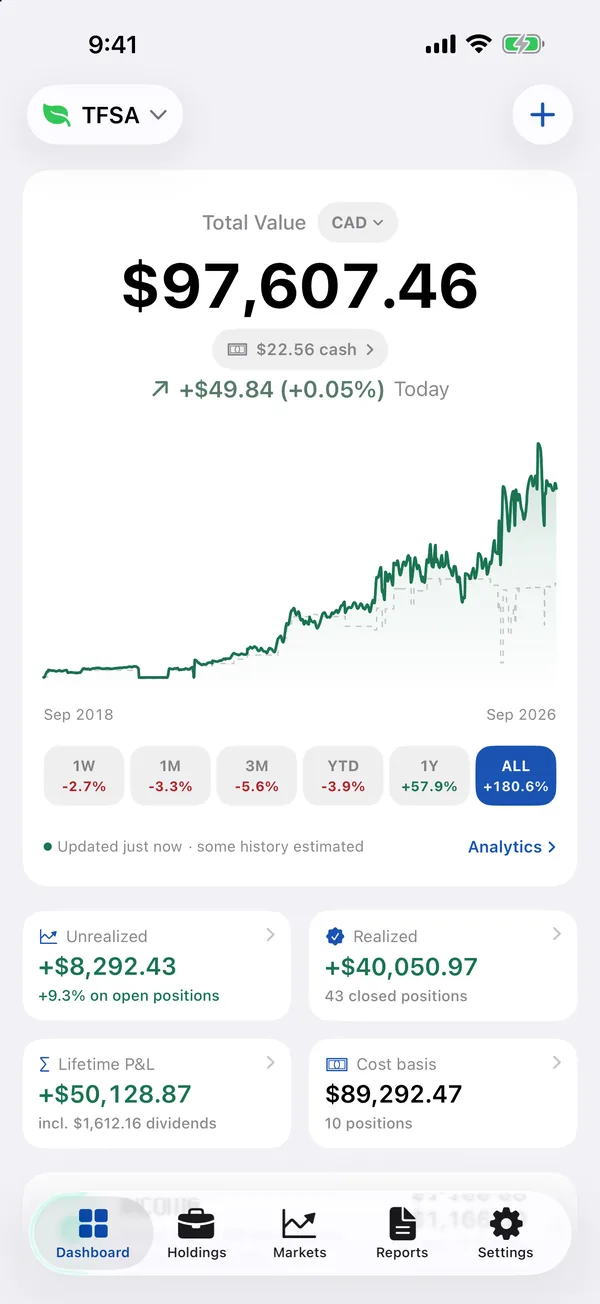
- Import every buy, sale and dividend. From your broker’s export file or any CSV, with a review screen before anything is saved.
- Read the Dashboard. Unrealized gain on what you hold, realized gain from sales, and lifetime profit including dividends.
- Sort Holdings by Return. Each position shows its total return since purchase.
- Go further in Analytics. Time-weighted returns from 1 week to all time, a monthly heatmap and a comparison with the S&P 500.
SmartFolio is free, with no account and no ads. It’s a tracker, not financial or tax advice.
Common questions
How do you calculate total return with dividends?
Take today’s value, subtract what you invested, add the dividends you received, then divide by what you invested and multiply by 100.
Do you add reinvested dividends to total return?
No — reinvested dividends bought extra shares that are already in today’s value. Adding them again double-counts.
What is the difference between total return and price return?
Price return is the change in price only; total return also counts dividends.
How do I annualise a total return?
Add 1 to the total return, raise it to the power of 1 ÷ years, and subtract 1. 16% over two years is about 7.7% a year.
Published · No affiliate links










 MMA.socialUFC fan ratings
 TrendingPunjabiPunjabi music charts
 BoldOpinionAnonymous hot takes