Disclosure: Brolic is ours. The advice works with any app, or with pen and paper.
In short
First make sure it’s a real plateau — the same lift stuck for three weeks or more in your log. Then check the boring things (sleep, food, stress), take a lighter week, and change one thing: the rep range, how often you train the lift, or the weak point where the bar slows down. Change one thing at a time so you know what worked.
- Three stuck weeks in a log is a plateau; one bad day isn’t.
- Fix sleep and food before you change the programme.
- Change one thing at a time.
Is it really a plateau?
One bad session isn’t a plateau. A plateau is the same lift stuck — same weight, same reps — for three weeks or more. Look at your log, not your memory: lifts often feel stuck while the numbers are still creeping up.
Step 1: check sleep, food and stress
Most plateaus aren’t programme problems. Short sleep, too little food (especially protein) and a stressful month all show up on the bar first. A strength plateau during a cut is normal: when you eat less to lose fat, holding your numbers is a win.
Step 2: take a lighter week
Tiredness builds up quietly over months of hard training. Drop the weight by roughly a third to a half for a week, keep the same movements, then go back to normal. You often come back feeling stronger than before.
Step 3: change the reps or how often you train the lift
If you’ve done sets of 5 for months, spend a few weeks on 8–10, or the other way round. Or train the stuck lift twice a week instead of once, with one heavier and one lighter day. Something new gives your body something new to adapt to.
Step 4: fix the weak point
Notice where the bar slows down, and train that part:
- Bench stalls just off the chest: paused bench press.
- Bench stalls near the top: close-grip bench and triceps work.
- Squat stalls coming out of the bottom: paused squats, front squats.
- Deadlift stalls off the floor: paused or deficit deadlifts.
- Deadlift stalls at the knees or lockout: Romanian deadlifts, rows, hip work.
Step 5: give it time, and keep the log
Change one thing, run it for three or four weeks, and look at the numbers. Change three things at once and you’ll never know which one worked. For lift-specific ideas, see how to increase your bench press and how to increase your squat.
Spot a plateau early with Brolic
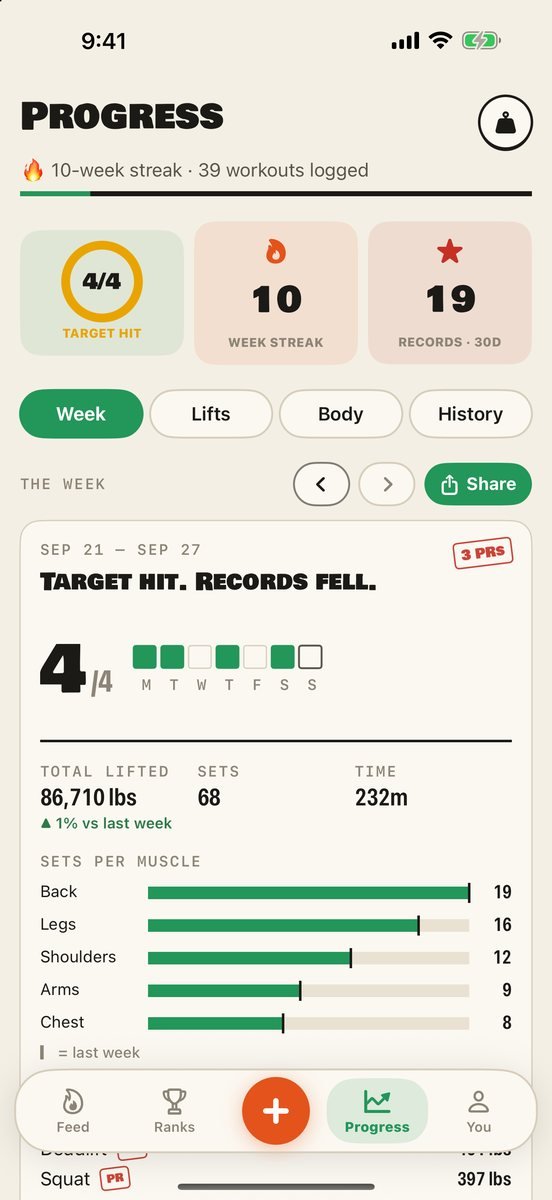
- Log every set. Weight and reps, ticked as you go. Every max shows the set it came from.
- Check each lift’s chart. Progress shows your max over time and how much stronger you are since you started, so a flat line is easy to see.
- Read the week. The weekly report compares total weight lifted with last week, counts sets per muscle group, and shows any muscle you trained last week but skipped this week.
- Keep the record complete. Leave a workout and resume it later, or log one you forgot for another day.
Brolic is free, with no subscription, no in-app purchases and no ads. It needs an account for the leaderboards.
Common questions
How do you break a plateau in the gym?
Confirm it in your log, sort out sleep and food, take a lighter week, then change one thing — reps, how often you train the lift, or a weak-point exercise — for three or four weeks.
How long does a strength plateau last?
It varies. Many lift after a lighter week or a new rep range; one that lasts months usually points to recovery, or a programme that hasn’t changed in a long time.
Is it normal to plateau while cutting?
Yes. Eating less makes adding strength harder, so holding your numbers during a cut is a good result.
Should I train to failure to break a plateau?
Not on every set. Stopping a rep or two short most of the time lets you recover and keep adding weight; the odd all-out set is fine.
Published · No affiliate links










 MMA.socialUFC fan ratings
 TrendingPunjabiPunjabi music charts
 BoldOpinionAnonymous hot takes