Disclosure: Brolic is ours. The advice works with any app, or with pen and paper.
In short
Divide your one-rep max by your bodyweight. As a very rough rule of thumb, after a year or two of steady training a 1× bodyweight bench, 1.5× squat and 2× deadlift are solid milestones for men, and about 0.75×, 1.25× and 1.5× for women. Age, height and training history move these a lot, so treat them as targets, not grades.
- Strength for your weight = your max ÷ your bodyweight.
- Rough milestones, not exact tables — everyone starts somewhere.
- Beat your own last month first.
Step 1: find your max without maxing out
You don’t need to test a true one-rep max. Take a hard set of 3–10 reps and estimate it with the Epley formula:
Max ≈ Weight × (1 + Reps ÷ 30)
185 lbs for 5 reps ≈ 185 × 1.167 ≈ 216 lbs. More in how to calculate your one-rep max.
Step 2: divide by your bodyweight
Strength ratio = Max ÷ Bodyweight
A 216 lb max at 180 lbs bodyweight is 216 ÷ 180 = 1.2× bodyweight. Use the same unit for both; kilos or pounds, the ratio is the same.
Rough strength milestones for men and women
These are rules of thumb that lifters often use as goals — not a scientific table or an average. They assume a one-rep max with a full range of motion.
| Lift | Starting out | Solid | Strong |
|---|---|---|---|
| Bench press — men | 0.75× | 1× | 1.5× |
| Bench press — women | 0.5× | 0.75× | 1× |
| Squat — men | 1× | 1.5× | 2× |
| Squat — women | 0.75× | 1.25× | 1.5× |
| Deadlift — men | 1.25× | 2× | 2.5× |
| Deadlift — women | 1× | 1.5× | 2× |
In your first few months you may be below the first column, and that’s normal. Age, height, limb length and years of training all shift these numbers.
How much should I lift as a beginner?
Early on, don’t chase a ratio — chase last week. Beginners can add weight quickly on all three lifts, and the milestones above tend to come with a year or two of steady, logged training plus enough food and sleep. Stuck on bench? See how to increase your bench press.
Total weight or pound for pound?
Heavier lifters usually lift more in total; lighter lifters often lift more for their size. That’s why lifting comparisons usually look at both — the raw weight, and the weight relative to bodyweight or within a weight class.
Strength-to-bodyweight calculator
Estimated max 216 · 1.20× bodyweight
Use the same unit (lbs or kg) for both. Max estimated with the Epley formula; most accurate from sets of 10 reps or fewer.
See your strength level with Brolic
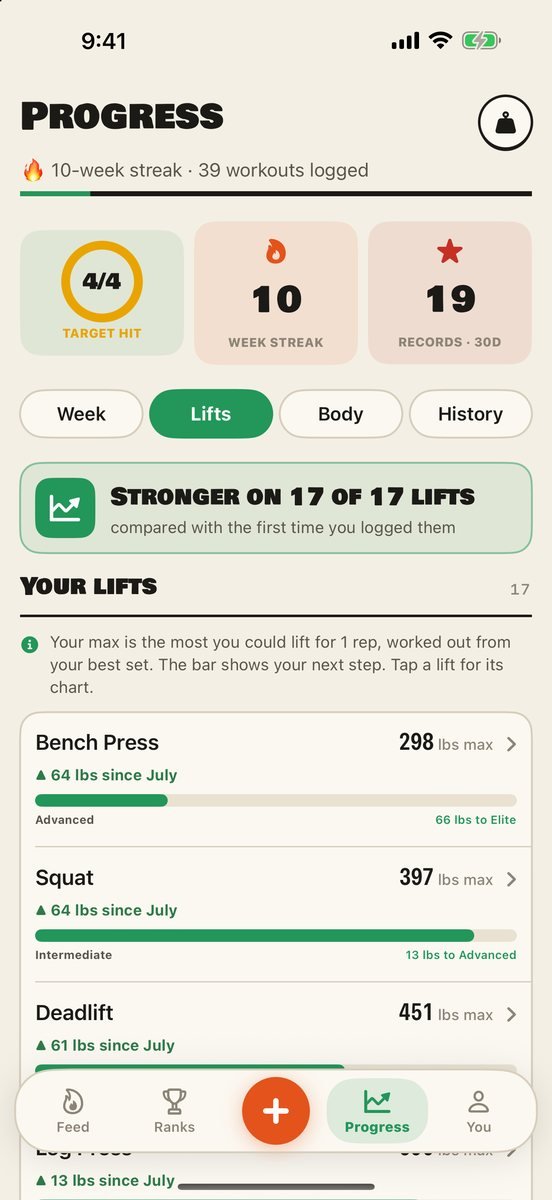
- Log a set. Tap a lift, type the weight and reps, tick the set. Brolic works out your max from your best set with the Epley formula.
- Open Progress. Every lift shows your max, how much stronger you are since you started, and a bar to your next strength level, from Beginner to Elite.
- Compare fairly. Rank by max or pound for pound — worldwide, in your country, your city or your weight class.
- See the set behind it. Every max shows the set it came from, like “from 255 lbs x 5”.
Brolic is free, with no subscription, no in-app purchases and no ads. It needs an account for the leaderboards. Other lifters see your first name and last initial.
Common questions
How much should I bench for my weight?
As a rough guide, about 1× bodyweight is a solid milestone for men and about 0.75× for women after a year or two of training. Beginners are often well below that, and that’s fine.
How much should I squat for my weight?
Roughly 1.5× bodyweight is a common goal for men and about 1.25× for women. Treat it as a target, not a grade.
How much should I deadlift for my weight?
Around 2× bodyweight for men and 1.5× for women are often-quoted goals. Most people lift more on the deadlift than on the other two.
How do I know how strong I am?
Estimate your one-rep max from a hard set, divide it by your bodyweight, and compare with rough strength milestones — and with your own numbers from last month.
Published · No affiliate links










 MMA.socialUFC fan ratings
 TrendingPunjabiPunjabi music charts
 BoldOpinionAnonymous hot takes