Disclosure: Brolic is ours. The advice works with any app, or with pen and paper.
In short
You don’t have to max out. Take a hard set of 3–10 reps and estimate: Epley 1RM = weight × (1 + reps ÷ 30). 100 kg for 5 reps ≈ 117 kg. The calculator below averages Epley and Brzycki.
- Estimate from a hard set — no max-out.
- Most accurate at 10 reps or fewer.
- Train at 70–85% of it for strength.
The formulas
Epley: 1RM = weight × (1 + reps ÷ 30)
Brzycki: 1RM = weight × 36 ÷ (37 − reps)
Both are estimates; they agree closely under about 10 reps and drift apart above that.
How to use your 1RM
- Heavy strength work: ~80–90% for 3–5 reps.
- General strength: ~70–80% for 6–10 reps.
- Re-estimate every few weeks from your best recent set.
Should you ever test a real max?
Only with good technique, a warm-up, and a spotter or safety pins. For most lifters, an estimated max tells you enough.
One-rep max calculator
An estimate — most accurate from sets of 10 reps or fewer.
Track it with Brolic
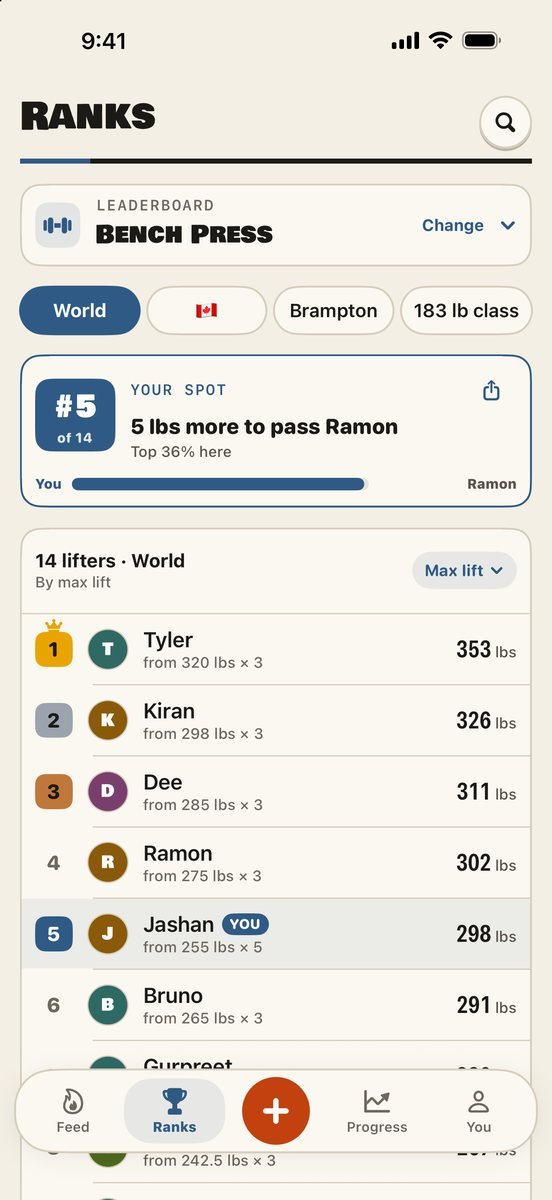
- Log the set. Tap the lift, type weight and reps, tick the set.
- Records caught for you. Beat a best and Brolic stamps it the moment you finish.
- Rank by max lift or pound for pound. A leaderboard for every lift — worldwide, your country, your city or your weight class.
- See your level. Where your lift sits against strength standards for your bodyweight, Beginner to Elite.
Brolic is free, with no subscription, no in-app purchases and no ads.
Common questions
How do I calculate my one-rep max?
Epley: weight × (1 + reps ÷ 30), from a hard set of 10 reps or fewer.
How accurate is a 1RM calculator?
Close for sets of up to about 10 reps; less reliable above that.
What percentage of 1RM should I train at?
Roughly 70–85% for most strength work.
Does Brolic track personal records?
Yes — it stamps a new best the moment you finish and puts it on the board.
Published · No affiliate links










 MMA.socialUFC fan ratings
 Trending
 Bold
Bold Top
Top