Disclosure: VaultFlow is ours. The advice works with any app, or with pen and paper.
In short
A common guideline is three to six months of essential costs — housing, utilities, groceries, insurance, transport and minimum debt payments. Keep more if your income is irregular or you’re the only earner; three months can be enough with a stable job and two incomes.
- Count essentials, not your full spending.
- 3 months with stable income; 6 or more if it isn’t.
- Keep it safe, separate and easy to reach.
Step 1: add up your essential costs
Your emergency fund needs to cover what you couldn’t cut if your income stopped: rent or mortgage, utilities, groceries, insurance, transport, phone and minimum debt payments. Leave out dining out and shopping — in an emergency, those stop. Your bank and card statements for the last few months will give you a real number.
Step 2: choose how many months
- 3 months: stable job, two incomes, few dependants.
- 6 months: one income, children, or a job that would take a while to replace.
- 9–12 months: self-employed, commission or seasonal income.
These are common rules of thumb, not a rule for you. Not financial advice.
What Employment Insurance does and doesn’t cover
In Canada, EI regular benefits generally pay 55% of your average insurable weekly earnings, up to a weekly maximum, usually after a one-week waiting period — and only if you qualify. Your emergency fund fills the gap EI leaves and covers the wait.
Where to keep an emergency fund in Canada
Somewhere safe and quick to reach: a high-interest savings account, or savings held in a TFSA so the interest isn’t taxed. Money you withdraw from a TFSA gets its contribution room back the following January, not straight away. Avoid keeping it in investments that can drop just when you need them.
Building it from zero
Saving six months of costs can take years, so set a first target — one month of rent, say — and celebrate it. Automate a transfer every payday, and put windfalls like tax refunds straight in. If you’re paying off high-interest cards, see how to pay off credit card debt; many people keep a small buffer while they clear debt.
Emergency fund calculator
Essentials only: housing, utilities, groceries, insurance, transport and minimum debt payments. Nothing you type leaves this page.
Build your emergency fund with VaultFlow
- Make it a goal. Set a target and a date; the goal shows progress and how much to save a month.
- Find your real essentials. Spending shows a month by category, so you know what housing, groceries and bills actually cost.
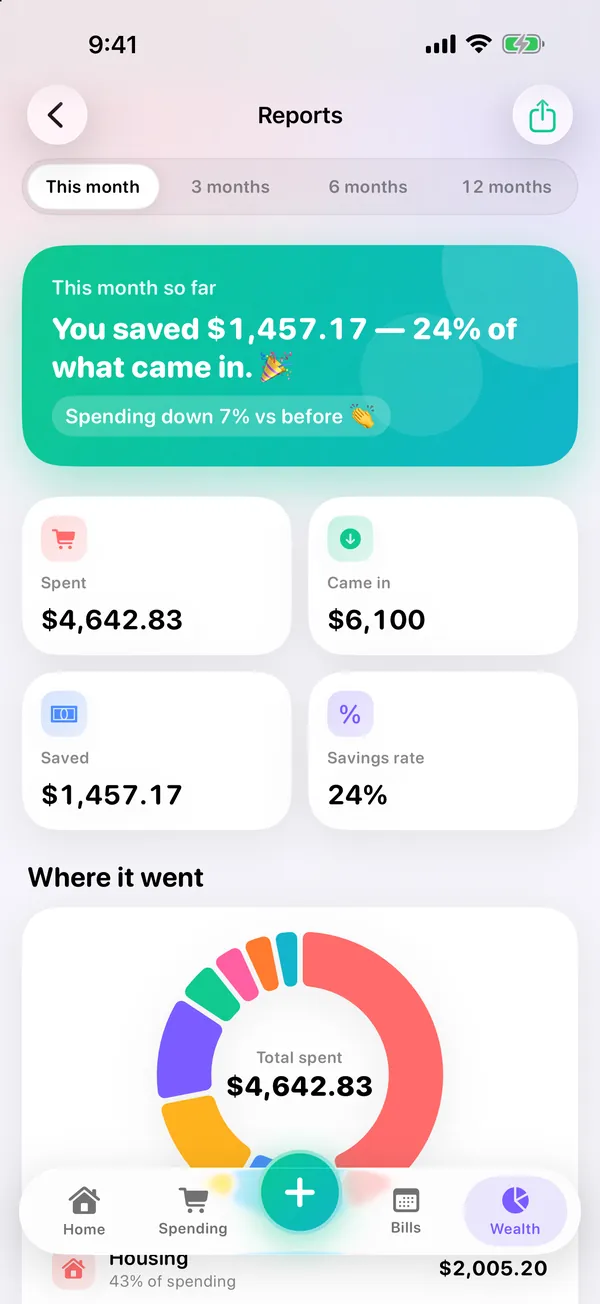
- Watch your savings rate. Reports show what you saved this month and as a share of what came in.
- See it in your net worth. Add the savings account it lives in, and it counts toward your net worth.
VaultFlow 5.0 is in review with Apple; the version on the App Store now (3.1) already has budgets, recurring bills, goals and net worth. Free, no subscription, no bank login.
Common questions
How much should I have in my emergency fund?
Three to six months of essential costs is a common guide; more if your income is irregular.
How much emergency fund should I have in Canada?
The same 3–6 month guide applies. EI, if you qualify, generally pays 55% of insurable earnings up to a maximum, so plan to cover the rest.
Should my emergency fund be in a TFSA?
Many Canadians keep it in a savings account or cash inside a TFSA so interest isn’t taxed. Withdrawn room comes back the next January.
Is there an app to track an emergency fund?
VaultFlow lets you set it up as a goal with a target and date and shows how much to save each month, free.
Published · No affiliate links










 MMA.socialUFC fan ratings
 TrendingPunjabiPunjabi music charts
 BoldOpinionAnonymous hot takes