 Free · No account · No subscription
Reset: Dopamine Detox
Block the apps that eat your time — and let a friend hold the key
Every blocker has an off switch, and at 11 p.m. you will find it. Reset is built around the one thing people who quit scrolling keep saying worked: someone else holds the key. Tap the apps, pick a length, and they vanish from your Home Screen. Give a friend your key and only they can end a block early. Not even you can get around it.
Free, with no subscription and no in-app purchases. Built in Edmonton by The Big Head. Not medical advice.
Real blocking
Built on Apple's Screen Time. Blocked apps disappear from the Home Screen and show a shield instead of opening. Instagram, TikTok, YouTube, whole categories, or any website. Held by iOS, not by the app.
The friend key
Scan each other's phones, send a link, or let them set a passcode. A locked block can't be ended early without them, and not even you can get around it. Emergency unlock waits for a period you chose in advance.
SOS for the urge
When the pull hits, SOS asks what you're escaping right now, gives you something better to do for five minutes, then checks whether the pull dropped. It learns which things work for you.
Boredom Gym
Twenty-two short exercises for sitting with nothing, each with its source. Thirty seconds first, then a minute, then longer. Skills train the boring way.
What it actually looks like
Real screens, straight from the app. Light mode shown; there is a dark mode too, and the horizon in the header changes with the time of day.
New in 2.2 Giving a friend your key is simple now. Scan each other’s phones, send a link, or let them set a passcode on your phone. Setup ends with a quick test, and every new block is locked to your friend.
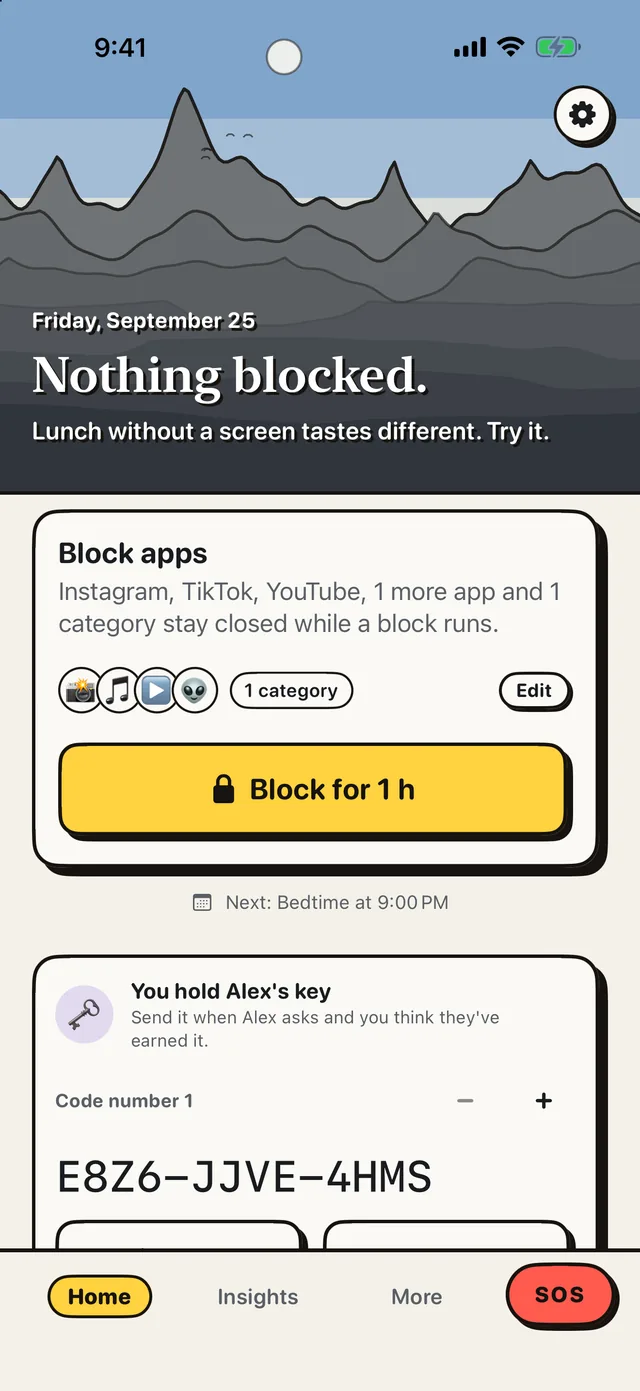
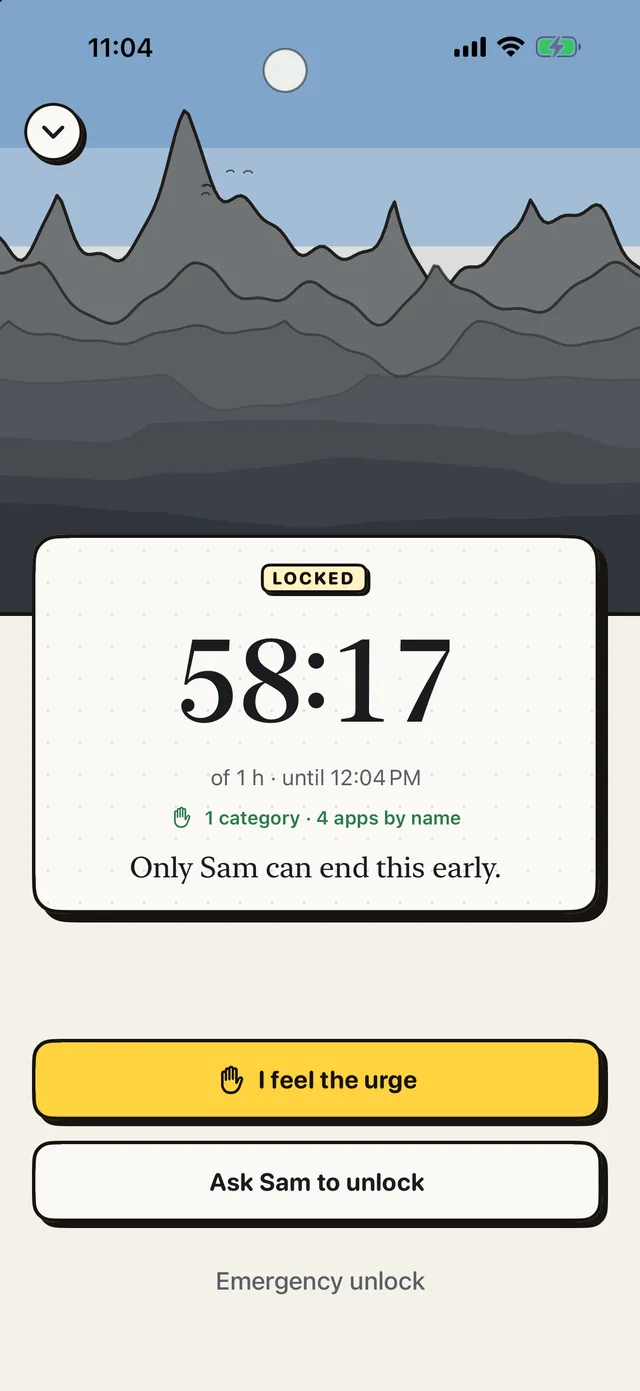
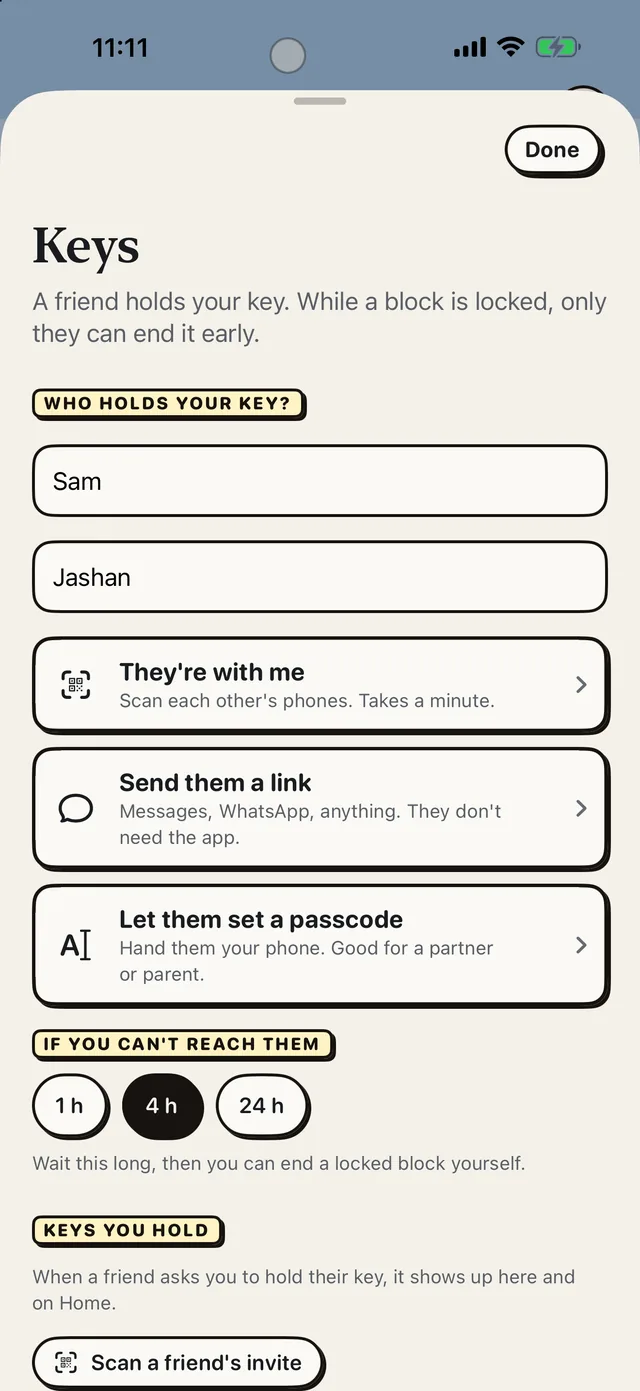
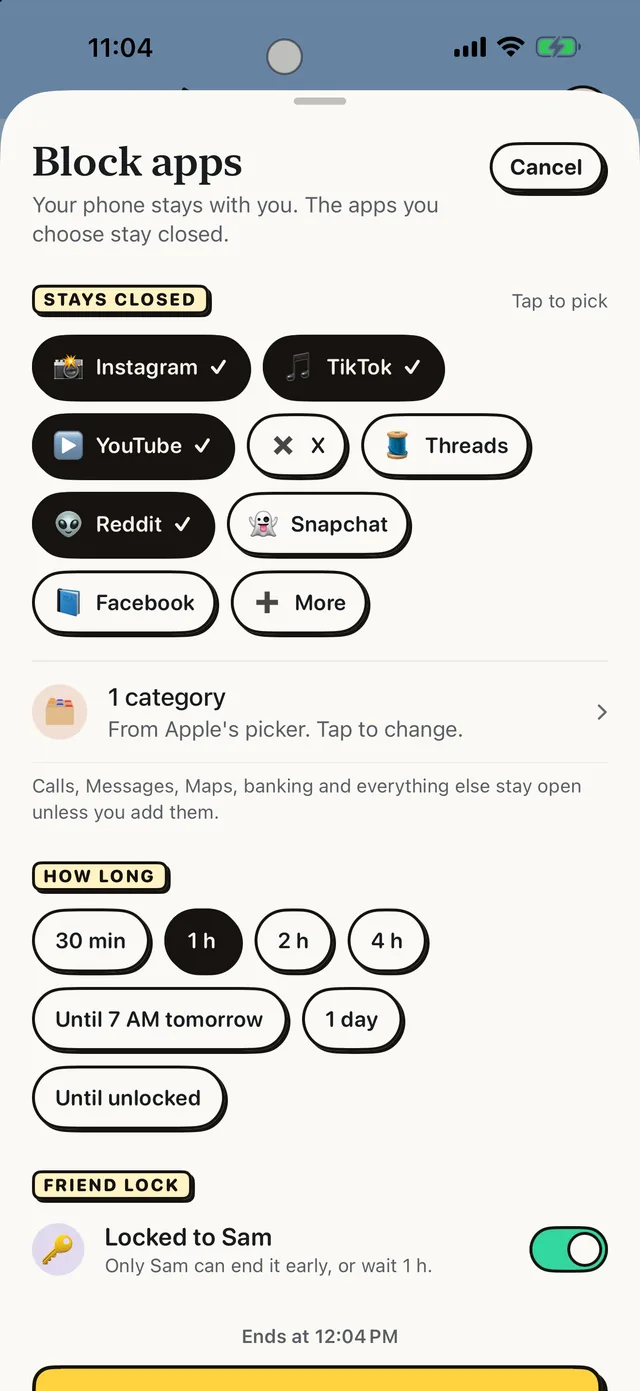
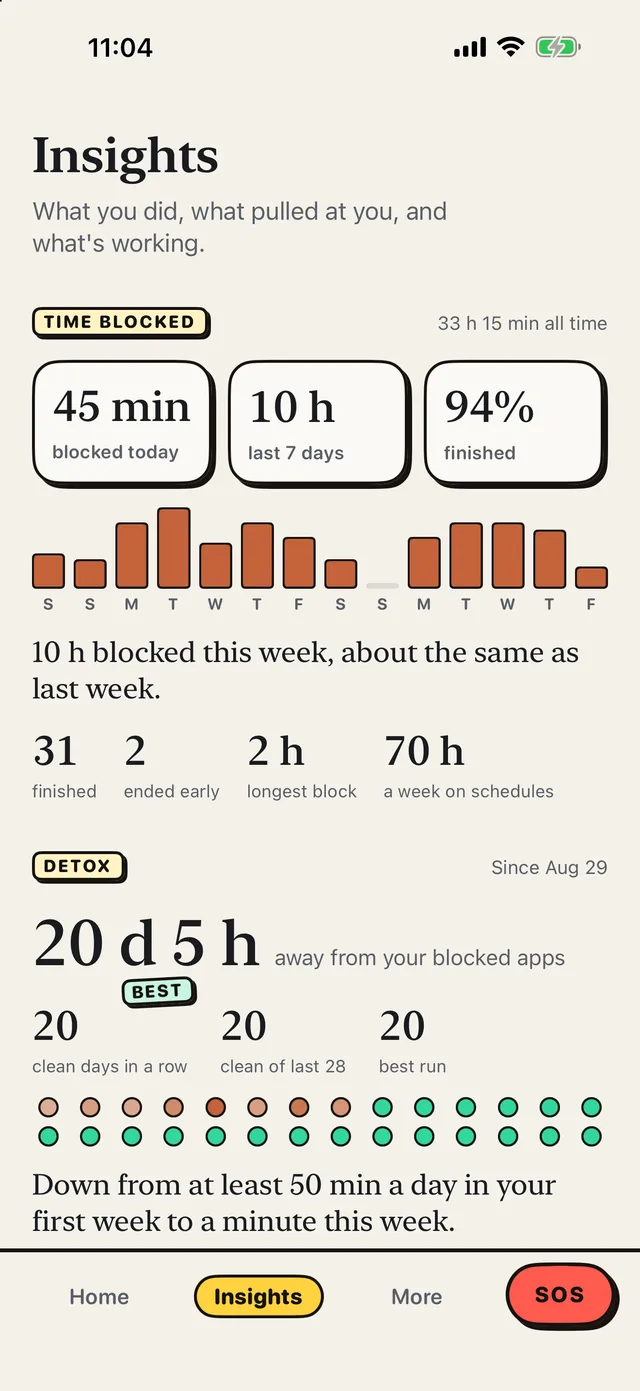
Captured on iPhone 17 Pro Max. The app names shown are the ones you pick; Reset ships with no list of what you use.
How a block works
Two taps on a good day. A phone call to a friend on a bad one. That difference is the whole product.
1. Pick what stays closed
Tap app chips for the usual suspects, or use Apple's picker for whole categories and websites. Calls, Messages, Maps and banking stay open unless you add them.
2. Pick how long
Thirty minutes, an evening, until 7 AM, a whole day, or "until unlocked". Or tap a recipe: Family dinner, Study session, Bedtime, Gym, Date night, Exam week.
3. Shut the door
The apps disappear. Open one from a link or Spotlight and you get a Screen Time shield with no Ignore button. Add apps mid-block, or add thirty minutes, but never remove any while a friend lock holds.
4. Or lock it
Once a friend holds your key, blocks are locked to them: only their code or passcode ends one early. The emergency unlock exists, and it waits: an hour, four hours or a day, chosen when you set the key up. Most urges pass long before that.
What "dopamine detox" means here
It's the phrase people search for at 1 a.m., so it's on the app. It is not a claim about brain chemistry.
No dopamine score
Dopamine neurons signal reward prediction, not pleasure, and nothing you do for a day resets them. Reset never shows a number it made up. Every exercise cites the study it comes from instead.
Win rate, not streaks
Streak counters are the top reason people delete habit apps after one bad night. Reset shows the share of blocks you finished and never resets anything to zero. There are no leaderboards.
A relapse is data
Ending a block early asks one question: what was going on? Bored, stressed, lonely, avoiding something. That answer is the most useful thing you can log, and it's never shown back as shame.
Replace, don't just remove
Blocking leaves the boredom or dread underneath. SOS, fifty-five small activities and the Boredom Gym exist so the gap gets filled with something other than another feed.
We can't see your data. By design.
A tool for getting your attention back shouldn't be another thing harvesting it. Reset has no server, so there is nothing to breach and no terms that can change later.
- No account and no server. The app makes no network requests of its own
- Apple's Screen Time gives Reset opaque tokens for the apps you pick. Reset never learns which apps they are
- Usage numbers in Insights are drawn by an Apple-controlled extension on your phone. The app itself never receives them
- The friend key is made on your friend's device and stays there. Your phone keeps only the part that checks a code. Nobody in the middle
- No analytics SDK, no advertising identifiers, no third-party code at all
- Export everything as JSON or delete it, whenever you like
How it compares
Different tools make different trades. This is about which job each one is for, not which is best.
| Tool | How it blocks | The off switch | Needs an account | Price |
|---|---|---|---|---|
| Reset | Apple Screen Time shields | Your friend, or a delayed emergency unlock | No | Free |
| Screen Time limits (built in) | Apple Screen Time limits | "Ignore Limit", one tap | No | Free |
| Delay / breathing apps | A pause before the app opens | Wait it out, then it opens | Varies | Often a subscription |
| Hardware-token blockers | Screen Time, unlocked by tapping a physical token | Walk to the token | Varies | One-time hardware purchase |
| Phone in another room | Distance | Walk to the phone | No | Free |
Categories describe how each kind of tool works in general; check any specific product's own listing for its current features and pricing.
Questions
Does Reset actually block apps, or just remind me?
It blocks them. Reset uses Apple's Screen Time frameworks, the same system a parent uses for a child's phone. Blocked apps disappear from the Home Screen and show a Screen Time shield instead of opening. The block is held by iOS, so closing Reset changes nothing.
What is the friend key?
A key that lives on a friend's phone. Their phone makes the codes; yours can only check them, so not even you can open your own block. Each code is twelve characters and works once. Start a friend-locked block and it can't be ended early without one. There is an emergency unlock with a waiting period you set in advance: an hour, four hours or a day.
Is this a real 'dopamine detox'?
It uses the name people search for and skips the myth. Nothing you do for a day resets dopamine, and Reset never shows a dopamine score. What it trains is behaviour: noticing the automatic reach, tolerating the gap, and doing something else. Every exercise in the app cites the study it comes from.
Does Reset need an account?
No. There is no sign-up, no server and no analytics. Everything you log stays on your phone. Apple's Screen Time hands Reset opaque tokens for the apps you pick, so Reset never even sees which apps they are.
Can I block websites?
Yes. Apple's picker has a Websites section, and blocked sites are shielded in Safari and other browsers that respect Screen Time. You can also add any app by its bundle identifier if it isn't in the picker.
What does it cost?
Nothing. Reset is free with no subscription, no in-app purchases and no ads. There is no paid tier.
Is it medical advice?
No. Reset is a behaviour-change tool. If phone use is tied up with anxiety, depression, sleep problems or compulsions that are hurting your life, a doctor or therapist can help in ways an app can't.
From the blog
Honest writing on quitting the scroll, with sources at the bottom of every post.
Reset is on the App Store
Free, with no subscription, no in-app purchases and no account to create.
Download on theApp StoreScreen time and scrolling guides
Honest comparisons that include the alternatives, not only our own app.
- ScreenZen Alternatives When Delays Stop Working
- Better Than Screen Time? iPhone Blocker Apps Compared
- Free Brick Alternative: Block Apps Without a Device
- Free Freedom App Alternatives for iPhone
- one sec App Alternatives: Free Screen Time Blockers
- Free Opal App Alternatives (No Subscription)
- How to Get Better at Being Bored: 6 Exercises
- How to Stop Scrolling on Your Phone in Bed
- Is the Reset App Private? How Your Data Stays Safe
- How to Block Instagram and TikTok on iPhone
- How to Help a Friend Who’s Addicted to Their Phone
- Let a Friend Lock Your Apps: Does It Actually Work?
- What Is a Dopamine Detox, and Does It Work?
- How to Stop Doomscrolling: What Actually Works







 MMA.socialUFC fan ratings
 TrendingPunjabiPunjabi music charts
 BoldOpinionAnonymous hot takes
 brolic.ioGym leaderboards